Oops! Something went wrong while submitting the form.
Notice: It looks like you are visiting us from United Arab Emirates or have selected it as your residency location.
For accurate information and services under the correct licensed entity, please visit the appropriate section of our website. For more information view Regulatory Information
For accurate information and services under the correct licensed entity, please visit the appropriate section of our website. For more information view Regulatory Information
For educational purposes only, not investment advice.
Trading crypto with leverage means the venue can close a position without asking. It does that once account equity falls under the maintenance margin, a published floor that every contract needs to stay open.
Risk management works in the room between that floor and an ordinary drawdown, which funding narrows every interval. At the eight-hour settlement most perpetual contracts use, a $100,000 position at 0.01% pays around $30 a day whether the price moves or not.
This article works through the liquidation engine, cumulative funding, and the margin mode that decides how far a single loss travels.
[[aa-key-takeaways]]
Key Takeaways
Traditional market-risk models can underestimate volatility clustering, thin order-book liquidity, and counterparty exposure. Crypto trading risk management needs controls built for those three.
A liquidation cascade is mechanical. Forced closures can move already-thin order books, which can trigger further liquidations in the same direction.
Funding payments on perpetual futures accrue at every interval and may materially change account equity over a multi-day hold, a cost that belongs alongside spread and fees.
Cross margin pools collateral across positions, while isolated margin contains exposure to a single position. The trade is wider liquidation scope for better capital efficiency.
Position sizing, a written drawdown policy, and jurisdiction-specific margin rules turn those controls into daily practice.
[[/a]]
[[aa-cta]]
One Account, Many Moving Risk Parts
See how cross margin, funding, and liquidation interact once spot, perpetual futures, and CFD exposure sit behind one balance.
Why Crypto Trading Needs a Crypto-Native Risk Framework
Sharing some statistical behavior with traditional markets, crypto invites a trader to treat risk in digital assets as equity risk with the volatility dial turned up. The gap is not one of degree.
These markets trade 24/7, cluster volatility into sharp bursts, and depend on continuously funded perpetual contracts. Those three features break the assumptions behind a single distribution or a short lookback window, and they break them precisely in the tail scenarios that decide whether an account survives.
Stress testing and scenario analysis therefore replace a single expected outcome. Maintenance margin, funding accrual, collateral value, venue reliability, and who is watching the screen all count as risks. A liquidation engine and a funding clock act only on borrowed exposure.
Mapping the Core Risk Layers in Crypto Markets
Crypto trading risk does not arrive in a single category. It works in layers, where a shock in one layer travels to the next. Each layer below comes with the signals that show it moving.
Fast fact: a traditional value-at-risk model calibrated on calmer markets may understate crypto tail risk, with crypto price series showing heavier tails and more persistent volatility clustering than the benchmarks those models were built around.
Volatility Clustering, Thin Liquidity, and Counterparty Exposure
Market volatility does not spread evenly across time. It clusters, with each large price swing raising the probability that another arrives soon after. Order books thin out under the same stress, widening slippage and leaving an exit that may not be available at any price.
Counterparty risk splits by venue type. On a centralized venue it lives in the legal entity, its licensing, and its operational resilience. On a decentralized protocol the same risk sits in automated market makers, oracle feeds, and smart-contract code. Either way, a provider's contracting entity, asset-segregation practice, and incident history belong in the risk assessment before capital arrives, alongside the liquidity risk of the venue itself.
Diversifying Exposure Across Coins and Account Structures
Holding BTC, ETH, and a handful of smaller tokens looks like portfolio diversification until correlations rise during a broad market move and those separate positions start moving together as a single position. A fuller view of concentration spans asset, venue, collateral type, strategy, and contracting entity, any one of which can bring several positions down at once when crowded. Shared collateral reconnects exposures a trader believed were separate. Cross margin does exactly that, by design.
How Liquidation Cascades Unfold in Leveraged Positions
A liquidation is an automated closure the venue performs under its own published rules. A trader can move or cancel a stop-loss order at will, but not a liquidation. A cascade emerges when enough of those closures move the market against traders holding similar positions, triggering their liquidations and extending the sequence.
The Mechanics of a Forced Liquidation
Account equity in a leveraged position is, broadly, collateral plus unrealized profit or loss, minus fees and accrued funding. Liquidation typically begins once that equity breaches the venue's maintenance-margin requirement. From there, the liquidation engine closes some or all of the position at whatever price the current order book will bear. Mark price, partial-liquidation rules, and the maintenance-margin level all vary by provider and jurisdiction.
From One Liquidation to the Next
Once a liquidation engine sends forced sell orders into the market, those orders consume the available bids, slippage widens, and the mark price drops. A lower mark price can be enough to push the next set of leveraged long positions into their own maintenance-margin breach.
Order-book depth determines how far the sequence runs. Forced selling takes the nearest bids first, leaving each subsequent liquidation to reach further down the book and fill worse than the one before it. That is how a single trigger becomes a chain reaction across accounts that never traded with each other. During a sharp rally the same mechanism runs upward, closing out short positions in a squeeze.
What Funding Costs Over a Multi-Day Hold
Funding is a recurring payment exchanged directly between long and short holders of a perpetual futures contract, designed to keep the perpetual's price aligned with the underlying spot price. A rate can be positive (typically longs pay shorts) or negative (shorts pay longs), published on most platforms as both a current or realized figure and a prediction for the next interval.
What the Funding Rate Mechanism Does
Because perpetual futures have no expiry date, funding substitutes for the price convergence a dated futures contract gets automatically as it approaches settlement. Interval timing (eight hours on most venues, though not all), the reference notional, any rate caps, and the exact formula all vary by venue and are worth checking in a platform's contract specifications before holding through multiple intervals.
Calculating Cumulative Costs Across a Multi-Day Hold
Cumulative funding is the sum of one payment per interval, each calculated as the position's notional at that moment multiplied by the rate then in force. With both notional and rate free to change between intervals, interest-style compounding does not apply.
A hypothetical illustration puts scale on it. A $100,000 notional position held through nine eight-hour intervals at a constant 0.01% per interval accrues about $90 of funding (100,000 × 0.0001 × 9), before fees, rate changes, or price movement. At its mildest, three days at a rate that never moves, the arithmetic still shows up as a cost.
A multi-day hold costs more than the entry spread suggests, the gap widening with every interval the position stays open. A sensitivity analysis across plausible rates therefore tells a trader more than any single reading.
Cross Margin vs Isolated Margin: A Portfolio-Level Risk Decision
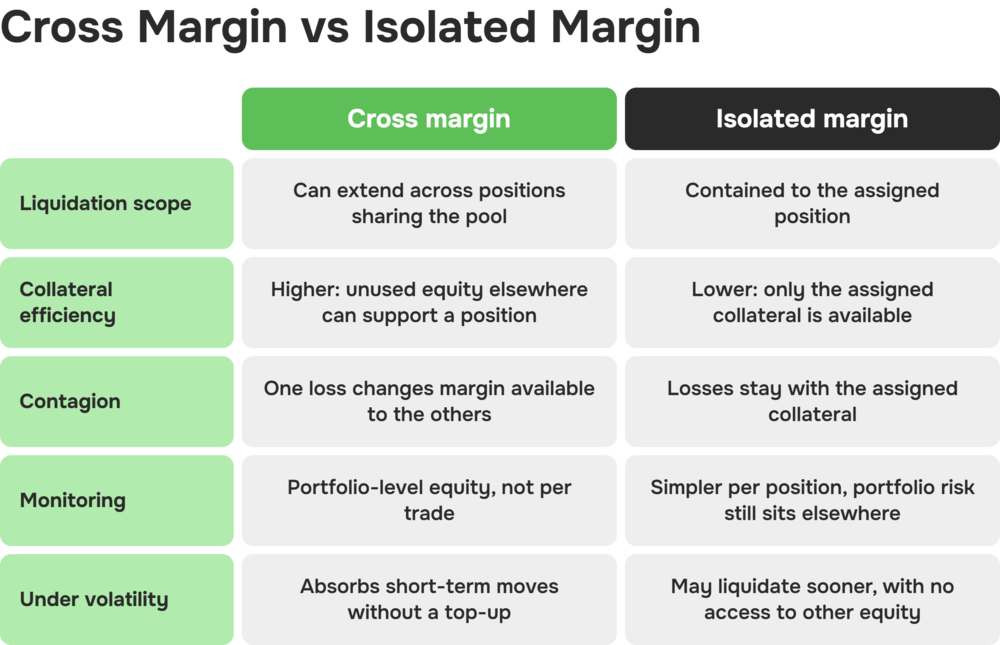
The margin mode a trader selects determines where a loss is allowed to travel inside an account. Cross margin pools available collateral across every open position, while isolated margin walls off a fixed amount for a single position. The same market move then produces a different margin-call sequence under each. Which mode fits depends on how a trader wants exposure to interact across a portfolio.
Cross Margin Shares Exposure Across Positions
Under cross margin, one losing position draws on the same equity pool supporting every other open position, where its losses can move the liquidation conditions of positions that look unrelated on a chart. A broad market swing pushes several of those positions the same way at once.
In a pool shared by three hypothetical positions, the first to breach its maintenance-margin threshold shifts the equity behind the other two in the same moment, even though nothing happened in their own markets.
Isolated Margin Contains Losses to One Position
Isolated margin assigns a defined amount of collateral to a single position, which limits how far that position's losses travel. That same boundary works in the other direction once the market moves. Unable to reach equity sitting elsewhere in the account, an isolated position closes out at an earlier price than it would under cross margin.
Containing one loss also leaves the rest of the portfolio where it was. Correlated exposures across other isolated positions, a venue-level failure, and the manual work of reallocating collateral between them are all risks that a margin mode does not address.
Position Sizing and Risk-Per-Trade Discipline
Defined risk inputs decide position size, the step that converts a market view into account-level exposure. Confidence in a setup or a recent winning streak decides nothing. Those inputs are:
account equity and the share of it a single trade may risk;
entry price and the invalidation level that proves the trade wrong;
the resulting stop distance, plus expected fees and likely slippage;
funding cost over the expected hold;
correlation to other open positions, and the margin mode in use.
Sizing Trades and Calculating Risk-Reward Relative to Account Equity
Position risk starts as quantity multiplied by the distance between entry and stop. Estimated fees, slippage, and expected funding go on top of that, before the total is measured against account equity. The risk-reward ratio follows from where take-profit orders sit relative to that stop.
The two cases below hold planned risk constant to isolate one relationship. The wider the stop, the smaller the position that fits inside the same risk budget. Take a $50,000 account, a planned risk of $500 on the trade, and an entry at $60,000 in BTC.
Fees, slippage, and funding come out of the same $500, leaving a position smaller than either case suggests. The figures are illustrative at those inputs and carry no view on where BTC trades.
How Licensing and Jurisdiction Shape Leverage and Margin Rules
Margin terms are not a global standard. They are set by the specific legal entity a trader is onboarded to, chosen by regulatory licensing and client residency together. Residency can change the leverage ceiling available, the disclosures a broker owes, and which products a client may access at all.
That is why regulated brokers run onboarding checks to establish the applicable entity before an account opens. Which entity a client contracts with is a regulatory risk in itself, since it decides what protections exist when something goes wrong and which regulatory changes reach the account.
The FSB's October 2025 thematic review, summarized by the BIS Financial Stability Institute, counts 11 jurisdictions with finalized crypto-asset frameworks as of August 2025 against five that have done the same for stablecoins. Only two jurisdictions, Bermuda and The Bahamas, comprehensively regulate the borrowing and lending activities behind crypto leverage.
Coverage of margin trading itself is thinner still. Where those activities sit outside the regulatory perimeter, two traders in different countries using the same platform can face materially different margin terms, leverage ceilings, and protections in a default.
Why Do Regulated Brokers Apply Different Margin Requirements by Jurisdiction?
Local rules set initial margin, maintenance margin, close-out procedures, asset segregation, required disclosures, and how losses are treated if the firm defaults. A broker serving several markets therefore offers different protections in each of them.
Before trading, the practical step is to confirm the contracting entity, its regulator, and the current margin schedule in that entity's own product documentation. A marketing page describes the group, while the entity documentation describes the account a client ends up with.
Behavioral Discipline in Volatile Markets
Every technical control above fails the moment a trader overrides it under pressure. Markets that never close, combined with volatility that arrives in bursts, create the conditions for emotional trading. It shows up as panic selling, revenge trading, FOMO entries into a move already underway, a stop pulled as price approaches it, or a funding cost left unwatched for days.
A written trading plan and checklist make discipline the default, so risk mitigation techniques become habit instead of mid-session guesswork. The checklist covers the thesis, the invalidation level, position size, margin mode, the funding calendar for the expected hold, the trader's own state at entry, and whether any deviation from the plan is deliberate.
Journaling Trades, Setting Drawdown Limits, and Avoiding Panic-Driven Decisions
A trading journal earns its place when it records what a screenshot cannot:
the original thesis and the collateral committed to it;
any operational incident on the account, from failed withdrawals to phishing attacks aimed at its credentials;
margin mode used, and funding paid across the hold;
execution slippage, and the maximum adverse move before the position recovered or closed;
any rule deviation, the state of mind at entry and exit, and a short review afterward.
Each trader sets their own drawdown limit, naming the loss that halts trading and how long the pause lasts. The workable figure follows from the trader's trading capital, objectives, and risk tolerance. Both belong in writing beforehand, while a drawdown is not yet forcing the choice.
How a UNIFIED Account Applies These Risk Principles
Centralizing collateral and exposure in one account structure is a risk trade-off before it is a convenience. Seeing every position against one balance makes portfolio-level monitoring possible while tying together dependencies that separate accounts would keep apart.
B2PRIME's UNIFIED account puts crypto spot, crypto perpetual futures, and traditional CFDs behind a single balance, with one pool of collateral backing all three. Ordinary cross margin pools collateral inside a single asset class. This structure runs the same pooling across all three at once. Capital moves where it is needed without a transfer, while the account becomes more sensitive to how collateral values, correlations, and entity-specific terms behave together.
One balance reduces idle capital and manual transfers. Several accounts keep a failure local at the price of efficiency and attention.
Building a Crypto Risk Framework You Can Actually Trade With
Risk analysis in crypto needs four parts at once: the mechanics of liquidation and funding, the account architecture a trader chooses, the governance rules that account runs under, and the discipline to follow them mid-session. A well-sized position still fails if nobody watches funding for a week, and a disciplined trader still gets caught by a margin mode they never examined.
Rules become usable once they are written down, reviewed after trades, and updated when conditions change. Traders who work through how liquidation, funding, and margin mode interact tend to arrive at the same conclusion. A single place to watch cross-collateral exposure beats reconstructing it while a market moves.
[[aa-cta]]
See How Cross-Collateral Risk Actually Works
One balance behind spot, perpetual futures, and CFDs, with the margin mode and funding terms published per entity.
CFDs are complex instruments and come with a high risk of losing money rapidly due to leverage. You should consider whether you understand how CFDs work and whether you can afford to take the high risk of losing your money. Crypto CFDs carry additional risks due to the high volatility of the underlying assets. Leveraged crypto positions can be liquidated in full, and losses can exceed the amount initially deposited.
This content is for informational and educational purposes only and does not constitute investment advice or a personal recommendation. B2PRIME is a trading name used by several entities of the B2PRIME group, including B2B Prime Services EU Ltd, which is authorized and regulated by the Cyprus Securities and Exchange Commission (CySEC), license no. 370/18; the entity that onboards a client, the applicable terms, and the available products depend on country of residence and client category. Past performance is not indicative of future results, and the worked examples here are simplified illustrations of mechanics rather than expected outcomes; margin, funding, and leverage terms are indicative and may change, so verify current details before trading.
[[/a]]
[[aa-faq]]
FAQs about Crypto Trading Risk Management
How can I manage risk when trading crypto?
Crypto trading risk management means treating market, liquidity, leverage, funding, counterparty, custody, operational, and jurisdictional risk as one connected set. In practice that means knowing how a liquidation engine and each margin mode behave, tracking funding across a hold, sizing positions from defined risk inputs, and keeping the same discipline when a session turns volatile.
How do liquidation cascades work in crypto trading?
A liquidation cascade happens when the forced closure of one leveraged position moves the market enough to trigger maintenance-margin breaches in similarly positioned accounts, each of those closures extending the sequence. Order-book liquidity carries the cascade. Forced orders consume the nearest levels and shift the mark price down. Positions that were comfortable at the old mark are over their threshold at the new one. It runs in both directions, through longs during a drop and through shorts in a squeeze during a rally.
How do funding rates affect a multi-day perpetual futures position?
Funding is a recurring payment exchanged between long and short holders of a perpetual futures contract at set intervals, accruing for every interval the position stays open. Interest-style compounding does not apply, but the payments add up across a multi-day hold, changing both the real cost of the position and its distance to liquidation. A platform's funding interval, rate history, and calculation method are worth checking before holding through several intervals.
What is the difference between cross margin and isolated margin?
Cross margin pools collateral across every open position in an account, where a loss in one can draw on the equity supporting the others. Isolated margin assigns a fixed amount to a single position, containing its losses but liquidating it sooner, with no access to the rest of the account. Which mode is better depends on whether a trader would rather cap a single loss or keep staying power by sharing exposure.
Why is trading with an unregulated crypto provider risky?
An unregulated or lightly regulated provider is not bound by the licensing entity's rules on client asset segregation, margin disclosure, dispute handling, or default-scenario loss treatment. A trader therefore has materially less recourse if the platform fails, restricts withdrawals, or misapplies margin rules. Verifying the exact regulated legal entity, its licensing authority, and its published margin and risk documentation is a practical part of counterparty due diligence before committing capital to any leveraged crypto position.
[[/a]]
Connect with Our Experts
Our team is equipped to provide solutions precisely to your requirements. Let's explore your options and discuss how we can support your objectives



.svg)