Oops! Something went wrong while submitting the form.
Notice: It looks like you are visiting us from United Arab Emirates or have selected it as your residency location.
For accurate information and services under the correct licensed entity, please visit the appropriate section of our website. For more information view Regulatory Information
For accurate information and services under the correct licensed entity, please visit the appropriate section of our website. For more information view Regulatory Information
For educational purposes only, not investment advice.
Cross margin and isolated margin determine which money backs a leveraged position. Under cross margin, the whole account balance backs every open trade. Under isolated margin, one position gets a fixed amount of collateral and no access to the rest of the account.
This article covers how each mode counts collateral, why the same entry can liquidate at two different prices, and where pooled equity turns into cascading-liquidation risk. It also looks at which trading profile each mode tends to suit and how a unified account runs both settings side by side.
[[aa-key-takeaways]]
Key Takeaways
Under cross margin, gains or spare collateral in one position support losses elsewhere in the same account, all of it drawn from one pooled equity balance.
Isolated margin ring-fences a fixed amount of collateral per position, which can help contain losses without drawing on funds allocated to other trades.
The same leveraged position can liquidate at different prices under cross versus isolated margin, each mode counting the collateral behind it differently.
Cross margin can improve capital efficiency for multi-position portfolios, but a severe move can raise cascading-liquidation risk across the account.
Traders can tactically mix margin modes using unified account infrastructure: shared collateral for some positions, position-level ring-fencing for others.
[[/a]]
[[aa-cta]]
One Account, Two Ways To Manage Margin
A UNIFIED account lets traders hold crypto spot, perpetual futures, and CFDs together while choosing shared or position-level collateral case by case.
What Cross Margin and Isolated Margin Actually Mean
Cross margin calculates available collateral from the whole margin account balance, while isolated margin calculates it from a fixed amount assigned to one position only. Each is a way leverage trading decides which capital stands behind a trade.
Both sit on top of the same underlying mechanics. Initial margin opens a leveraged position, maintenance margin is the minimum equity needed to keep it open, and margin level tracks how close current equity is to that maintenance threshold. A margin call responds to that reading. The modes differ in whose equity gets checked against whose maintenance requirement.
Two similar-sounding terms are worth separating here. Cross margining is a position-level setting that spreads existing collateral across open positions. Cross-collateralization is the account-level structure that lets several asset classes contribute to one collateral pool in the first place.
Both liquidation formulas are built around maintenance margin, the number to understand before comparing either mode.
Cross Margin: Pooling Account Equity as Shared Collateral
Under cross margin, the full account balance backs every open position, letting unrealized gains on one trade delay liquidation on another that is losing. The pooling runs in both directions: a large loss on one position eats into the cushion under positions that are otherwise performing well.
Kraken's own cross-margin documentation, current as of September 2026, describes this pooling mechanic directly. Eligible collateral types and liquidation engines differ by platform, leaving no numbers portable between providers.
Isolated Margin: Ring-Fencing Collateral to a Single Position
Isolated margin assigns a defined amount of collateral to one position and stops there. A loss on that trade cannot automatically draw on equity sitting elsewhere in the account.
The same ring-fencing that contains the loss also caps the buffer available to absorb it. Fees, funding payments, slippage, and the platform's liquidation procedure can each move the realized outcome away from a clean theoretical number, a gap that widens in volatile markets.
A Worked Example: Same BTC Position, Two Different Liquidation Prices
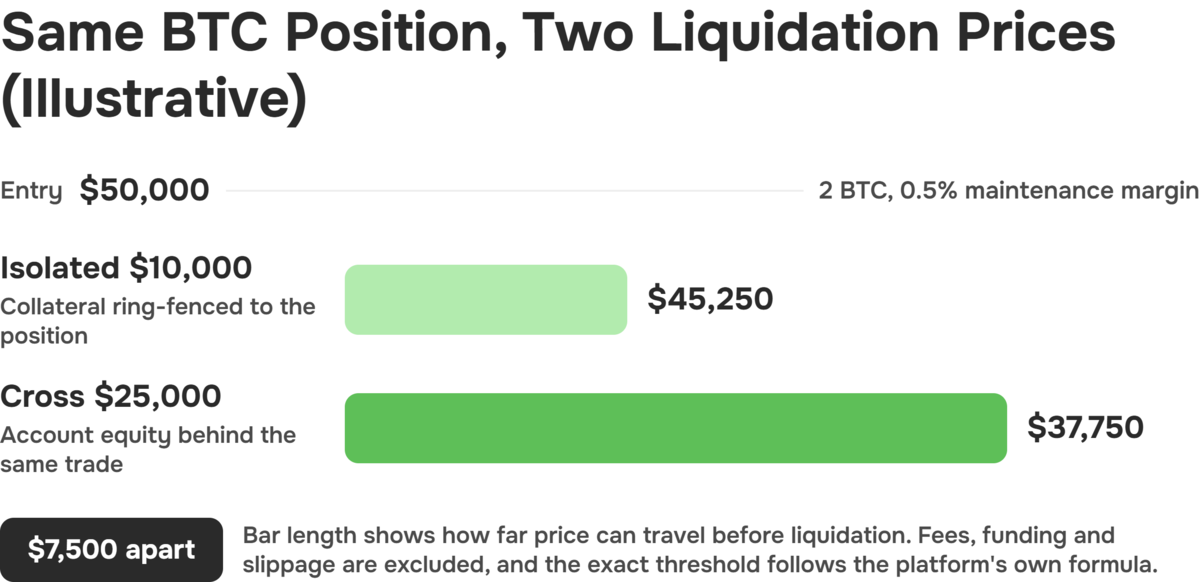
The same position can liquidate at two different prices on nothing more than the collateral counted against it. The exact threshold still follows the platform's formula and maintenance-margin schedule.
The arithmetic runs like this on a hypothetical long position on a BTC trading pair: BTC at $50,000, size 2 BTC, notional value $100,000, 10x leverage, and a 0.5% maintenance margin requirement (equal to $500). With $10,000 allocated as isolated collateral, the position's liquidation price works out to $50,000 − (($10,000 − $500) ÷ 2) = $45,250. With $25,000 of cross account equity backing the same position, the calculation becomes $50,000 − (($25,000 − $500) ÷ 2) = $37,750.
Entry, size, and leverage are identical across both calculations. The $7,500 gap is the equity difference and nothing else.
These figures exclude trading fees, funding payments, and slippage, all of which can move the actual liquidation point in either direction.
The Core Trade-Off: Capital Efficiency Versus Cascading Liquidation Risk
Cross margin's pooled buffer doubles as its main risk. The same mechanism that gives a losing position more room can transmit that loss into collateral supporting unrelated, profitable positions. Isolated margin avoids that transmission by design, at the cost of duplicated buffers sitting idle across positions that could otherwise share capital. Neither trade-off is inherently better. Correlation between the positions and the monitoring a trader can sustain decide which one fits.
Fast fact: Institutional cross-margining programs, such as the CME-FICC arrangement that lets clearing members offset Treasury and interest-rate futures exposure, may account for offsetting risk across products when calculating collateral requirements for clearing members. That institutional clearing framework is not a retail platform's cross-margin setting at a larger scale. The two operate under different risk models, counterparties, and regulatory oversight.
Matching Margin Mode to Your Trading Profile
Margin mode should follow how a portfolio is structured, not how confident a trader feels about a single position. What follows maps each mode's consequences against position count, correlation, and monitoring capacity.
Hedgers and Multi-Position Portfolio Traders
Sizing net exposure, watching concentration in correlated crypto assets, and pressure-testing whether the hedging still holds under a stress scenario all come before margin mechanics. A book holding Bitcoin and Ethereum looks diversified on two charts and behaves as one position when the market turns, on two assets that move together more often than not.
Shared collateral can then recognize offsetting profit and loss across several positions. Shared collateral helps while correlations behave as expected. When they break down in a sharp move, the same pooling adds exposure instead of absorbing it.
High-Conviction, Single-Position Traders
Some traders allocate isolated collateral to a single volatile thesis and accept a closer liquidation threshold in exchange for containing risk to that one trade.
Treating "high conviction" as a risk control skips the steps that actually manage exposure. Those steps are position size relative to the account, stop placement ahead of the maintenance-margin threshold, and take-profit orders defined before entry rather than during the trade. Beyond those, liquidation slippage moves the realized exit further than the theoretical price.
Conviction explains why a trader takes a position without saying anything about how much of the account that position may lose.
What Margin Segregation Rules Mean for How You Manage Risk
Margin segregation determines where a loss gets absorbed first. Regulatory close-out rules act on the whole account regardless of which margin mode is selected. Under the European Securities and Markets Authority's product intervention measures, a CFD provider must close out a retail client's open positions once account margin falls to 50% of the minimum required margin.
The 50% floor is regulatory, applying on top of whichever margin mode a trader has chosen. Before trading, it is worth confirming the legal entity a broker operates under, the product terms, maintenance-margin schedules, collateral haircuts, liquidation sequence, and any negative-balance provisions that apply.
Mixing Margin Modes Within One UNIFIED Account
Cross-collateralization at the account level and margin mode at the position level solve different problems, both of them available inside a single account structure.
Several asset classes, such as spot holdings, perpetual futures positions, and CFD exposures, can draw from one shared pool. Margin mode is then the separate choice of whether a given position inside that pool is backed by shared equity or ring-fenced collateral.
A cross-collateral account structure can carry both layers simultaneously, letting a trader keep a hedge on shared collateral while isolating one speculative position, subject to the platform's supported modes, haircuts, and jurisdictional terms.
Margin Mode Is a Tactical Choice
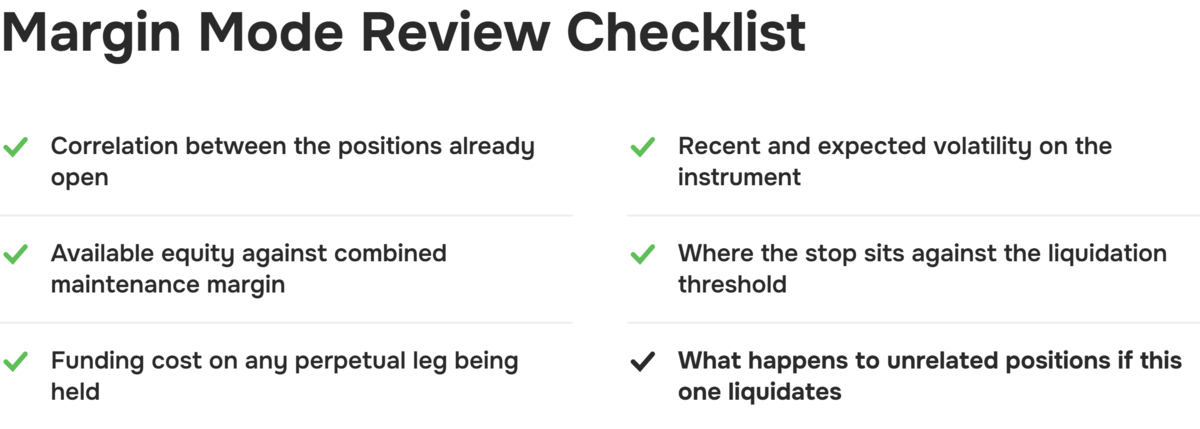
Margin mode is a configurable piece of risk management, worth reassessing whenever exposure, correlation, available collateral, or volatility shifts meaningfully. A short review before switching or adding to a position covers:
where a stop loss sits relative to the liquidation threshold;
what happens to unrelated positions if this one is liquidated.
Traders who have not compared spot and margin trading mechanics directly may want that background first.
Cross and Isolated Margin on One UNIFIED Account
Margin mode shapes where a loss draws collateral from, either shared account equity or one ring-fenced position. That choice sits on top of the account structure rather than replacing it.
B2PRIME's UNIFIED account supports both layers. Spot, perpetual futures, and CFD exposure sit inside one cross-collateral structure, putting crypto trading and CFD positions on the same collateral pool. Margin mode stays configurable at the position level, subject to eligibility and applicable entity terms.
[[aa-cta]]
Manage Margin Mode Position By Position
Hold spot, perpetual futures, and CFDs in one account and choose shared or ring-fenced collateral for each position as a portfolio's needs change.
CFDs are complex instruments and come with a high risk of losing money rapidly due to leverage. You should consider whether you understand how CFDs work and whether you can afford to take the high risk of losing your money. Crypto CFDs carry additional risks due to the high volatility of the underlying assets. Crypto perpetual futures carry the same volatility risk, and losses can exceed the amount initially deposited.
This content is for informational and educational purposes only and does not constitute investment advice or a personal recommendation. This article recommends neither cross margin nor isolated margin, and nothing here is an instruction to change a margin setting. B2PRIME (B2B Prime Services EU Ltd) is authorized and regulated by the Cyprus Securities and Exchange Commission (CySEC), license no. 370/18; product availability, eligible collateral, and leverage depend on the client's jurisdiction and applicable terms. The liquidation-price example is an illustration of the arithmetic rather than a projection of any trading outcome. Past performance is not indicative of future results, and platform formulas, maintenance-margin schedules, and account terms are indicative and may change; verify current details before trading.
[[/a]]
[[aa-faq]]
FAQs about Cross and Isolated Margin
What is the difference between cross margin and isolated margin?
Cross margin calculates available collateral from the entire account balance, where gains or spare equity in one position can support losses in another. Isolated margin calculates collateral from a fixed amount assigned to a single position, beyond which a loss on it cannot reach for funds held elsewhere in the account.
What is the main advantage of cross margin?
Cross margin's main advantage is capital efficiency, with the whole account balance supporting each position and no separate collateral locked behind every one. That same pooling can also raise cascading-liquidation risk if a large loss reduces the equity cushion available to other open positions.
Which margin mode is safer?
Neither mode is universally safer. They contain risk in different places. Isolated margin limits losses on one position to its assigned collateral while leaving buffers duplicated and idle elsewhere. Cross margin pools those buffers efficiently and can transmit one position's losses into the collateral supporting others. The safer choice depends on portfolio structure, correlation between positions, and how closely a trader monitors the account.
How does margin mode affect the liquidation price?
The liquidation price depends on how much collateral margin mode counts against the position, which puts the same entry price, size, and leverage at two different levels depending on whether isolated or cross collateral backs the trade. Fees, funding payments, and slippage are excluded from the basic liquidation-price formula and can move the actual outcome further.
Can traders mix margin modes within one account?
Some account structures, including unified or cross-collateral accounts, allow a trader to apply cross margin to some positions and isolated margin to others within the same account, subject to the platform's supported modes and terms. This lets a trader ring-fence a single speculative position while still pooling collateral across a hedged or multi-position portfolio.
[[/a]]
Connect with Our Experts
Our team is equipped to provide solutions precisely to your requirements. Let's explore your options and discuss how we can support your objectives