Oops! Something went wrong while submitting the form.
Notice: It looks like you are visiting us from United Arab Emirates or have selected it as your residency location.
For accurate information and services under the correct licensed entity, please visit the appropriate section of our website. For more information view Regulatory Information
For accurate information and services under the correct licensed entity, please visit the appropriate section of our website. For more information view Regulatory Information
For educational purposes only, not investment advice.
A perpetual contract is a derivative that tracks an asset's price and never expires. With no settlement date, the position stays open until the trader closes it or the venue closes it for insufficient margin. Crypto venues list them on BTC, ETH and most liquid tokens.
Without an expiry to pull the price back toward spot, that job falls to funding: a payment exchanged directly between traders holding long and short positions every few hours. On a $100,000 position at a 0.01% rate it comes to $10 per settlement.
This article covers how funding is calculated, what mark price protects against, and how a cross-collateral account changes the exposure.
[[aa-key-takeaways]]
Key Takeaways
A perpetual contract is a crypto derivative with no expiry date; it stays open until closed, offset, or liquidated for insufficient margin.
Periodic funding payments between long and short holders pull the perpetual's price back toward the spot price, though they do not guarantee convergence.
Mark price, not the latest traded price, typically determines unrealized profit and loss and triggers liquidation on most venues.
Initial margin opens a position, maintenance margin keeps it open, and leverage magnifies both gains and losses.
Cross-collateralized accounts, such as B2PRIME's UNIFIED account, can improve margin efficiency, but losses on one position may draw down the collateral supporting others.
[[/a]]
[[aa-cta]]
One Account, Three Markets: Crypto Spot, Perps, and CFDs
B2PRIME's UNIFIED account lets eligible holdings support margin across Crypto Spot, Crypto Perpetual Futures, and CFDs under one regulated balance.
How Perpetual Contracts Work: No Expiry, No Delivery
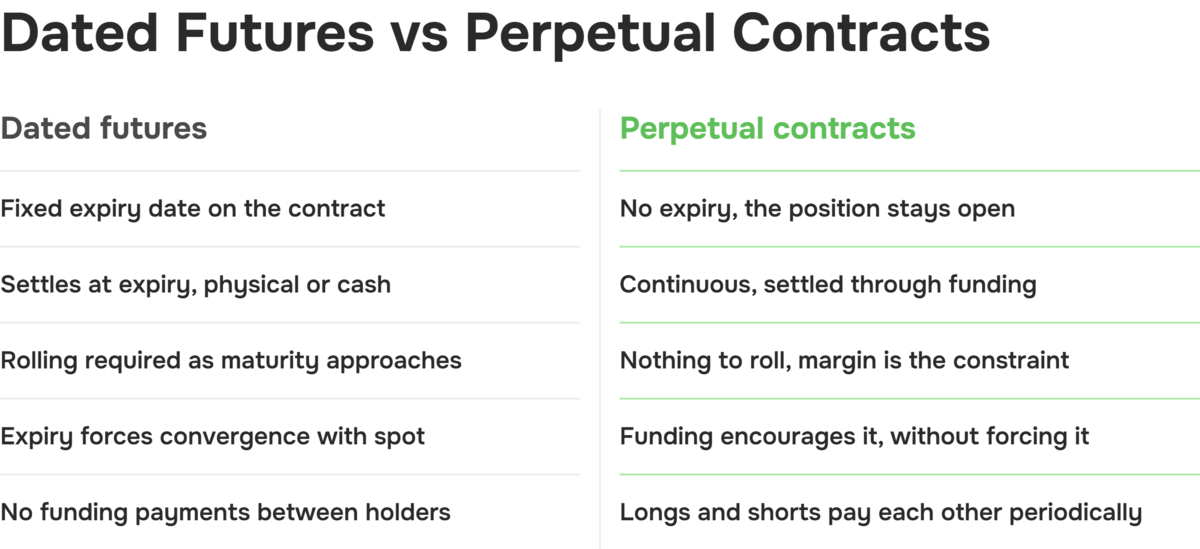
A perpetual contract has no expiration date and no scheduled delivery of the underlying asset. It stays open only while margin requirements are met: a trader can close it manually, offset it with an opposite order, or have it forcibly liquidated if equity falls below the maintenance threshold. The absence of an expiry does not make holding free. Funding charges accrue continuously regardless of profitability, compounding the cost of a position that no maturity date ever forces a decision on.
The structure predates crypto. Robert Shiller proposed perpetual futures in 1993 as a way to trade assets that change hands rarely. The design reached digital assets through BitMEX in 2016, which called them perpetual swaps, a name many venues still use.
How Perpetual Contracts Differ From Expiry-Based Futures
Traditional futures converge with spot through a fixed expiry that pulls price and spot together mechanically as maturity approaches. Perpetuals have no such deadline, leaving recurring funding and a reference price to do that work.
Margin and cumulative funding keep shifting across a position's life even though it never expires. Contracts also differ in their backing. A linear perpetual is quoted and margined in stablecoins, while an inverse perpetual is margined in the underlying coin itself. For a deeper comparison, see B2PRIME's guide to perpetual futures fundamentals.
The Funding Rate Mechanism: How Perpetuals Stay Tethered to Spot
Funding payments transfer directly between traders holding long and short positions at scheduled intervals, with no exchange counterparty on the other side. Funding payment equals position notional multiplied by the funding rate. A $100,000 position at a 0.01% rate produces $10, as Binance Academy's funding-fee explainer describes, as of September 2026.
Positive funding usually means longs pay shorts, and a negative rate reverses the direction. Rate and frequency are never universal, with each crypto exchange setting its own formula, interval, and cap. That holds from centralized venues to decentralized ones such as dYdX. The same asset, ETH for instance, can carry different funding on two platforms at the same moment.
What Happens When the Contract Price Drifts From Spot
When the perpetual trades above spot, a premium state that futures traders call contango, positive funding charges longs and pays shorts, narrowing the gap over time. A discount, or backwardation, works in reverse. Funding encourages a convergence it cannot guarantee, with market volatility and basis risk persisting for extended periods. Funding costs spiking during a sustained premium raise the cost of holding even when the directional view turns out to be correct.
Mark Price vs. Last Price: The Real Driver of Liquidation Risk
Last price is the most recent trade on that venue's own order book. Mark price is a fair-value estimate, commonly derived from an external spot index adjusted for the funding basis. Most platforms use it to calculate unrealized profit and loss and to trigger liquidation.
A single large order or a thin-liquidity spike in last price does not necessarily reflect where the market actually is.
On a BTC perpetual, last price briefly falls to $50,100 while mark price holds at $50,500. A dip in last price does not trigger liquidation on its own. It waits until mark price crosses the maintenance threshold, which each venue sets for itself.
Why Exchanges Trigger Liquidations Off Mark Price, Not Last Price
Exchanges prefer an index that blends prints from several venues. A single outlier moves it far less than it moves last price. That may reduce, but does not eliminate, liquidation risk from manipulation, thin liquidity, or momentary dislocations.
Index composition, weighting, and smoothing differ from venue to venue, making methodology venue-specific as well. A platform's index constituents, thresholds, and outage policy are worth confirming directly.
Margin Mechanics in Perpetual Trading: Initial Margin, Maintenance Margin, and the Insurance Fund
Initial margin is the collateral required to open a leveraged position, and maintenance margin is the minimum equity required to keep it open. At 10x leverage a 10% move against the position consumes the margin behind it. Posting initial margin opens the position, after which unrealized profit and loss moves account equity in real time. Some venues, though not all, issue a margin call once equity falls to the maintenance threshold.
If equity keeps falling, liquidation triggers. In a fast market a position can even close beyond the point where all remaining margin is consumed, a level known as the bankruptcy price. Both thresholds are measured against account equity, which is collateral value plus unrealized profit and loss, minus accrued fees.
Not every platform issues a margin call before liquidation. A venue's liquidation policy is the only place that difference is spelled out.
What the Insurance Fund Does When a Liquidation Falls Short
When a liquidation executes below the bankruptcy price, the shortfall has to be absorbed somewhere. An insurance fund, where one exists, may cover some or all of that deficit, sparing other participants losses that mechanisms like auto-deleveraging would otherwise socialize. An insurance fund is neither a compensation scheme nor protection against ordinary trading losses. It manages only the shortfall at forced liquidation.
Only a platform's own figures say what its fund size and residual mechanisms are.
Perpetual Contracts vs. Spot Trading and Margin Trading
Spot trading transfers ownership of the underlying asset outright. Margin trading and perpetual contracts both belong to leveraged trading and create exposure without necessarily requiring ownership, but borrowing, funding, and settlement mechanics differ. B2PRIME's guide to spot vs. margin trading covers ownership, leverage, and liquidation between those two in depth. The comparison below adds perpetuals as a third case.
When Perpetuals Make More Sense Than Spot or Margin
Perpetuals may be operationally relevant for no-expiry derivative exposure, a straightforward route to short selling without borrowing the underlying asset, or hedging an existing position without touching the asset itself. None of that makes perpetuals inherently suitable for any particular trader or objective. Recurring funding costs, mark-price-driven liquidation risk, leverage risk, and venue-specific counterparty risk have to be weighed against whatever operational convenience they offer.
Cross-Collateral Margin: Trading Perpetuals From a UNIFIED Account
Cross-collateral trading pools eligible assets across positions so one balance can support multiple markets at once. That flexibility works in both directions, a loss on one position reaching collateral that other positions rely on. B2PRIME's UNIFIED account consolidates CFDs, Crypto Spot, and Crypto Perpetual Futures into one account with margin shared across them, where availability depends on jurisdiction and the applicable legal entity.
Eligible holdings support margin across positions, with gains on one instrument redeployable to another without a separate transfer.
How Spot Holdings as Collateral Change the Liquidation Math
A haircut is the discount applied to an asset's market value when calculating its eligible margin contribution. A crypto asset with a 20% haircut contributes 80% of its market value toward margin.
A trader holds $10,000 in eligible spot crypto collateral, after haircut, supporting a losing perpetual position. B2PRIME's UNIFIED account sets a margin call at 40% of required margin and stop-out at 20%, both published in the account terms.
A decline in the collateral asset's price at the same time shrinks eligible collateral on top of the loss already accruing on the perpetual, pushing both sides of the margin ratio down at once. That correlation can bring margin call and stop-out forward faster than either factor alone would. Capital efficiency carries that trade-off in any account type. Pooled margin is worth modeling before it is treated as free flexibility.
Common Use Cases for Perpetual Contracts: Speculation, Hedging, and Arbitrage
Perpetuals support three distinct objectives, each with its own funding, margin, and execution risk profile. None of the following suggests a use case fits a particular reader's circumstances.
Directional exposure (speculation): a long or short position expressing a price view without owning the asset. Funding accrues regardless of whether the view proves correct, and leverage magnifies losses as much as gains.
Hedging an existing holding: one of the risk management tools available to a spot holder. A trader holding spot Bitcoin or Ethereum might open a short perpetual sized to offset some of that exposure during anticipated volatility, though the hedge itself carries funding costs and liquidation risk on the short leg.
Spot-perpetual basis trading: holding a spot position and an offsetting perpetual to capture funding payments as the primary return. Traders often call these arbitrage opportunities, though the name understates what can go wrong. A funding reversal, execution slippage, or a margin shortfall on either leg can erode or reverse a return that depends on funding staying favorable.
Why Regulation Matters as Perpetual Trading Becomes Institutionalized
As perpetual contracts draw more institutional volume, regulators focus on more than pricing alone. Counterparty structure, collateral custody, disclosure, and liquidation governance all matter to price discovery and market integrity.
In June 2026, the CFTC published a request for public comment on extending standard futures to 24/7 trading and on perpetual contracts referencing physically delivered energy commodities such as crude oil. A request covering energy rather than crypto still puts perpetual structures under review across asset classes.
Crypto perpetuals came up separately on May 29, 2026, when the CFTC approved a bitcoin perpetual futures contract and issued a policy statement on listing perpetual contracts. Perpetuals referencing other asset classes are directed to prior Commission approval under Regulation 40.3 instead of self-certification.
Regulatory attention of this kind connects to how a broker is structured to trade through it. B2PRIME operates under licenses across six jurisdictions and maintains segregated client funds, though product availability always depends on the applicable legal entity and the trader's own jurisdiction.
Where a UNIFIED Account Fits Cross-Collateral Perpetuals
Perpetual contract risk comes down to three mechanisms: funding pulling price toward spot, mark price governing when liquidation triggers, and the margin rules that decide how much room a position has before that happens. A UNIFIED account changes how collateral is managed across markets without touching any of that underlying market risk.
For traders already weighing where to execute across Crypto Spot, Crypto Perpetual Futures, and CFDs, that infrastructure decision is a practical one worth evaluating on its own terms.
[[aa-cta]]
Trade Perpetuals Alongside Spot and CFDs, One Margin Pool
See how B2PRIME's UNIFIED account applies the funding, mark-price, and margin mechanics covered above to a single cross-collateral balance.
CFDs are complex instruments and come with a high risk of losing money rapidly due to leverage. You should consider whether you understand how CFDs work and whether you can afford to take the high risk of losing your money. Crypto CFDs carry additional risks due to the high volatility of the underlying assets. Leveraged crypto positions can be liquidated in full, and losses can exceed the amount initially deposited.
This content is for informational and educational purposes only and does not constitute investment advice or a personal recommendation. Nothing here is an instruction to open, hold, or close a position. B2PRIME (B2B Prime Services EU Ltd) is authorized and regulated by the Cyprus Securities and Exchange Commission (CySEC), license no. 370/18; product availability, eligible collateral, and leverage depend on the client's jurisdiction and applicable terms. The mark-price, margin, and haircut examples are simplified illustrations of mechanics rather than expected outcomes. Past performance is not indicative of future results, and venue figures and account terms are indicative and may change; verify current details before trading.
[[/a]]
[[aa-faq]]
FAQs about Perpetual Contracts
What is a perpetual contract?
A perpetual contract is a crypto derivative contract that tracks the price of an underlying asset without an expiry date. It stays open until a trader closes it, offsets it with an opposite position, or it is liquidated for failing to meet margin requirements. It uses periodic funding payments to stay tethered to the underlying spot price, unlike dated futures, which converge to spot through a fixed expiry.
How long can you hold a perpetual contract?
There is no maximum holding period tied to expiry. A perpetual position can stay open indefinitely as long as margin requirements continue to be met. Funding charges accrue continuously during that time regardless of whether the position is profitable, compounding the cost of a long hold. A margin shortfall can force liquidation at any point.
How does funding keep a perpetual contract near spot price?
Funding is a periodic payment between long and short position holders, calculated as position notional multiplied by the funding rate. When the perpetual trades above spot, longs typically pay shorts, which creates an incentive that may narrow the premium over time, and the payment direction reverses when it trades below spot. Funding encourages convergence toward spot but does not guarantee it, and rates and intervals vary by venue.
Why does mark price matter more than last price for liquidation?
Most venues calculate unrealized profit and loss and trigger liquidation using mark price, a fair-value estimate typically derived from an external index, rather than the last traded price on their own order book. This means an isolated large order or a thin-liquidity spike does not automatically force a liquidation. Mark price may reduce, but does not eliminate, the risk of liquidation driven by manipulation or temporary dislocations, and its specific methodology and thresholds differ by venue.
How does cross-collateral margin change perpetual risk?
Cross-collateral margin allows eligible holdings, such as spot crypto, to support margin requirements across multiple positions in one account, which can improve capital efficiency. It also means losses on one position can draw down the collateral supporting others. When the collateral asset and the perpetual position decline together, both sides of the margin ratio deteriorate at once, and that correlation can bring margin calls and liquidation forward faster than either factor alone would.
[[/a]]
Connect with Our Experts
Our team is equipped to provide solutions precisely to your requirements. Let's explore your options and discuss how we can support your objectives