Oops! Something went wrong while submitting the form.
Notice: It looks like you are visiting us from United Arab Emirates or have selected it as your residency location.
For accurate information and services under the correct licensed entity, please visit the appropriate section of our website. For more information view Regulatory Information
For accurate information and services under the correct licensed entity, please visit the appropriate section of our website. For more information view Regulatory Information
For educational purposes only, not investment advice.
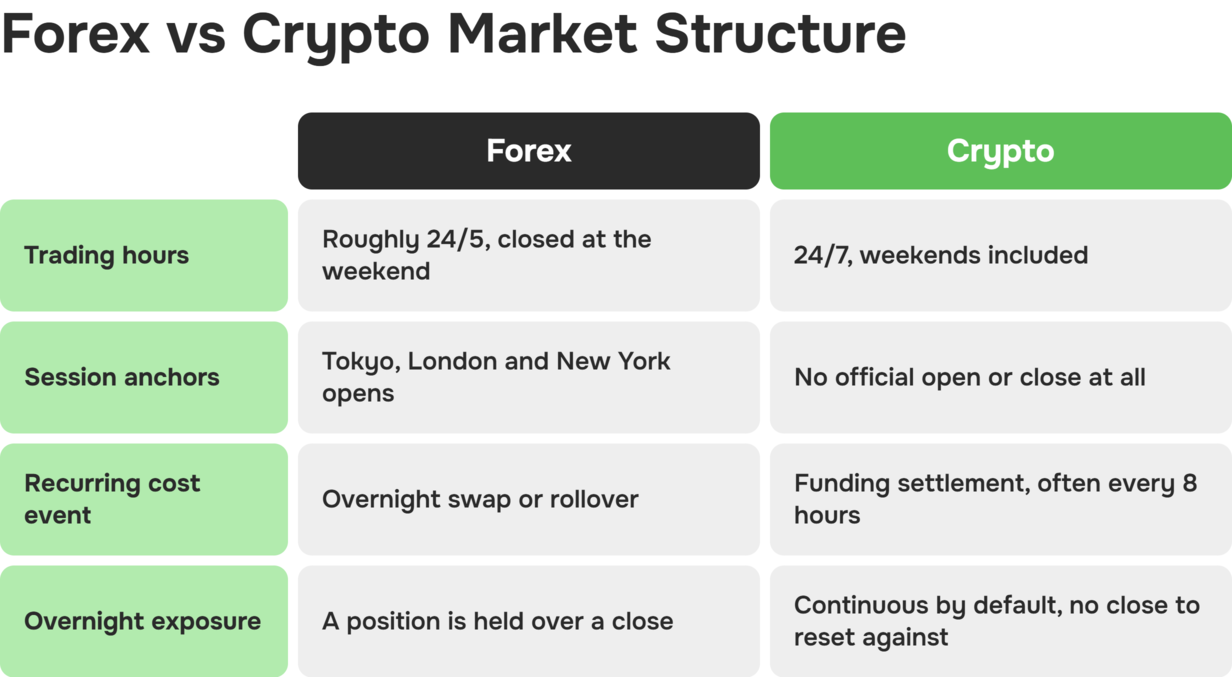
Crypto trades 24 hours a day, seven days a week, with no opening bell and no daily close. A day trader in forex or equities plans around session opens and the closing auction. In crypto neither exists.
The nearest thing to a fixed point is the funding settlement on perpetual contracts, which most venues run every eight hours, commonly at 00:00, 08:00 and 16:00 UTC. Liquidity varies by hour without ever following a schedule steady enough to trade blind, and on most venues weekend books thin out with no news behind the drop.
This article covers the funding window as a replacement for session timing, and the five intraday strategies built around it.
[[aa-key-takeaways]]
Key Takeaways
With no official open, close, or reliable daily reset in a 24/7 market, crypto day trading strategies need liquidity-based decision windows of their own.
Funding cycles and on-chain flows may help traders read intraday positioning and recurring volatility, though neither behaves as a fixed schedule of price moves.
Scalping, trend following, range trading, breakout trading, and funding-rate arbitrage each address different liquidity and volatility conditions; none of them removes execution, leverage, or model risk.
Position sizing, leverage limits, and the choice between cross and isolated margin can help manage liquidation risk and funding costs, but neither is a guarantee against loss.
Execution speed, platform reliability, and jurisdiction-specific licensing are practical factors to weigh before choosing a counterparty for continuous-market trading.
[[/a]]
[[aa-cta]]
One Account for Spot, Perps, and CFDs
B2PRIME's UNIFIED account lets crypto spot holdings serve as margin across perpetual futures and CFD positions, all in one cross-collateral structure.
Why Crypto's 24/7 Market Breaks Traditional Day Trading Frameworks
Even in a market that trades around the clock, liquidity and participation vary by hour and by day. A session template built for forex or equities needs adapting before it fits. Forex is organized around overlapping regional sessions in Tokyo, London, and New York, with liquidity peaks near session opens, while equities add a hard open and close with end-of-day settlement.
Crypto order books stay open through weekends and across every region at once, with no equivalent anchor anywhere in the week. Participation shifts with regional hours, funding events, and macro releases, but never into a pattern that makes one hour reliably more liquid than another. Weekend trading tends to see thinner order books on many venues, which can widen spreads and raise slippage risk.
No Session Opens, No Closes: Why Forex Kill Zones Don't Translate to Crypto
ICT-style "kill zones" identify time windows around institutional session transitions, such as the London or New York open, where liquidity and directional moves have historically clustered in forex.
In crypto, a kill zone built around a session open has no session to anchor to.
The underlying technical analysis tools behind kill-zone analysis, including order blocks, fair value gaps, and liquidity levels, stay useful in crypto price action. B2PRIME's guide to price action and ICT trading strategies covers those definitions in depth. For crypto the anchor changes: funding-settlement timestamps, regional participation shifts, and scheduled macro releases become the recurring reference points in place of a session clock.
The Funding Window Framework: Crypto's Structural Replacement for Session Timing
Perpetual futures funding schedules give traders a recurring checkpoint in an otherwise continuous market. Funding is a periodic payment exchanged directly between long and short position holders, structured to keep a perpetual contract's price close to the underlying spot price. A settlement is not an official market open, and a scheduled payment does not by itself guarantee a directional move.
A funding window is the monitoring period a trader defines around a scheduled payment, long enough to read positioning data before acting on it. Payment timing is a separate question from volatility or direction, and treating settlement as an automatic trade trigger confuses the schedule with the move.
How 8-Hour Funding Cycles Create Recurring Volatility Windows
Many crypto exchanges settle funding every 8 hours, commonly reported around 00:00, 08:00, and 16:00 UTC, though the exact schedule is venue-specific and worth verifying with the chosen platform. Bitcoin and Ethereum perpetuals can carry different rates on the same day, so a BTC book and an ETH book pay different holding costs through the same stretch of intraday volatility.
The payment is position notional multiplied by the prevailing funding rate. A $50,000 notional position at a 0.01% funding rate settles a $5 payment, paid by longs to shorts, or the reverse if the rate is negative.
Some traders watch the minutes around settlement for changes in open interest or order-book depth, and trading bots monitor the same window continuously. The timing of the payment alone predicts nothing about whether volatility follows.
Reading Funding Rates as an Intraday Positioning Signal
A positive funding rate generally means long positions are paying short positions, a reading that can reflect crowded long positioning. A negative rate reverses it. On its own, funding-rate direction describes market sentiment at that moment without forecasting where price goes next. Any sentiment analysis built on a single input stops there too.
Crowded positioning has sometimes preceded a reversal and sometimes persisted through a continuing trend. Extreme or fast-changing funding rates count as one input alongside price action, open interest, and traded volume.
Redefining ICT and Smart Money Kill Zones as Liquidity and Funding Windows
ICT and smart-money concept (SMC) frameworks are often described in terms of what "institutions" are doing at a price level. No public data source confirms institutional intent behind a specific order. A liquidity sweep read as evidence of a known institutional plan claims more than the data supports.
Liquidity pools around prior highs and lows, funding-settlement timestamps, liquidation clusters, and shifts in regional activity can all be observed directly.
A more observable checklist, similar in spirit to B2PRIME's ICT trading checklist, starts with a liquidity sweep beyond a prior high or low. A structural confirmation follows, such as a break of the trendlines drawn on the move, then a rise in volume and a predefined invalidation level. Every item is checkable against public data. Inside a single session, fundamental analysis has little to add to that.
On-Chain Flow as Crypto's Order Flow Signal
Exchange inflows and outflows, large wallet transfers, and stablecoin movements can help read intraday supply, demand, and collateral conditions. Forex and equity markets offer no equivalent data.
The data carries three limitations. Providers periodically relabel wallet addresses as exchanges restructure infrastructure, transfers between an exchange's own wallets can be misread as external outflows, and tagging updates can lag by hours. Glassnode's own transparency notice on exchange balance data documents these limitations directly.
On-chain signals need confirmation from price action, traded volume, and derivatives data such as open interest and funding before they say anything about direction.
Five Core Strategies for Trading Crypto Intraday
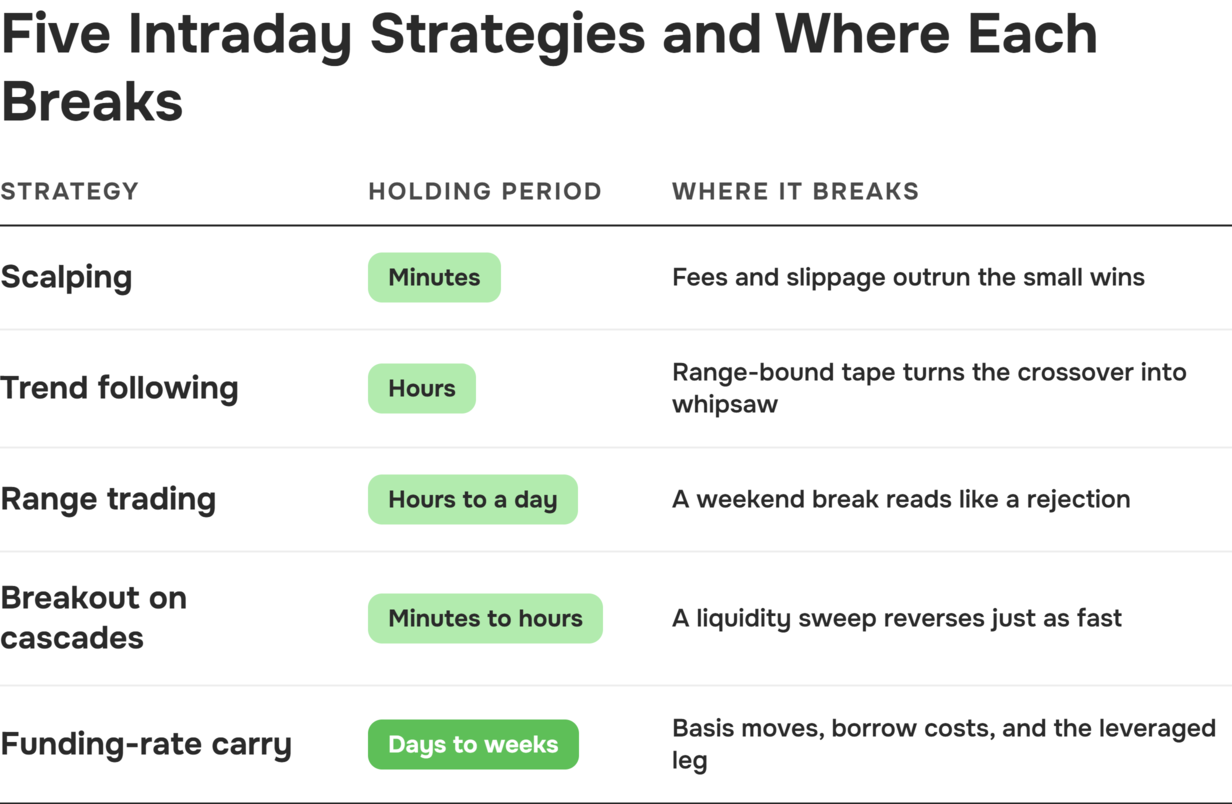
The strategies below address different liquidity and volatility conditions. None removes execution risk, leverage risk, or the chance that a model built on past conditions performs differently going forward. All five close inside the day, unlike swing trading across several sessions, dollar cost averaging into a position, or hodling through cycles.
Perpetual futures and CFDs are leveraged derivative products. Leverage amplifies both gains and losses relative to the capital deposited. A position can be liquidated once those losses erode the posted margin, and the final loss may exceed the amount originally deposited. Spot positions, by contrast, mean owning the underlying asset outright.
B2PRIME's roundup of crypto derivatives trading strategies covers a broader set of approaches. The five below stay on intraday, liquidity-driven setups.
Scalping Short-Term Volatility
Scalping typically works on one to five minute candlestick charts, targeting short-term price movements that repeat through the session. With a small target move, tight spreads, depth, latency, and trading fees weigh more heavily than they would over a longer holding period. A spread or depth filter before entry is the common answer. Desks that run size also measure their fills against VWAP over the same window to see what the execution actually cost.
The net result on a single scalp is gross price movement less spread, commission, slippage, and any funding accrued while open. B2PRIME's dedicated guide to scalping covers entry mechanics in more detail.
Overtrading is the failure mode here, whether the orders come from a person or from algorithmic trading. Each trade carries its own cost base, and higher frequency compounds fees and slippage as readily as gains. Trading more often does not, by itself, improve the odds of a positive result.
Trend Following With Moving Average Crossovers
Trend following sits inside the momentum trading family, where technical analysis supplies most of the triggers. A common setup on 15-minute to 1-hour crypto charts uses a 5-period and 13-period exponential moving average crossover as an entry trigger. Three filters sit around it: structure, meaning higher highs and higher lows for a long bias, plus traded volume and a minimum volatility threshold.
Intraday setups tend to prefer an exponential average, which reacts faster than a simple moving average (SMA) of the same length.
Other indicators sit on top of the crossover. The relative strength index (RSI) reads overbought or oversold levels, moving average convergence divergence (MACD) shows the shift in momentum, and Bollinger Bands show whether the range is expanding. None of them turns a lagging signal into one that arrives before the move.
The lag built into a moving average means a crossover confirms a move that has already partly happened. In a range-bound market the same lag generates a string of false signals, known as whipsaws. The invalidation level, a trailing-exit rule, and the conditions for staying flat belong to the setup and get defined before entry.
Range Trading Support and Resistance Flips
Range trading is a mean reversion approach. It assumes price returns toward the middle of a band it has respected before. A range is generally tradeable once price has reacted from the same support and resistance levels several times and depth at those boundaries can absorb typical order flow. One test proves nothing, for a range or for any chart pattern.
When resistance breaks and price retests it from above, that former resistance can act as new support. A broken support level works the same way in reverse. The pattern is a tendency observed across many setups and guarantees nothing. Range trades should be invalidated on a close beyond the boundary, with room left for ordinary volatility and slippage.
Weekend liquidity thinning turns that into a specific risk. A range that held through a liquid weekday can narrow enough over a weekend that an apparent rejection is the start of a breakout.
Breakout Trading Around Liquidation Cascades
When many leveraged positions are liquidated in a short window, that forced closing can accelerate a price move already underway. The effect is more pronounced in crypto derivatives, where so much open interest sits on leverage.
The initial break alone rarely separates a genuine continuation from a liquidity sweep and a fast reversal. Volume expansion, supporting open-interest context, and a retest of the broken level that holds all count. A market order placed during a cascade fills against depth that evaporates as liquidations stack up, at prices materially different from the last quote. A slippage tolerance set on entries limits that exposure without removing it.
Funding Rate Arbitrage Between Spot and Perpetual Positions
This strategy pairs a spot position with an opposing perpetual position on the same asset, structured to stay close to directionally neutral while collecting the funding payment on the perpetual leg.
The funding income has to be weighed against basis changes between spot and perpetual prices, fees on both legs, borrowing cost, and slippage. Margin and liquidation risk still apply to the leveraged perpetual leg even though the position is hedged. Holding an opposing position materially reduces directional exposure without eliminating risk.
A large enough basis move, a funding-rate reversal, or a liquidation on the perpetual leg during a volatility spike can still produce a loss despite the hedge.
Managing Risk in a Market That Never Closes
Continuous trading extends exposure beyond a trader's working hours by default. Risk controls therefore have to cover per-trade risk, total portfolio exposure, correlated positions, leverage, funding carry, and the hours when nobody is watching the screen.
A common guideline caps the capital risked on a single trade at 1-2% of account equity. It is a starting reference point for position sizing, not a suitability assessment. The appropriate level depends on factors the rule does not capture, including experience, total exposure, and financial circumstances. On a hypothetical $50,000 account, a 1% risk budget works out to $500 for a single position.
A position sized correctly at entry can still gap through its stop level overnight or over a weekend in a market with no daily close. Once slippage is involved, the realized loss runs past the planned risk budget.
Cross Margin vs Isolated Margin: Liquidation Risk and Funding Carry Costs
Cross margin shares collateral across all open positions, letting margin from a healthy one offset a losing one and delay liquidation on any single trade. The same sharing lets a large loss on one position draw down the collateral backing every other open position.
Isolated margin ring-fences a fixed amount of collateral to a single position, holding any loss inside that allocation. That position can then be liquidated sooner once its fixed collateral is exhausted, even while the rest of the account has margin sitting unused.
the liquidation price for a given position, since isolated positions liquidate from their own allocated margin only;
how far liquidation risk on one position spreads to others, a question only cross margin raises;
how funding costs accumulate against shared or ring-fenced collateral.
Traders running several concurrent positions, including a funding-rate arbitrage pair, generally set the structure deliberately and treat the platform's automatic default as a starting point only.
Staying Disciplined When the Market Gives No Daily Close to Reset Against
Some traders build the daily reset that crypto never delivers on its own. A written trading plan sets out what ends the session. The usual triggers are a maximum daily loss, a run of consecutive losing trades, abnormally wide spreads or a known news event, a late entry driven by FOMO, and simple fatigue during a long stretch at the screen. Those rules are worth rehearsing on a demo account before capital is exposed to them.
Scheduled review windows, price alerts, and server-side stop-loss orders support that discipline better than a manual close attempted away from the screen, though stop and limit orders can still slip in fast-moving conditions. All of that answers crypto's missing reset point. B2PRIME's broader look at choosing a crypto CFD trading strategy covers general trading psychology in more depth.
Matching Execution Infrastructure and Licensing to a Trading Strategy
The strategy picks the counterparty: a scalping or liquidation-breakout approach needs execution latency and depth that a funding-rate arbitrage position held for days can do without. A practical evaluation checklist covers execution latency, quoted depth, order types, charting and API integration, and funding-rate transparency. It also covers which regulated entity an account actually sits with and what client-fund protections that entity offers.
Why Execution Speed and Multi-Jurisdictional Licensing Both Matter for Intraday Crypto Trading
For slippage-sensitive strategies like scalping and breakout trading around liquidation cascades, a delayed fill turns a planned entry into a worse one. B2PRIME reports an average execution speed of approximately 7 ms, with actual fill speed still depending on market conditions and connectivity.
A broker holding multiple licenses across jurisdictions typically routes clients to different legal entities by region, and each entity carries its own product permissions, leverage limits, and client-money protections. A brand spanning several entities does not spread one license across them. The protections on an account are the ones its entity carries.
Trade Crypto's Funding Cycles and Volatility With a Regulated, Unified Account
Crypto day trading works better as a scheduled process than as an always-on activity, built around funding awareness, defined risk limits, and dependable execution. B2PRIME's UNIFIED account brings Crypto Spot, Crypto Perpetual Futures, and traditional CFDs together in one cross-collateral account. Spot, perpetual, and hedged CFD exposure can then be managed without fragmenting capital across platforms.
For a strategy that touches several of these product types in a single day, that structure is worth evaluating.
[[aa-cta]]
Trade Funding Cycles on Regulated Infrastructure
Execution quality, licensing, and margin structure are all worth evaluating together before capital is allocated to a 24/7 crypto strategy.
CFDs are complex instruments and come with a high risk of losing money rapidly due to leverage. You should consider whether you understand how CFDs work and whether you can afford to take the high risk of losing your money. Crypto CFDs carry additional risks due to the high volatility of the underlying assets. Crypto perpetual futures carry the same volatility risk, and losses can exceed the amount initially deposited.
This content is for informational and educational purposes only and does not constitute investment advice or a personal recommendation. None of the five strategies is a recommendation, and nothing here is an instruction to trade. B2PRIME (B2B Prime Services EU Ltd) is authorized and regulated by the Cyprus Securities and Exchange Commission (CySEC), license no. 370/18; product availability, eligible collateral, and leverage depend on the client's jurisdiction and applicable terms. The position-sizing and funding figures are simplified illustrations rather than expected outcomes. This article contains forward-looking statements that involve risks and uncertainties, since the scenarios and figures described rest on simplified assumptions rather than observed outcomes. Past performance is not indicative of future results, and leverage limits, venue figures, and entity protections are indicative and may change; verify current details before trading.
[[/a]]
[[aa-faq]]
FAQs about Crypto Day Trading
Do day trading strategies work on crypto?
Strategies built for other markets can work on crypto, but only after adjustment: with no session opens or closes, the timing has to come from funding windows, liquidity conditions, and on-chain context. No strategy removes the risk of loss, and results depend on execution, risk management, and market behavior nobody can predict.
What strategies are commonly used for crypto day trading?
Five approaches come up most often: scalping, trend trading through moving-average crossovers, ranges around support and resistance, breakouts around leveraged liquidation cascades, and funding-rate arbitrage between spot and perpetual positions. Each fits different liquidity and volatility conditions, and most traders specialize in one or two. Margin, leverage, and liquidation all differ between spot, perpetual futures, and CFDs.
How do funding rates affect crypto day trading?
Funding rates are periodic payments exchanged between long and short holders of a perpetual futures contract, commonly settled every 8 hours, though exact timing is venue-specific. A positive rate means longs are paying shorts and a negative rate the reverse, and either reading describes positioning rather than the next price move. A position held through settlement books the payment as a cost or a credit, separate from any price gain or loss.
What is the 1% rule in crypto trading, and how does leverage change it?
The 1% rule keeps the risk on any single trade near 1% of total account equity, or $500 on a hypothetical $50,000 account. The figure is a starting reference point and settles nothing about what suits a specific trader. Leverage amplifies both gains and losses, and a loss on a leveraged position may exceed the initial margin, so the capital actually at risk can run past that 1%.
What should a trader evaluate when choosing a platform for crypto day trading?
Execution speed and quoted depth come first, then order types, charting and API integration, mobile access, and funding-rate transparency. Licensing weighs as heavily, since protections vary by entity and jurisdiction, so which license covers the specific account is worth settling before opening it.
[[/a]]
Connect with Our Experts
Our team is equipped to provide solutions precisely to your requirements. Let's explore your options and discuss how we can support your objectives