Oops! Something went wrong while submitting the form.
Notice: It looks like you are visiting us from United Arab Emirates or have selected it as your residency location.
For accurate information and services under the correct licensed entity, please visit the appropriate section of our website. For more information view Regulatory Information
For accurate information and services under the correct licensed entity, please visit the appropriate section of our website. For more information view Regulatory Information
For educational purposes only, not investment advice.
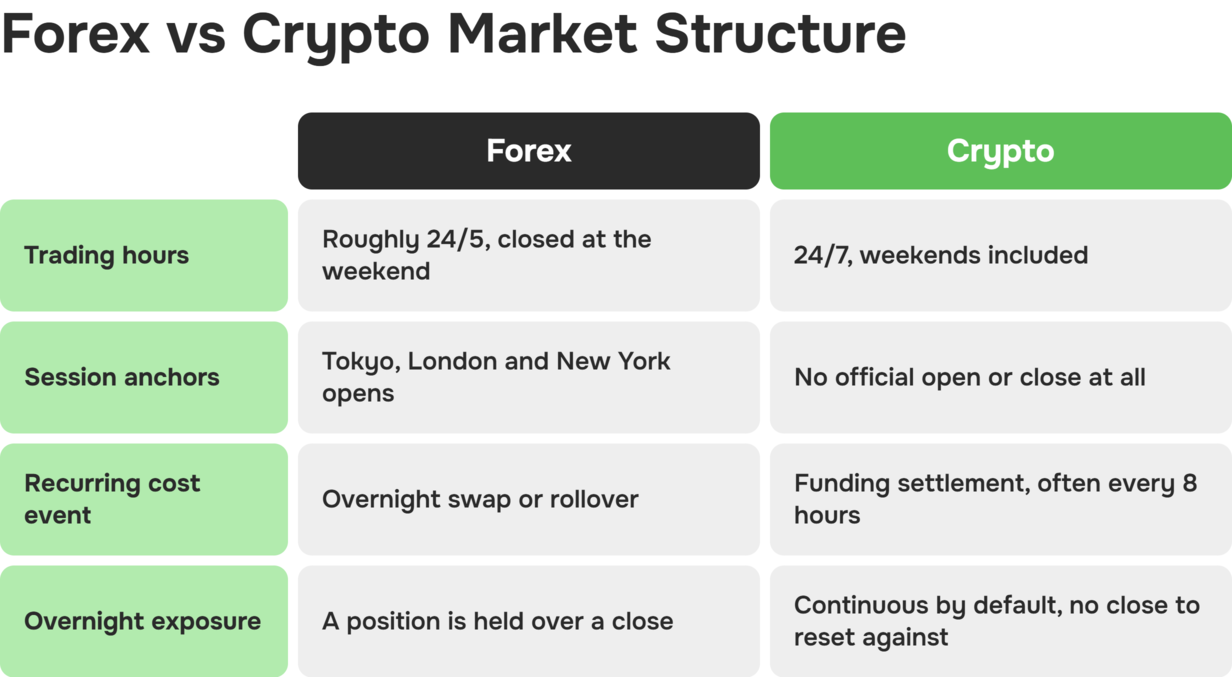
Crypto trades 24 hours a day, seven days a week, with no opening bell and no daily close. A day trader in forex or equities plans around session opens and the closing auction. In crypto neither exists.
The nearest thing to a fixed point is the funding settlement on perpetual contracts, which most venues run every eight hours, commonly at 00:00, 08:00 and 16:00 UTC. Liquidity varies by hour without ever following a schedule steady enough to trade blind, and on most venues weekend books thin out with no news behind the drop.
This article covers the funding window as a replacement for session timing, and the five intraday strategies built around it.
[[aa-key-takeaways]]
Key Takeaways
With no official open, close, or reliable daily reset in a 24/7 market, crypto day trading strategies need liquidity-based decision windows of their own.
Funding cycles and on-chain flows may help traders read intraday positioning and recurring volatility, though neither behaves as a fixed schedule of price moves.
Scalping, trend following, range trading, breakout trading, and funding-rate arbitrage each address different liquidity and volatility conditions; none of them removes execution, leverage, or model risk.
Position sizing, leverage limits, and the choice between cross and isolated margin can help manage liquidation risk and funding costs, but neither is a guarantee against loss.
Execution speed, platform reliability, and jurisdiction-specific licensing are practical factors to weigh before choosing a counterparty for continuous-market trading.
[[/a]]
[[aa-cta]]
One Account for Spot, Perps, and CFDs
B2PRIME's UNIFIED account lets crypto spot holdings serve as margin across perpetual futures and CFD positions, all in one cross-collateral structure.
Why Crypto's 24/7 Market Breaks Traditional Day Trading Frameworks
Even in a market that trades around the clock, liquidity and participation vary by hour and by day. A session template built for forex or equities needs adapting before it fits. Forex is organized around overlapping regional sessions in Tokyo, London, and New York, with liquidity peaks near session opens, while equities add a hard open and close with end-of-day settlement.
Crypto order books stay open through weekends and across every region at once, with no equivalent anchor anywhere in the week. Participation shifts with regional hours, funding events, and macro releases, but never into a pattern that makes one hour reliably more liquid than another. Weekend trading tends to see thinner order books on many venues, which can widen spreads and raise slippage risk.
No Session Opens, No Closes: Why Forex Kill Zones Don't Translate to Crypto
ICT-style "kill zones" identify time windows around institutional session transitions, such as the London or New York open, where liquidity and directional moves have historically clustered in forex.
In crypto, a kill zone built around a session open has no session to anchor to.
The underlying technical analysis tools behind kill-zone analysis, including order blocks, fair value gaps, and liquidity levels, stay useful in crypto price action. B2PRIME's guide to price action and ICT trading strategies covers those definitions in depth. For crypto the anchor changes: funding-settlement timestamps, regional participation shifts, and scheduled macro releases become the recurring reference points in place of a session clock.
The Funding Window Framework: Crypto's Structural Replacement for Session Timing
Perpetual futures funding schedules give traders a recurring checkpoint in an otherwise continuous market. Funding is a periodic payment exchanged directly between long and short position holders, structured to keep a perpetual contract's price close to the underlying spot price. A settlement is not an official market open, and a scheduled payment does not by itself guarantee a directional move.
A funding window is the monitoring period a trader defines around a scheduled payment, long enough to read positioning data before acting on it. Payment timing is a separate question from volatility or direction, and treating settlement as an automatic trade trigger confuses the schedule with the move.
How 8-Hour Funding Cycles Create Recurring Volatility Windows
Many crypto exchanges settle funding every 8 hours, commonly reported around 00:00, 08:00, and 16:00 UTC, though the exact schedule is venue-specific and worth verifying with the chosen platform. Bitcoin and Ethereum perpetuals can carry different rates on the same day, so a BTC book and an ETH book pay different holding costs through the same stretch of intraday volatility.
The payment is position notional multiplied by the prevailing funding rate. A $50,000 notional position at a 0.01% funding rate settles a $5 payment, paid by longs to shorts, or the reverse if the rate is negative.
Some traders watch the minutes around settlement for changes in open interest or order-book depth, and trading bots monitor the same window continuously. The timing of the payment alone predicts nothing about whether volatility follows.
Reading Funding Rates as an Intraday Positioning Signal
A positive funding rate generally means long positions are paying short positions, a reading that can reflect crowded long positioning. A negative rate reverses it. On its own, funding-rate direction describes market sentiment at that moment without forecasting where price goes next. Any sentiment analysis built on a single input stops there too.
Crowded positioning has sometimes preceded a reversal and sometimes persisted through a continuing trend. Extreme or fast-changing funding rates count as one input alongside price action, open interest, and traded volume.
Redefining ICT and Smart Money Kill Zones as Liquidity and Funding Windows
ICT and smart-money concept (SMC) frameworks are often described in terms of what "institutions" are doing at a price level. No public data source confirms institutional intent behind a specific order. A liquidity sweep read as evidence of a known institutional plan claims more than the data supports.
Liquidity pools around prior highs and lows, funding-settlement timestamps, liquidation clusters, and shifts in regional activity can all be observed directly.
A more observable checklist, similar in spirit to B2PRIME's ICT trading checklist, starts with a liquidity sweep beyond a prior high or low. A structural confirmation follows, such as a break of the trendlines drawn on the move, then a rise in volume and a predefined invalidation level. Every item is checkable against public data. Inside a single session, fundamental analysis has little to add to that.
On-Chain Flow as Crypto's Order Flow Signal
Exchange inflows and outflows, large wallet transfers, and stablecoin movements can help read intraday supply, demand, and collateral conditions. Forex and equity markets offer no equivalent data.
The data carries three limitations. Providers periodically relabel wallet addresses as exchanges restructure infrastructure, transfers between an exchange's own wallets can be misread as external outflows, and tagging updates can lag by hours. Glassnode's own transparency notice on exchange balance data documents these limitations directly.
On-chain signals need confirmation from price action, traded volume, and derivatives data such as open interest and funding before they say anything about direction.
Five Core Strategies for Trading Crypto Intraday
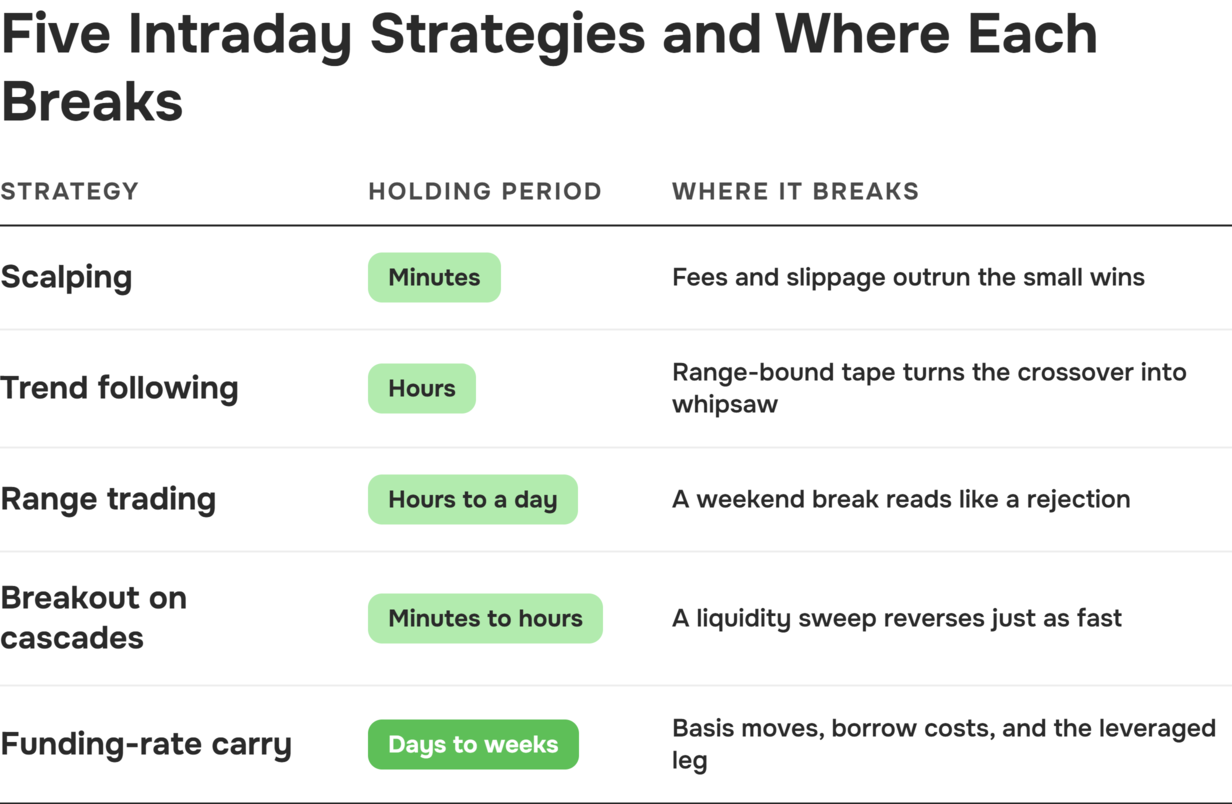
The strategies below address different liquidity and volatility conditions. None removes execution risk, leverage risk, or the chance that a model built on past conditions performs differently going forward. All five close inside the day, unlike swing trading across several sessions, dollar cost averaging into a position, or hodling through cycles.
Perpetual futures and CFDs are leveraged derivative products. Leverage amplifies both gains and losses relative to the capital deposited. A position can be liquidated once those losses erode the posted margin, and the final loss may exceed the amount originally deposited. Spot positions, by contrast, mean owning the underlying asset outright.
B2PRIME's roundup of crypto derivatives trading strategies covers a broader set of approaches. The five below stay on intraday, liquidity-driven setups.
Scalping Short-Term Volatility
Scalping typically works on one to five minute candlestick charts, targeting short-term price movements that repeat through the session. With a small target move, tight spreads, depth, latency, and trading fees weigh more heavily than they would over a longer holding period. A spread or depth filter before entry is the common answer. Desks that run size also measure their fills against VWAP over the same window to see what the execution actually cost.
The net result on a single scalp is gross price movement less spread, commission, slippage, and any funding accrued while open. B2PRIME's dedicated guide to scalping covers entry mechanics in more detail.
Overtrading is the failure mode here, whether the orders come from a person or from algorithmic trading. Each trade carries its own cost base, and higher frequency compounds fees and slippage as readily as gains. Trading more often does not, by itself, improve the odds of a positive result.
Trend Following With Moving Average Crossovers
Trend following sits inside the momentum trading family, where technical analysis supplies most of the triggers. A common setup on 15-minute to 1-hour crypto charts uses a 5-period and 13-period exponential moving average crossover as an entry trigger. Three filters sit around it: structure, meaning higher highs and higher lows for a long bias, plus traded volume and a minimum volatility threshold.
Intraday setups tend to prefer an exponential average, which reacts faster than a simple moving average (SMA) of the same length.
Other indicators sit on top of the crossover. The relative strength index (RSI) reads overbought or oversold levels, moving average convergence divergence (MACD) shows the shift in momentum, and Bollinger Bands show whether the range is expanding. None of them turns a lagging signal into one that arrives before the move.
The lag built into a moving average means a crossover confirms a move that has already partly happened. In a range-bound market the same lag generates a string of false signals, known as whipsaws. The invalidation level, a trailing-exit rule, and the conditions for staying flat belong to the setup and get defined before entry.
Range Trading Support and Resistance Flips
Range trading is a mean reversion approach. It assumes price returns toward the middle of a band it has respected before. A range is generally tradeable once price has reacted from the same support and resistance levels several times and depth at those boundaries can absorb typical order flow. One test proves nothing, for a range or for any chart pattern.
When resistance breaks and price retests it from above, that former resistance can act as new support. A broken support level works the same way in reverse. The pattern is a tendency observed across many setups and guarantees nothing. Range trades should be invalidated on a close beyond the boundary, with room left for ordinary volatility and slippage.
Weekend liquidity thinning turns that into a specific risk. A range that held through a liquid weekday can narrow enough over a weekend that an apparent rejection is the start of a breakout.
Breakout Trading Around Liquidation Cascades
When many leveraged positions are liquidated in a short window, that forced closing can accelerate a price move already underway. The effect is more pronounced in crypto derivatives, where so much open interest sits on leverage.
The initial break alone rarely separates a genuine continuation from a liquidity sweep and a fast reversal. Volume expansion, supporting open-interest context, and a retest of the broken level that holds all count. A market order placed during a cascade fills against depth that evaporates as liquidations stack up, at prices materially different from the last quote. A slippage tolerance set on entries limits that exposure without removing it.
Funding Rate Arbitrage Between Spot and Perpetual Positions
This strategy pairs a spot position with an opposing perpetual position on the same asset, structured to stay close to directionally neutral while collecting the funding payment on the perpetual leg.
The funding income has to be weighed against basis changes between spot and perpetual prices, fees on both legs, borrowing cost, and slippage. Margin and liquidation risk still apply to the leveraged perpetual leg even though the position is hedged. Holding an opposing position materially reduces directional exposure without eliminating risk.
A large enough basis move, a funding-rate reversal, or a liquidation on the perpetual leg during a volatility spike can still produce a loss despite the hedge.
Managing Risk in a Market That Never Closes
Continuous trading extends exposure beyond a trader's working hours by default. Risk controls therefore have to cover per-trade risk, total portfolio exposure, correlated positions, leverage, funding carry, and the hours when nobody is watching the screen.
A common guideline caps the capital risked on a single trade at 1-2% of account equity. It is a starting reference point for position sizing, not a suitability assessment. The appropriate level depends on factors the rule does not capture, including experience, total exposure, and financial circumstances. On a hypothetical $50,000 account, a 1% risk budget works out to $500 for a single position.
A position sized correctly at entry can still gap through its stop level overnight or over a weekend in a market with no daily close. Once slippage is involved, the realized loss runs past the planned risk budget.
Cross Margin vs Isolated Margin: Liquidation Risk and Funding Carry Costs
Cross margin shares collateral across all open positions, letting margin from a healthy one offset a losing one and delay liquidation on any single trade. The same sharing lets a large loss on one position draw down the collateral backing every other open position.
Isolated margin ring-fences a fixed amount of collateral to a single position, holding any loss inside that allocation. That position can then be liquidated sooner once its fixed collateral is exhausted, even while the rest of the account has margin sitting unused.
the liquidation price for a given position, since isolated positions liquidate from their own allocated margin only;
how far liquidation risk on one position spreads to others, a question only cross margin raises;
how funding costs accumulate against shared or ring-fenced collateral.
Traders running several concurrent positions, including a funding-rate arbitrage pair, generally set the structure deliberately and treat the platform's automatic default as a starting point only.
Staying Disciplined When the Market Gives No Daily Close to Reset Against
Some traders build the daily reset that crypto never delivers on its own. A written trading plan sets out what ends the session. The usual triggers are a maximum daily loss, a run of consecutive losing trades, abnormally wide spreads or a known news event, a late entry driven by FOMO, and simple fatigue during a long stretch at the screen. Those rules are worth rehearsing on a demo account before capital is exposed to them.
Scheduled review windows, price alerts, and server-side stop-loss orders support that discipline better than a manual close attempted away from the screen, though stop and limit orders can still slip in fast-moving conditions. All of that answers crypto's missing reset point. B2PRIME's broader look at choosing a crypto CFD trading strategy aborda a psicologia geral de trading com mais profundidade.
Adequando a infraestrutura de execução e o licenciamento a uma estratégia de trading
A estratégia define a contraparte: uma abordagem de scalping ou de rompimento por liquidação exige uma latência de execução e uma profundidade de mercado que uma posição de arbitragem de taxa de financiamento mantida por dias não requer. Uma lista de verificação prática de avaliação abrange latência de execução, profundidade cotada, tipos de ordem, integração de gráficos e API, e transparência da taxa de financiamento. Também cobre com qual entidade regulada a conta está vinculada e quais proteções aos fundos do cliente essa entidade oferece.
Por que a velocidade de execução e o licenciamento multijurisdicional são importantes para o trading intradia de cripto
Para estratégias sensíveis a slippage, como scalping e trading de rompimento em torno de cascatas de liquidação, um atraso na execução transforma uma entrada planejada em uma pior. A B2PRIME relata uma velocidade média de execução de aproximadamente 7 ms, sendo que a velocidade real de preenchimento ainda depende das condições de mercado e da conectividade.
Uma corretora que detém múltiplas licenças em várias jurisdições geralmente direciona os clientes para diferentes entidades legais por região, e cada entidade possui suas próprias permissões de produto, limites de alavancagem e proteções ao capital do cliente. Uma marca que abrange várias entidades não estende uma única licença a todas elas. As proteções de uma conta são aquelas oferecidas pela entidade à qual ela está vinculada.
Negocie ciclos de financiamento e volatilidade de cripto com uma conta unificada e regulada
O day trading de cripto funciona melhor como um processo programado do que como uma atividade ininterrupta, estruturado em torno da consciência sobre taxas de financiamento, limites de risco definidos e execução confiável. A conta UNIFIED da B2PRIME reúne Cripto Spot, Futuros Perpétuos de Cripto e CFDs tradicionais em uma única conta com margem cruzada. A exposição em spot, perpétuos e CFDs protegidos pode, então, ser gerenciada sem fragmentar o capital entre plataformas.
Para uma estratégia que envolve vários desses tipos de produtos em um único dia, essa estrutura merece ser avaliada.
[[aa-cta]]
Negocie ciclos de financiamento em infraestrutura regulada
A qualidade da execução, o licenciamento e a estrutura de margem devem ser avaliados em conjunto antes que o capital seja alocado a uma estratégia de cripto 24/7.
CFDs são instrumentos complexos e apresentam um alto risco de perda rápida de dinheiro devido à alavancagem. Você deve considerar se entende como os CFDs funcionam e se pode arcar com o alto risco de perder seu dinheiro. CFDs de cripto acarretam riscos adicionais devido à alta volatilidade dos ativos subjacentes. Futuros perpétuos de cripto carregam o mesmo risco de volatilidade, e as perdas podem exceder o valor inicialmente depositado.
Este conteúdo tem fins meramente informativos e educacionais e não constitui aconselhamento de investimento ou recomendação pessoal. Nenhuma das cinco estratégias é uma recomendação, e nada aqui é uma instrução para negociar. A B2PRIME (B2B Prime Services EU Ltd) é autorizada e regulada pela Comissão de Valores Mobiliários de Chipre (CySEC), licença nº 370/18; a disponibilidade de produtos, garantias elegíveis e alavancagem dependem da jurisdição do cliente e dos termos aplicáveis. Os números de dimensionamento de posição e financiamento são ilustrações simplificadas, não resultados esperados. Este artigo contém declarações prospectivas que envolvem riscos e incertezas, uma vez que os cenários e números descritos baseiam-se em premissas simplificadas e não em resultados observados. O desempenho passado não é indicativo de resultados futuros, e os limites de alavancagem, números da plataforma e proteções da entidade são indicativos e podem mudar; verifique os detalhes atuais antes de negociar.
[[/a]]
[[aa-faq]]
Perguntas frequentes sobre day trading de cripto
Estratégias de day trading funcionam com cripto?
Estratégias criadas para outros mercados podem funcionar com cripto, mas apenas após ajustes: como não há abertura ou fechamento de sessão, o timing deve vir das janelas de financiamento, condições de liquidez e contexto on-chain. Nenhuma estratégia elimina o risco de perda, e os resultados dependem da execução, do gerenciamento de risco e do comportamento do mercado, que ninguém pode prever.
Quais estratégias são comumente usadas para day trading de cripto?
Cinco abordagens aparecem com mais frequência: scalping, trading de tendência através de cruzamentos de médias móveis, faixas em torno de suporte e resistência, rompimentos em torno de cascatas de liquidação alavancadas e arbitragem de taxa de financiamento entre posições spot e perpétuas. Cada uma se adapta a diferentes condições de liquidez e volatilidade, e a maioria dos traders se especializa em uma ou duas. Margem, alavancagem e liquidação diferem entre spot, futuros perpétuos e CFDs.
Como as taxas de financiamento afetam o day trading de cripto?
As taxas de financiamento são pagamentos periódicos trocados entre detentores de posições compradas e vendidas de um contrato futuro perpétuo, geralmente liquidados a cada 8 horas, embora o timing exato seja específico de cada plataforma. Uma taxa positiva significa que os compradores estão pagando os vendedores, e uma taxa negativa, o contrário; qualquer uma das leituras descreve o posicionamento, não o próximo movimento de preço. Uma posição mantida durante a liquidação registra o pagamento como um custo ou crédito, separado de qualquer ganho ou perda de preço.
O que é a regra de 1% no trading de cripto e como a alavancagem a altera?
A regra de 1% mantém o risco de qualquer operação individual próximo a 1% do patrimônio total da conta, ou US$ 500 em uma conta hipotética de US$ 50.000. Esse valor é um ponto de referência inicial e não define o que é adequado para cada trader. A alavancagem amplia tanto os ganhos quanto as perdas, e uma perda em uma posição alavancada pode exceder a margem inicial, portanto, o capital efetivamente em risco pode ultrapassar esse 1%.
O que um trader deve avaliar ao escolher uma plataforma para day trading de criptomoedas?
A velocidade de execução e a profundidade de mercado vêm em primeiro lugar, seguidas pelos tipos de ordem, ferramentas de gráficos e integração via API, acesso móvel e transparência nas taxas de financiamento. O licenciamento tem o mesmo peso, já que as proteções variam conforme a entidade e a jurisdição; por isso, vale a pena verificar qual licença cobre a conta específica antes de abri-la.
[[/a]]
Fale com os Nossos Especialistas
A nossa equipa está preparada para fornecer soluções perfeitamente adaptadas às suas necessidades. Vamos explorar as suas opções e discutir como podemos apoiar os seus objetivos.