Oops! Something went wrong while submitting the form.
Notice: It looks like you are visiting us from United Arab Emirates or have selected it as your residency location.
For accurate information and services under the correct licensed entity, please visit the appropriate section of our website. For more information view Regulatory Information
For accurate information and services under the correct licensed entity, please visit the appropriate section of our website. For more information view Regulatory Information
For educational purposes only, not investment advice.
A sound scalping setup can still lose money when broker friction eats a 3- to 5-pip target. With targets that small and dozens of trades a day, spread, commission, slippage, and latency stop being background details and start deciding whether the strategy works at all.
This guide covers the core setups and risk rules, then puts execution at the center with a cost-adjusted model you can run against your own broker before committing capital.
[[aa-key-takeaways]]
Key Takeaways
A scalping strategy depends on very small price moves, so spread, commission, and slippage can determine whether a setup remains viable.
Scalping differs from day and swing trading mainly in trade frequency, holding time, and how little room execution leaves for error.
Practical setups include momentum pullbacks, breakout retests, and mean-reversion entries built around EMA, VWAP, and RSI.
Discipline starts with preset session rules for position sizing, total exposure, and daily loss limits, all set before the first trade.
Platform features like one-click execution, direct chart trading, and depth-of-market visibility help a scalping strategy hold up under fast conditions.
[[/a]]
[[aa-cta]]
Test Your Scalping Costs on a Demo
Model spread, commission, and fills on B2PRIME's platforms across FX, crypto, and commodities before risking capital.
Scalping is a high-frequency method built on tiny targets, where costs and fills shape the outcome as much as direction does. Holding times run from seconds to minutes, targets from roughly 2 to 10 pips, and volume from 10 to 100 trades a day.
How Scalping Differs From Day Trading and Swing Trading
A swing trader holding for days absorbs a spread once against a large target; a scalper pays the spread many times a day against small ones. An execution cost the swing trader barely notices can be decisive for the scalper. So a scalper's trading plan includes numbers a swing trader can leave out: the spread at entry, the commission per round trip, and how much slippage to expect when the market moves fast.
What Makes Scalping Viable: The Core Maths
Net expectancy is the gross target minus the bid-ask spread, commission, and slippage. On a 5-pip target, a 1-pip spread plus commission and a little slippage can remove half the intended reward before the trade is even managed. If the average net capture drops below what the win rate needs to cover losing trades, the strategy stops working, no matter how good the entries look.
Core Scalping Setups and the Indicators That Power Them
Most scalping setups lean on ordinary technical analysis; the challenge is repeatable execution under real costs. The three below rely on levels and momentum rather than chart patterns, so none depends on a particular session. ICT trading strategies and the wider smart money concepts approach take the same setups and time them to liquidity windows.
Momentum Scalping With EMA Pullbacks
On a 1-minute or 5-minute chart, the setup runs on two moving averages: a 9-period exponential moving average and a 21-period one. The trade is the pullback that follows the crossover. Entering on the cross itself means paying for a move that has already happened. The pullback entry waits for a better price, with the stop-loss just beyond the recent swing.
Traders who prefer a slower read swap the EMA for a simple moving average (SMA), which lags more but flips less often. The trend still sets the direction either way.
Breakout and Retest Scalping
Pre-session highs, round numbers, and prior range edges are where breaks get tested. Two filters can thin out false breaks: trading volume expansion on the break, then price action that holds the retest. The same logic runs in reverse for short positions. Because a false break takes out a tight scalping stop almost at once, support and resistance levels get mapped before the session rather than during it.
Mean Reversion Scalping With VWAP and RSI
VWAP draws the intraday fair-value line. RSI, the relative strength index, gauges how overheated the move away from it has become; a stochastic oscillator reads the same stretch on a different scale. The entry comes only after a rejection or a momentum stall near an overbought or oversold extreme. Price looking overbought or oversold is not a signal on its own, since a strong trend can stay that way far longer than a tight stop allows.
Risk Management Rules Every Scalper Needs
At dozens of trades a session, there is no time to decide how much to risk once a position is open. The numbers have to exist before the session starts: how much a single trade can lose, and how much the open book can lose together. Fixing them bounds the loss without doing anything for the gain.
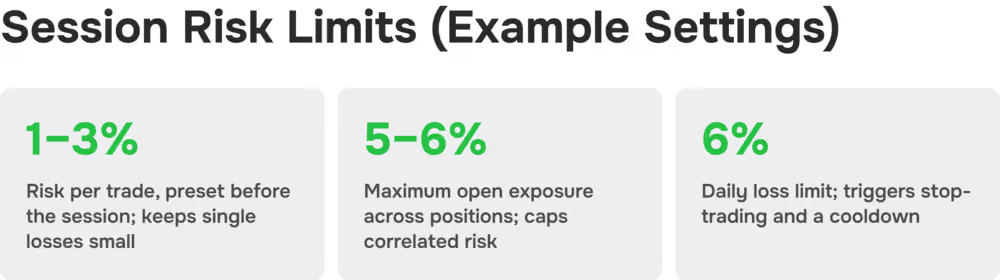
Two named frameworks make that pre-set explicit. The percentages are illustrative starting points to adapt to your risk tolerance, with many traders running smaller per-trade risk.
The 3-5-7 Rule: Position Sizing Across a Session
The 3-5-7 rule caps risk at 3% per trade and 5% across all open positions, and sets about 7% as the session's profit target. Fixing size and total exposure before the session makes it harder for a bad run to escalate. Any reasonable set of numbers works, as long as it exists before the first trade.
The 3-6-9 Rule: Exposure Limits and Session Targets
The 3-6-9 variant runs wider: 3% per trade, 6% across open positions, and 9% as the session target, with stop conditions written down alongside them. The loss caps do the real work in either rule; the session figure only marks where to stop for the day.
Daily Loss Limits and Drawdown Recovery Discipline
A daily loss cap and a cooldown rule protect decision quality after early losses. In a drawdown, size should shrink first, because increasing size to recover usually compounds execution mistakes rather than fixing them.
Both rules sit inside the same practical ranges:
Why Execution Quality Is a Core Strategy Variable, Not a Footnote
Spread, slippage, and latency directly change net expectancy. They belong in the same calculation as the target and the win rate, with the figures taken from the trader's own account. A setup that works at 0.0–0.5 pip spreads can fail if spreads widen, commissions rise, or fills slip.
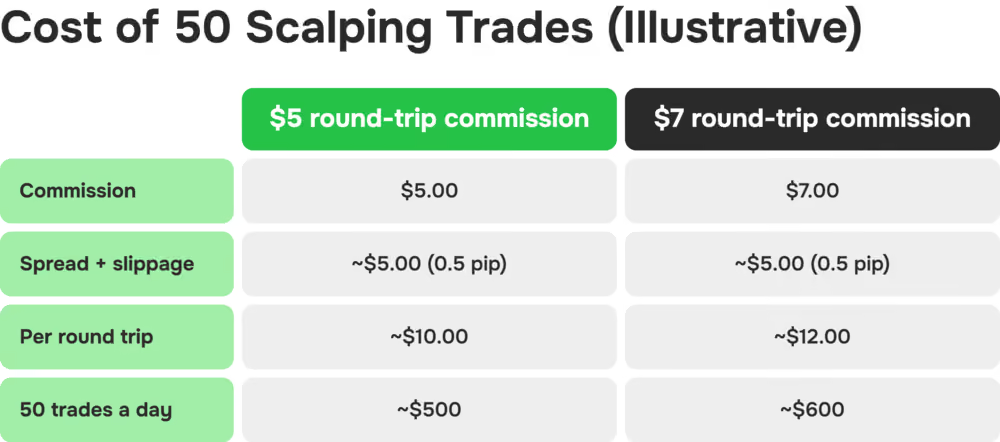
B2PRIME's RAW pricing starts from $2.50 per side, or $5 for a round trip at that rate, with roughly 7ms average execution latency. Fill quality still varies with market conditions and connectivity, and lower cost reduces the break-even threshold rather than making a strategy profitable.
Cost-Adjusted P&L: Spread, Commission, and Slippage Across 50 Trades
The table below models a hypothetical session: 50 trades on a standard lot of EUR/USD at about $10 per pip, each with a 5-pip take profit, a 0.3-pip spread, and 0.2 pips of assumed slippage.
Small transaction costs compound. A $2 difference per round trip becomes about $100 a day at this frequency, and roughly $2,000 a month over 20 sessions, before spread and slippage. Against a 5-pip target worth about $50 gross, a $10–12 round-trip cost takes a fifth to a quarter of the intended reward. These figures are illustrative and do not imply any result.
How Latency Differentials Compound Into Material P&L Differences
Latency shows up through repetition. Missing entries by a fraction of a pip, or being filled slightly worse across dozens of trades, adds up faster in a high-frequency session than one dramatic slip would. Predictable routing is therefore worth more to a scalper than to a position trader.
Best Markets for Scalping: FX, Crypto, and Commodities Compared
Not every highly liquid market suits scalping the same way. Major currency pairs such as USD/JPY run tight spreads on clear session windows. Crypto perpetual futures trade around the clock, with wider spreads and more movement. Gold and oil CFDs sit in between, calm for stretches and sharp around data releases.
For a forex scalping strategy, the pair choice comes down to how its spread behaves relative to target size. Crypto spreads swing hardest, so a setup that clears costs on a calm day can fail on a volatile one. That swing is the practical limit on any crypto CFD strategy. A cross-collateral account lets a trader scalp across these markets from one balance instead of splitting capital between a broker and an exchange.
Platform Capabilities That Determine Whether Your Setup Holds Up
Two things stand between the price a scalper sees and the price they get: how the order is routed, and how many clicks it takes to send. A trading platform either widens or narrows that gap.
cTrader: Depth-of-Market Visibility and One-Click Execution
cTrader offers real-time data on depth of market, detachable layouts, and one-click limit order entry. When targets are only a few pips, seeing the available liquidity and shaving clicks off each entry can change the fill a trader actually gets.
TradingView: Direct Execution Without Platform-Switching Latency
Direct execution from TradingView removes the tab-switching step of analyzing on one screen and trading on another. That shortens the gap between decision and order. The trade is also logged on the same chart it was planned on.
What to Check in Your Broker's Terms Before Scalping
A strategy can fail before the first trade if the broker's terms restrict it. Five things are worth checking in any regulated broker's documentation before funding an account:
Whether scalping is permitted at all.
Re-quote language in the execution terms.
The execution model: STP/ECN or dealing desk.
Minimum distance rules for stop-loss orders.
Overnight financing and withdrawal policies.
Scalp With the Execution Conditions the Strategy Actually Requires
The cost of scalp trading is set by the account it runs through, from the spread at entry to the commission per side and the fill when the market moves. B2PRIME runs those conditions on one account: tier-1 execution under B2PRIME's neutral-execution model, RAW pricing from $2.50 per lot per side, and cTrader, TradingView, or B2TRADER. A demo session shows how those conditions handle a specific setup before capital is at risk.
[[aa-cta]]
Validate the Maths Before You Scale
RAW pricing from $2.50 per lot per side, DOM and one-click execution on cTrader, and direct TradingView trading.
CFDs are complex instruments and come with a high risk of losing money rapidly due to leverage. You should consider whether you understand how CFDs work and whether you can afford to take the high risk of losing your money. Crypto CFDs carry additional risks due to the high volatility of the underlying assets.
This content is for informational and educational purposes only and does not constitute investment advice or a personal recommendation. B2PRIME (B2B Prime Services EU Ltd) is authorized and regulated by the Cyprus Securities and Exchange Commission (CySEC), license no. 370/18.
[[/a]]
[[aa-faq]]
FAQs about Scalping Trading Strategies
Which strategy is best for scalping?
There is no single best strategy. For many active traders, momentum scalping with EMA pullbacks is a practical starting point because it trades with the trend and offers a defined entry and stop. Breakout-retest and VWAP mean-reversion setups suit different conditions. The more important factor is whether your execution costs let any of them stay net-positive.
Is scalping profitable after spreads and commissions?
It can be, but only if net expectancy survives costs. Because a scalper pays spread and commission many times a day against small targets, the break-even bar is higher than it is for day traders holding a position for hours. Modeling your own cost per round trip against your average capture is how to check viability before committing size.
What is the minimum latency needed for scalping?
There is no fixed threshold, but lower and more consistent latency helps, since scalping depends on predictable fills across many trades. Latency in the single-digit-millisecond range is favorable; more important than a single number is stable routing and controlled slippage during fast conditions.
Do all brokers allow scalping?
No. Some brokers restrict scalping, apply minimum holding times, or use dealing-desk models and re-quotes that interfere with fast entries. Scalping permissions, the execution model, and minimum-distance rules are worth confirming in the broker's terms before funding an account.
[[/a]]
Connect with Our Experts
Our team is equipped to provide solutions precisely to your requirements. Let's explore your options and discuss how we can support your objectives



.svg)