Oops! Something went wrong while submitting the form.
Notice: It looks like you are visiting us from United Arab Emirates or have selected it as your residency location.
For accurate information and services under the correct licensed entity, please visit the appropriate section of our website. For more information view Regulatory Information
For accurate information and services under the correct licensed entity, please visit the appropriate section of our website. For more information view Regulatory Information
For educational purposes only, not investment advice.
The same bullish BTC view behaves differently depending on whether it is expressed in spot, perpetual futures, or a CFD. Ownership, leverage, carry, custody, and liquidation risk are all set by the instrument before the thesis has a chance to play out.
This guide puts the three side by side: how each one settles, what carry costs over a 30-day hold, and how one account can hold all of them instead of splitting capital across separate providers.
[[aa-key-takeaways]]
Key Takeaways
In spot vs futures crypto, spot gives you asset ownership, while perpetual futures give you price exposure without custody.
Perpetual futures can support leveraged long or short positions, but funding payments may become a meaningful holding cost when positions stay open.
CFDs sit apart from both spot and futures by offering regulated, cash-settled exposure across crypto and other markets without requiring token ownership.
For hedging or short-term speculation, derivatives may offer better capital efficiency than spot, but they also introduce margin calls and liquidation risk.
Choosing between spot, perpetual futures, and CFDs usually comes down to your objective: ownership, leveraged trading, or cross-asset margin efficiency.
[[/a]]
[[aa-cta]]
Compare All Three Instruments on One Balance
Trade crypto spot, perpetual futures, and CFDs from a single regulated account instead of managing three separate margin pools.
In the crypto spot market, buying or selling means the actual coin changes hands, whether that is Bitcoin, Ethereum, or anything else quoted there. Settlement is immediate delivery: the asset belongs to the trader, held in a wallet or with a custodian, and nothing accrues against it. No embedded leverage, no funding payments, no liquidation level.
Spot adds custody and transfer work. Buying the same coin with borrowed funds turns it into spot margin trading and puts a liquidation level back on a position that had none.
What Spot Trading Actually Means in Practice
The trader owns the underlying asset and can withdraw it to a blockchain address they control, subject to the venue's own withdrawal rules. On venues that quote against stablecoins such as USDT, the position also carries exposure to the stablecoin itself. The only ongoing costs are custody and transaction fees; unlike perpetual futures and financed CFD positions, spot has no periodic funding charge.
Where Spot Fits in a Professional Portfolio
For professionals, spot is the ownership tool for four specific use cases: treasury or balance-sheet holdings, long-term directional exposure without leverage, collateral for cross-asset margin, and the long leg of cash-and-carry basis trades paired with derivatives.
In a cash-and-carry structure, a trader holds spot BTC while shorting an equivalent notional in perpetual futures or a CFD, collecting the basis or funding differential between the two legs while remaining broadly market-neutral on price.
Removing leverage removes liquidation risk. It does nothing about the price falling, the keys being lost, or the venue failing. Entry timing still moves the average cost basis of a long-term holding; support and resistance levels show where good entries tend to cluster, with or without leverage.
Perpetual Futures: Leveraged Exposure Without Expiry
Futures contracts with expiration dates have to be rolled to keep the exposure alive. Perpetual futures do not expire, so a long position can stay open indefinitely without the trader ever holding the coin. Leverage works in both directions, long or short, under the margin and liquidation rules set out in standard perpetual futures mechanics. The funding rate is the running cost of that position and resets throughout the day.
How the Funding Rate Keeps Contracts Anchored to Spot
Funding transfers value between longs and shorts. That transfer tends to pull the contract back toward the spot price whenever a premium or discount persists. If a contract trades 0.05% above the current market price and the funding rate is positive, longs pay shorts periodically until that premium compresses.
Funding Costs as a Persistent Drag on Held Positions
Funding fees are a carry cost. A leveraged BTC long held for 30 days at a typical rate of around 0.01% every eight hours accrues roughly 0.9% over the month, before entry commission. Intraday traders may barely notice a single payment. These figures are illustrative and do not represent any specific product's actual funding rate.
Spot carries none of that periodic charge. A CFD still charges carry, as a financing rate the broker sets in advance. The perpetual rate can flip negative and reverse who pays whom. That reversal is why you can't budget income on the receiving side: sentiment and position imbalance can turn in a session.
Leveraged contracts with no expiry fill a hedging and speculation role large enough that the Bank for International Settlements tracks the market. None of that cost is paid upfront: it shows up as funding, margin, and basis risk.
CFDs: Regulated Exposure Across Asset Classes
A CFD is a contract between a trader and a broker to exchange the difference between an asset's open and close price. Nothing is delivered: no coin, no share, no barrel of oil. The trade sits on the broker's books rather than an exchange's, with the broker as the counterparty to every position.
How CFDs Differ Structurally From Spot and Perpetual Futures
Three structural distinctions separate a CFD from the other two:
Settlement. A CFD holder owns nothing, as with perpetuals, but the position settles through the broker account's profit and loss instead of an exchange margin system.
Carry. Nothing transfers between traders. Overnight financing is broker-defined and set in advance, while perpetual funding moves with the market.
Scope. One margin pool covers currencies, indices, commodities, and digital assets. Spot and perpetual futures accounts rarely cover that mix.
One bullish BTC view expressed in three ways over a hypothetical 30-day hold shows the gap. In spot, the trader owns the coin outright, with no leverage and no funding, and the capital requirement is the full position value. In perpetual futures, the trader posts initial margin on a fraction of that capital at 5x leverage, pays variable funding, and carries liquidation risk if price moves against the position.
A CFD can offer comparable leverage, with overnight financing set by the broker and calculable in advance, cash settlement, and shorting on the same terms as a long. Margin requirements, shorting mechanics, and holding costs differ across all three; this is illustrative only and not a recommendation for any specific structure.
Regulatory Classification and Why It Matters for Institutional Traders
Product classification changes who oversees the account, how onboarding works, and what a fund or prop firm has to check before the account opens. Regulated broker CFDs sit in a different oversight structure than offshore perpetual venues. That difference decides what a mandate allows.
ESMA's product-intervention measures impose leverage limits and standardized risk warnings specifically on CFD providers across the EU. Offshore perpetual venues are not required to apply that layer.
B2PRIME is licensed in six jurisdictions: CySEC in Cyprus, DFSA in Dubai, FSCA in South Africa, FSC in Mauritius, FSA in Seychelles, and SCB in the Bahamas. Onboarding routes each client to the entity that covers their region. That entity sets the protections and the product access on the account, not the performance of anything traded in it. Crypto spot and perpetual futures are offered inside the same licensed structure.
Overnight Financing Versus Funding Rates: A Cost Comparison
Comparing the two costs means putting both in one unit: cost as a percentage of notional over the intended hold.
CFD financing is normally charged daily on the full notional, at a rate the broker publishes in its contract specifications, which gives a 30-day hold a number the trader can calculate before entry. Perpetual funding is charged every eight hours: 90 separate payments across the same month, with only the first known when the position opens.
The other 89 have to be estimated. A conservative estimate uses the recent funding range rather than the current print, and sizes the carry against the top of that range.
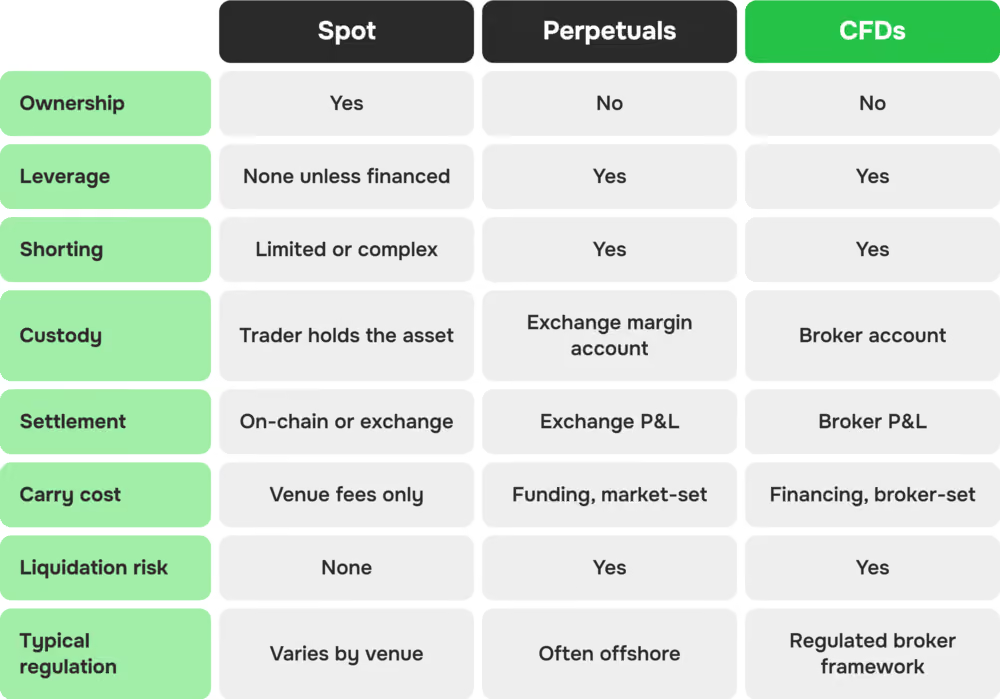
Spot vs. Perpetual Futures vs. CFDs: Side-by-Side Comparison
All three price the same coin. What differs is who holds it, what the carry costs, and whether a move against the position can close it.
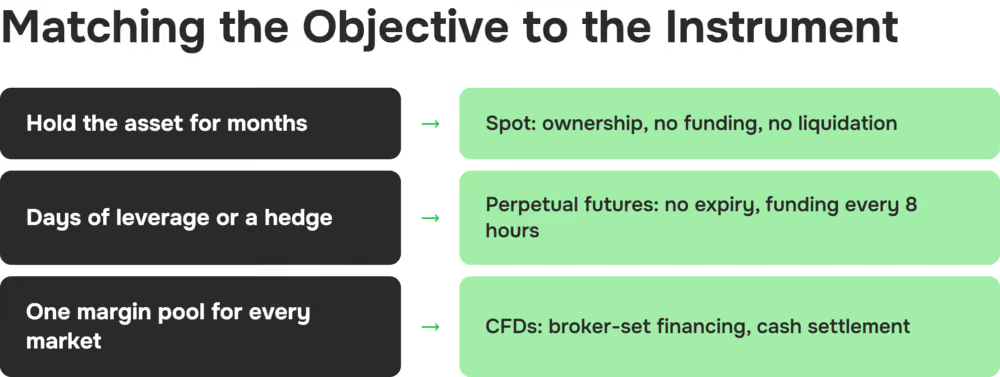
Choosing the Right Instrument for Your Objective
Two questions settle the choice: how long the position stays open, and whether the trader needs the asset itself or only its price. Risk management follows from the answer, because each instrument fails differently.
Long-Term Directional Exposure With Asset Ownership
A treasury position or a long-horizon allocation leaves one real option, because spot is the only one of the three that ends with the trader holding the asset. Two operational decisions remain: who custodies the coin, and whether a stablecoin quote puts a second asset in the position.
Leveraged Short-Term Speculation or Hedging Without Custody
Perpetuals suit a position measured in hours or days, whether directional or a hedge against spot the trader already holds. Nothing has to be moved into a wallet to open one. Because these markets run 24/7 and volatility doesn't wait for office hours, an unwatched position can hit liquidation overnight. Stop-loss orders sit inside the same margin system and reduce, rather than remove, that risk.
Regulated Leveraged Exposure With Cross-Asset Margin Efficiency
CFDs put leveraged crypto in the same margin pool as forex, indices, and commodities. In a unified cross-collateral account, crypto holdings can back CFD margin and CFD profits can rotate back into crypto without moving funds between providers.
Stop Splitting Capital Across Three Separate Accounts
A trader running spot on one exchange, perpetual futures on another, and CFDs through a separate broker keeps three onboarding files, three margin pools, and three sets of counterparty exposure. That split shows up as idle capital and transfer delays.
B2PRIME's Unified Trading Account holds crypto spot, crypto perpetual futures, and traditional CFDs in one regulated cross-collateral balance, reachable from TradingView, cTrader, and B2TRADER.
[[aa-cta]]
One Account for Spot, Futures, and CFDs
Consolidate margin across instruments instead of managing three separate providers and three separate risk dashboards.
CFDs are complex instruments and come with a high risk of losing money rapidly due to leverage. You should consider whether you understand how CFDs work and whether you can afford to take the high risk of losing your money. Crypto CFDs carry additional risks due to the high volatility of the underlying assets.
This content is for informational and educational purposes only and does not constitute investment advice or a personal recommendation. B2PRIME (B2B Prime Services EU Ltd) is authorized and regulated by the Cyprus Securities and Exchange Commission (CySEC), license no. 370/18.
[[/a]]
[[aa-faq]]
FAQs about Spot vs Futures Crypto
What is the difference between spot and futures in crypto?
Spot gives you ownership of the coin after settlement. Futures give you price exposure through a contract, with margin and liquidation risk.
Which is better, spot or futures trading?
Neither is structurally better, because each serves a different objective. Spot may suit longer holding horizons and custody-focused strategies, while futures may help with hedging, short exposure, and tighter capital efficiency. Where an edge depends on leverage, the numbers to watch before taking the derivatives route are funding, margin usage, and liquidation thresholds.
How are perpetual futures different from buying the coin?
Perpetual futures track spot without expiry, so the position can stay open without the trader ever taking delivery of the token. Instead of delivery, a running cost applies, since funding accrues as long as the contract is held. Leverage adds a second risk: in a fast market, liquidation can close the position before the view plays out.
Where do CFDs fit in spot vs futures crypto?
CFDs give regulated price exposure without custody or token settlement. The check before holding one overnight is the broker's financing rate against perpetual funding on the same notional.
What should I check before choosing between perpetual futures and CFDs for a multi-day position?
The first check is the cost of carry on both instruments. For perpetual futures, that means the current funding rate plus an estimate of total funding across the intended holding period, since rates reset periodically and shift with market sentiment. For CFDs, it means the broker's overnight financing rate, set in advance and not tied to position imbalance.
After carry comes the regulatory framework, margin requirements, and whether cross-asset margining is available at the position size in question. Neither instrument is structurally cheaper across all holding periods; the answer depends on the prevailing rate environment when the position opens.
[[/a]]
Connect with Our Experts
Our team is equipped to provide solutions precisely to your requirements. Let's explore your options and discuss how we can support your objectives



.svg)