Oops! Something went wrong while submitting the form.
Notice: It looks like you are visiting us from United Arab Emirates or have selected it as your residency location.
For accurate information and services under the correct licensed entity, please visit the appropriate section of our website. For more information view Regulatory Information
For accurate information and services under the correct licensed entity, please visit the appropriate section of our website. For more information view Regulatory Information
For educational purposes only, not investment advice.
Professional traders do not choose a CFD trading platform the way retail listicles suggest, by app-store ratings or interface polish. They ask how orders get filled, what the trading costs once commission and financing are counted, and which licensed entity will hold the money.
All three answers come from the broker. Contracts for difference are leveraged instruments that follow an asset's price without the trader owning it. The broker prices those contracts, supplies the liquidity behind them, and holds the account under a licence. The platform is only the interface a trader works from, yet ranking pages treat the two as one product.
This guide works through the broker's side in that order — fill, then cost, then licence — and ends with what a single multi-asset balance changes about all three.
[[aa-key-takeaways]]
Key Takeaways
Choosing a CFD trading platform starts with separating the interface from the broker, because charting tools and execution infrastructure are not the same thing.
Low latency can matter more than interface polish, because slippage and fill quality decide what a trade costs beyond its spread.
Raw-spread pricing with a separate commission may reveal trading costs more clearly than all-in spreads, making broker comparisons more accurate at higher volume.
The licensed entity behind your account can change leverage limits, investor protections, and how disputes are handled, so confirm this before funding.
A single multi-asset account can keep capital working instead of sitting in transfers between a broker and a crypto venue.
[[/a]]
[[aa-cta]]
Evaluate the Execution Layer First
Test B2PRIME's regulated liquidity, RAW pricing, and roughly 7ms average execution before committing capital.
What "Best CFD Platform" Means Once Real Capital Is at Stake
A first account is chosen based on comfort: minimum deposit, copy-trading and social trading availability, educational resources, economic calendars, and customer support hours. For retail traders, those are honest criteria, because on a small account a slightly worse fill costs less than an awkward daily workflow.
All of them, though, are measured in calm markets. Two brokers with similar app ratings and minimum deposits can look interchangeable for months. One high-volatility news event separates them: which execution held up, whose spreads widened least, whose legal entity answers if a dispute follows. A composite score averages exactly those differences away.
The Platform vs. Broker Distinction: Two Separate Infrastructure Layers
A trader may like a platform's interface and still reject the broker behind it for shallow liquidity or a single offshore licence. Those are two separate decisions.
Switching from one charting platform to another leaves counterparty risk, pricing, and entity protections exactly where they were. The interface never touched them.
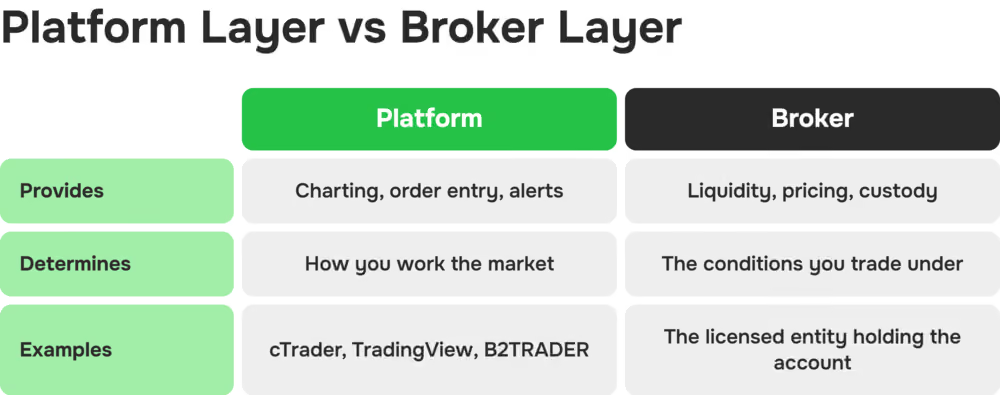
The Execution Layer: What the Platform Does
The platform handles charting, order entry, account management, alerts, and day-to-day workflow speed. B2PRIME, a multi-asset broker regulated in six jurisdictions, offers this layer through its own B2TRADER platform, a TradingView connection, and cTrader.
The Liquidity and Regulatory Layer: What the Broker Does
The broker supplies the liquidity, the pricing, and the execution model (dealing desk, STP/ECN, or direct market access). It also sets the rules for holding client money and the entity a client is onboarded to based on residence. Together they set the trading conditions. The fill, for one, depends on the depth of CFD liquidity behind the quote, and no chart layout changes it.
Low Latency as a Professional Evaluation Criterion
Price can move between the moment a trader clicks and the moment an order fills. The difference between those two prices is slippage. Latency, the time the broker's infrastructure adds between click and fill, is the share a broker can engineer down.
Faster routing trims the price given up between the decision and the fill. Market risk and adverse moves stay. A broker evaluation therefore gives latency one line and reserves the headline for what routing cannot fix.
What Latency Benchmarks Mean in Practice
At sub-10ms, the round trip between client and liquidity source is short enough to disappear next to normal price movement. B2PRIME reports roughly 7ms average execution latency; the methodology and the live conditions behind any such figure are worth checking directly.
An average is not a floor. Measured under normal trading conditions, it describes what routing usually does, while extreme market volatility, heavy news flow, or an infrastructure problem at either end of the connection can push any broker's fills well past it. The number compares brokers against each other and promises nothing about a single order once conditions turn.
How Execution Infrastructure Affects Slippage and Fill Rates
Latency surfaces in slippage and fill rates during volatile periods, when prices move fastest. On major currency pairs such as GBP/USD, it shows up as a wider gap between the on-screen quote and the price that fills.
At that moment, routing quality, liquidity depth, and server stability count for more than interface speed, because a fast-loading chart on a thin pool still fills badly. At size, the difference shows, since a deeper pool fills more volume at the quoted price.
Platform Options for Institutional-Grade CFD Trading
This is the one choice in this guide that leaves trading conditions untouched, because liquidity, instruments, and the licensed entity stay identical behind all three platforms below. The choice sets only the workspace. A trader can stay on the TradingView charts they already use, take cTrader for its execution terminal, or work in B2TRADER, the broker's own environment. Anyone arriving from MetaTrader 4 or MetaTrader 5 will find the order types familiar.
B2TRADER
B2TRADER is B2PRIME's own platform, a multi-asset environment built for fast execution and available on web, iOS, and Android. In 2026, an AI assistant moved directly into its workspace, putting sentiment readings, technical and on-chain signal drivers, and key market metrics beside the chart of whatever instrument is open.
TradingView
TradingView puts execution on the chart itself, beside the technical indicators and research tools a trader already uses: a built-in library of 400-plus, PineScript scripting, and a strategy tester that runs against historical data. B2PRIME connects to it as a Platinum Partner through B2TRADER. Once the two accounts are linked, orders go in from the same chart, with no tool-switching mid-decision.
cTrader
cTrader is the standalone alternative, an ECN-style workflow with advanced order types, automated strategies through cBots with built-in backtesting, and copy-trading access. Risk management tools sit in the same panel, from trailing stops to take-profit orders. It feels familiar to traders coming from proprietary trading desks, where depth of market and order-level control are the default.
The Real Cost of CFD Trading: RAW Spreads vs. All-In Spreads
Trading cost has three separate components: spread, commission, and financing. Only the all-in figure across the three is comparable between brokers, measured over the holding period a trader actually uses. Account-level charges such as inactivity fees sit outside those three and are worth reading before funding.
Lower costs do not create profits or improve returns; they reduce one input into a trade's overall economics, and trading CFDs carries a high risk of loss regardless of the pricing model used.
How the Market Maker Model Creates a Structural Conflict of Interest
In a market maker model, the broker may take the other side of client orders itself and earn from the spread markup instead of passing through raw market pricing. Professionals examine potential conflicts of interest before choosing a pricing structure because the design allows them, whether or not any given firm ever acts on it.
How RAW Spread Plus Commission Pricing Separates Execution Cost From Spread Cost
A raw-spread account passes through direct market pricing and charges a separate, disclosed commission. The broker's margin then sits on the statement as a fixed number instead of inside a wider quote. The cost becomes clear before the trade instead of after. RAW is B2PRIME's name for its tier of that model.
What the Cost Difference Compounds to at Trading Volume
At $5.00 round-trip commission against $7.00, the saving is $2.00 per round trip. Across 100 round trips, that is $200; across 200 round trips, $400, before spread enters the calculation at all.
The rate is only half the question; the deposit that unlocks it is the other half. Per-side commissions near $1.00 are typically reserved for accounts funded at $100,000 or more, while B2PRIME's RAW account starts from $2.50 per lot per side with no minimum. Figures here are indicative and should be checked against current schedules.
Past performance and cost comparisons do not indicate future results or profitability.
Regulatory Credibility Is Not a Checkbox: What Multi-Jurisdictional Licensing Actually Means
A licence looks like a badge in a footer and works as an operating framework. The entity that holds the account determines the leverage caps a client gets, how client money is segregated, and where a complaint goes. The jurisdiction and the regulator's enforcement record determine how much those rules matter in practice. All three get checked before the first deposit.
Why the 2026 ASIC Record Penalty Case Matters for Every CFD Trader
Regulatory failure carries a price tag. In 2026, the Federal Court of Australia, acting on an ASIC case, ordered record penalties totaling AUD 300 million against a CFD operator for misconduct the regulator characterized as egregious.
The case says nothing about any other broker. It documents the gap between claiming to be regulated and a regulator that acts when a firm breaks the rules.
How to Verify Which Legal Entity You Are Actually Trading Under
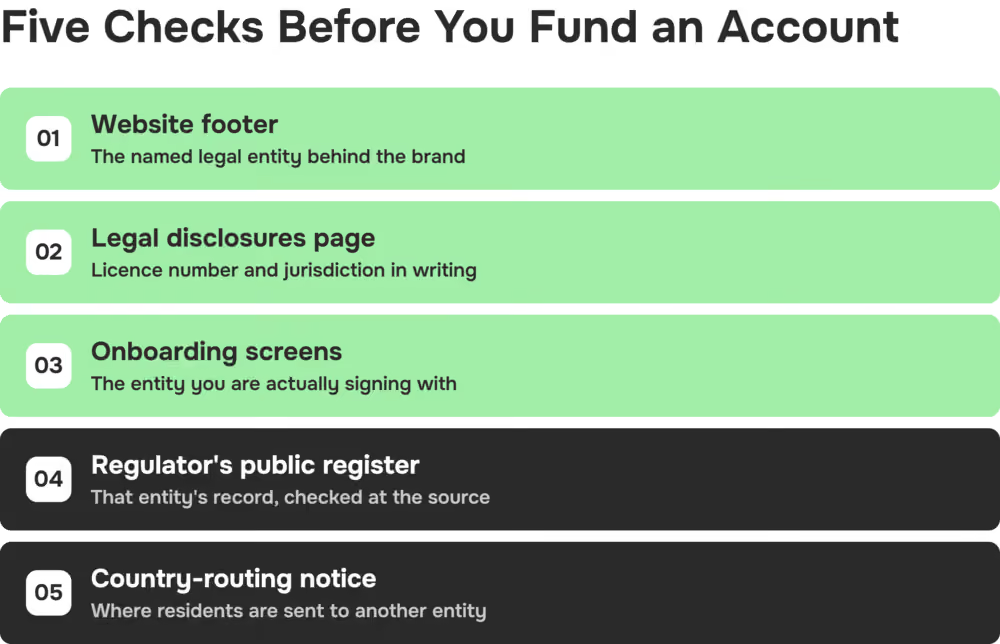
Five checks settle which entity will actually hold the account. Four sit on the broker's own site: the legal entity named in the footer, the disclosures page, the entity shown on the onboarding screens, and any country-routing note that moves a client elsewhere by residence. The fifth sits outside it, in the regulator's public register, where the named entity and its licence number can be cross-checked.
The FCA in the UK, the CFTC in the US, and CySEC in Cyprus each publish theirs. Checking an entity there takes minutes.
B2PRIME operates under six licences: CySEC in Cyprus, DFSA in Dubai, FSCA in South Africa, FSC in Mauritius, FSA in Seychelles, and SCB in the Bahamas, all listed on its legal page. Which of the six ends up holding a given account is set at onboarding, by residence.
Regulation has been moving toward exactly that level of detail. ESMA's product-intervention measures on CFDs set accountability at entity level and standardised the protections that come with it. Those protections decide a client's recourse when something goes wrong.
Multi-Asset Access Under a Single Account: An Institutional Efficiency Argument
A desk running forex, indices, and commodities alongside cryptocurrencies normally funds each venue separately. A single account holding every asset class removes exactly that duplication.
Every handoff between systems is a place where money sits idle or a transfer runs late. Sharing collateral across instruments removes that handoff from the sequence. Coverage also differs by broker, with commodity CFDs and CFDs on ETFs appearing on some venues and not on others.
B2PRIME's cross-collateral structure lets crypto holdings support CFD margin, with CFD gains staying inside the same account. A trader who would otherwise sell BTC, wire the proceeds to a broker, and wait for settlement can post that BTC as collateral and open the CFD position in the same session.
Choose the Platform Last
While interface preference decides day-to-day comfort, the trading conditions are set by infrastructure that never appears on screen. That invisibility is why the two get confused.
The order runs: the broker's execution model, then the cost structure, then the legal entity behind the account, then how that account holds collateral. Platform workflow comes last. Once the stack checks out, the remaining choices are which CFD strategies the capital will run and which account type matches them. A demo account allows fills to be timed and spreads watched before any money moves.
[[aa-cta]]
Test the Infrastructure Yourself
RAW pricing from $2.50 per lot per side, ~7ms average execution, and TradingView, cTrader, or B2TRADER access under six regulated licences.
CFDs are complex instruments and come with a high risk of losing money rapidly due to leverage. You should consider whether you understand how CFDs work and whether you can afford to take the high risk of losing your money. Crypto CFDs carry additional risks due to the high volatility of the underlying assets.
This content is for informational and educational purposes only and does not constitute investment advice or a personal recommendation. B2PRIME (B2B Prime Services EU Ltd) is authorised and regulated by the Cyprus Securities and Exchange Commission (CySEC), licence no. 370/18.
[[/a]]
[[aa-faq]]
FAQs about CFD Trading Platforms
Which CFD platform criteria matter most for professional traders?
Execution quality, the legal entity, the pricing model, and access to deep multi-asset liquidity usually matter more than layout or copy features. That is why many professional traders check the broker layer first and choose between cTrader, TradingView, and B2TRADER last.
What is the difference between cTrader and TradingView for CFD trading?
cTrader was built as an execution platform and may suit traders who want depth of market, advanced order control, and API connectivity. TradingView began as a charting environment and may suit those who want direct execution without leaving familiar charts.
What is a RAW spread account and why does it matter?
A RAW spread account passes through tighter market pricing and charges a separate commission, instead of hiding costs inside a wider spread. For active CFD traders, that structure may make trading costs easier to measure and to compare between brokers. At B2PRIME, the RAW account charges from $2.50 per lot per side, against a common market standard commonly cited closer to $3.50.
How do I verify if a CFD broker is properly regulated?
The broker's legal page lists the exact entity, license number, and jurisdiction that holds the account. The regulator's own register then confirms that entity, whose rules set the leverage caps, disclosures, complaint routes, and negative balance protection a client actually gets.
What leverage is available for CFD trading?
Leverage depends on your jurisdiction, client classification, and product, so the same broker may offer different limits across entities. At B2PRIME, maximum leverage reaches 1:500 for forex trading and 1:155 on its Crypto Perpetual Futures accounts, although lower limits may apply. Because leverage amplifies gains and losses, this overview is for educational purposes only, not investment advice.
[[/a]]
Connect with Our Experts
Our team is equipped to provide solutions precisely to your requirements. Let's explore your options and discuss how we can support your objectives



.svg)