Oops! Something went wrong while submitting the form.
Notice: It looks like you are visiting us from United Arab Emirates or have selected it as your residency location.
For accurate information and services under the correct licensed entity, please visit the appropriate section of our website. For more information view Regulatory Information
For accurate information and services under the correct licensed entity, please visit the appropriate section of our website. For more information view Regulatory Information
For educational purposes only, not investment advice.
Is your broker routing your order to the market, or taking the other side of it? A broker that routes the order out is working as an ECN broker. One that takes the other side is working as a market maker, whichever label sits on its site.
Many brokers now sit somewhere between the two. The ECN vs market maker question is checkable in two places: on the statement, where the cost shows, and in the routing behind the fill. Both are visible before any money moves.
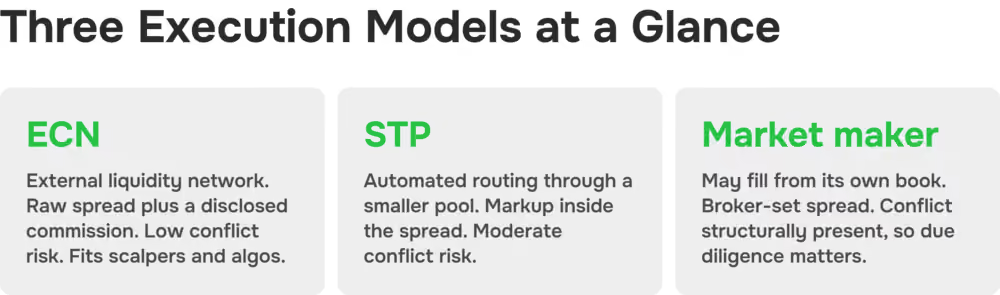
This guide takes the three models in turn (ECN, STP, and market maker), then the cost arithmetic behind each, the fit by trading style, and the checks that show which model a broker actually runs.
[[aa-key-takeaways]]
Key Takeaways
An ECN broker routes your order to external liquidity, while a market maker may take the other side of the trade internally.
That structural difference is the whole conflict-of-interest question, because a trade kept on the broker's own book can put its revenue and the client's result on opposite sides.
ECN pricing usually combines raw spreads with a separate commission. A headline spread misses that commission, so only total round-trip cost makes brokers comparable.
STP sits between the two, passing orders through automatically while the broker's margin usually travels inside the spread, where no separate line shows it.
For retail traders and institutions alike, an ECN claim stays undecided until execution disclosures, requote patterns, and order-flow transparency settle it.
[[/a]]
[[aa-cta]]
Verify Your Execution Model Before You Fund
Put B2PRIME's routing, RAW pricing, and fill quality through a demo first.
The Core Difference: Who Is on the Other Side of Your Trade
The execution model answers who fills your order, who earns from it, and whether the broker's revenue depends on your result. Agency-style routing sends the order out to outside liquidity providers competing for the fill. Principal-style market making means the broker may become the counterparty and fill the trade from its own book.
"NDD," short for no dealing desk, genuinely describes an execution model in which orders route to outside liquidity with no desk touching them. "Institutional pricing" describes nothing that specific. Either way, the label is the broker's own claim about itself — one the execution documents either confirm or contradict.
How the ECN Model Works
An electronic communication network (ECN) is an automated marketplace where orders from banks, institutions, and other traders are matched against each other, with price and time priority deciding the fill. An ECN broker connects client orders to it and earns a separately disclosed commission instead of a spread markup. Prices come from the interbank market and the wider liquidity pool its participants supply. Direct market access means routing an order straight into that pool.
Raw spreads on EUR/USD and other major currency pairs can start near 0.0 pips under normal conditions and widen during illiquid or volatile periods, as pricing does under any execution model. An advertised zero spread usually means the cost sits in the commission or the markup instead.
How the Market Maker Model Internalises Your Order
A market maker can fill the trade internally, set its own bid and ask prices, and decide afterward whether to hedge that exposure externally or keep it. Dealing desk brokers often quote fixed spreads on that basis, since they set the price.
On the client side, that shows up as requotes, spreads that widen during fast-moving news, and a human decision between the click and the fill. A requote makes that decision visible: the broker offers a new price instead of filling the one clicked. A purely electronic ECN route has no such step.
The Conflict of Interest Built Into the Market Maker Model
A broker can earn more when client flow stays in-house. That structural incentive reaches execution decisions the client never sees. An order either goes out to the market or stays on the broker's book. The industry calls those two paths A-book and B-book routing.
Price manipulation is the concern most often raised about internalized flow, whether fair or not. Because trust cannot settle that concern, order execution is set out in a written policy.
A-Book vs. B-Book: What Your Broker Does With Your Trade
A-book means external routing. The trade passes through to real liquidity, and the broker earns a commission or a small markup whether the client wins or loses. B-book means internal retention, where the broker keeps the trade on its own book and takes the other side of it.
Many firms run both, splitting flow by client profile and instrument. ECN branding on the website is therefore no proof that a particular order reached external liquidity.
Why B-Book Retention Means Your Loss Is Your Broker's Gain
When a B-booked client trade loses, the broker may keep that loss as revenue instead of earning only a commission on the flow. That describes the model's construction, with no claim about how any individual firm behaves. Experienced traders manage the design, whatever the firm's reputation, by asking for the order-handling policy in writing.
The full mechanism, including the disclosure policies written to address it, sits in the A-book vs B-book breakdown.
STP as the Third Model: Where It Sits Between ECN and Market Maker
STP brokers, named for straight-through processing, sit between the other two models. They pass orders through automatically, as an ECN broker does. The orders land with the broker's own set of liquidity providers, though, and the margin usually sits in the spread with no separate commission line. That overlap is why much of the market advertises itself as ECN/STP. The ECN vs STP comparison covers where that middle ground sits.
Spread Structures and Total Trading Cost Compared
The models put cost in different places. On an ECN account, the commission appears on the statement as its own line. On a marked-up account, nothing appears at all, because the cost is already inside the quote you accepted. Transparent pricing is therefore a property of the model a broker runs — marketing cannot add it.
The comparable number is total cost per round trip, since a quote that looks cheaper can carry the larger markup.
Lower cost does not automatically mean better trading outcomes; it reduces one input into total economics, and CFD trading carries a high risk of loss regardless of pricing model.
Raw Spread Plus Commission vs. Spread Markup: A Worked Example
A markup is paid in dollars the same way a commission is. On a standard lot, where 1 pip is $10, an illustrative 0.2-pip markup costs $2 per side. A "zero commission" quote can therefore land at the same total as a disclosed fee, with nothing on the statement itemising it.
Against that, B2PRIME's RAW account charges from $2.50 per side, $5.00 round trip, while the $3.50 per side common at comparable raw-pricing brokers comes to $7.00 round trip (indicative, commission only). Extended to 100 round trips a month, the gap is roughly $200, about $2,400 across a year at the same trading volume. Bid-ask spreads sit on top of that in both models. Minimum deposits determine who reaches the lower commission tiers.
These figures are illustrative cost comparisons, not profitability projections; savings reduce cost, not market risk, and past performance does not indicate future results.
Matching the Model to the Trading Strategy
The fit depends on how sensitive a strategy is to spread, latency, requotes, and transparency. Trade frequency and hold time set that sensitivity, so the same broker can suit one desk and fail another. The trade-offs below are conditional and are not a recommendation for any specific reader.
Scalpers and High-Frequency Traders
Scalpers are most exposed to spread markup, requotes, and slippage because scalping earns by capturing small moves repeatedly. One extra pip of markup, or a pattern of repeated requotes, changes expectancy across hundreds of trades.
On a 5-pip target, a single extra pip taken across entry and exit is a fifth of the intended gross, charged before the trade has had time to develop. No strategy type has less room for opaque pricing.
Algorithmic and Automated Traders
Automated systems, including high-frequency trading, need stable routing logic, predictable fills, and no manual steps in between, because small distortions in trade execution break the assumptions a strategy was backtested on.
B2PRIME, a multi-asset broker with licenses in six jurisdictions, reports roughly 7-millisecond average execution latency, regardless of the route orders take: the TradingView or cTrader trading platform, or direct API access. The TradingView route connects through B2TRADER, B2PRIME's own platform. Because execution conditions vary with market state, the figure describes the infrastructure in aggregate and does not guarantee any single fill.
Swing and Position Traders
Per-trade cost carries less weight at this frequency. The remaining exposures are conflict of interest, spreads that widen during news events, and the quality of the exit on a large position. Hedge funds and other financial institutions ask the same questions at a size where the answers cost more.
Size changes the arithmetic in both directions. Against the move a swing trade targets, a marked-up spread is small enough that some longer-term traders tolerate it. On a large exit, the same spread can cost more in absolute terms than a scalper's markup does across hundreds of trades. The due-diligence questions therefore stay the same.
How to Verify Whether a Broker Is Truly ECN
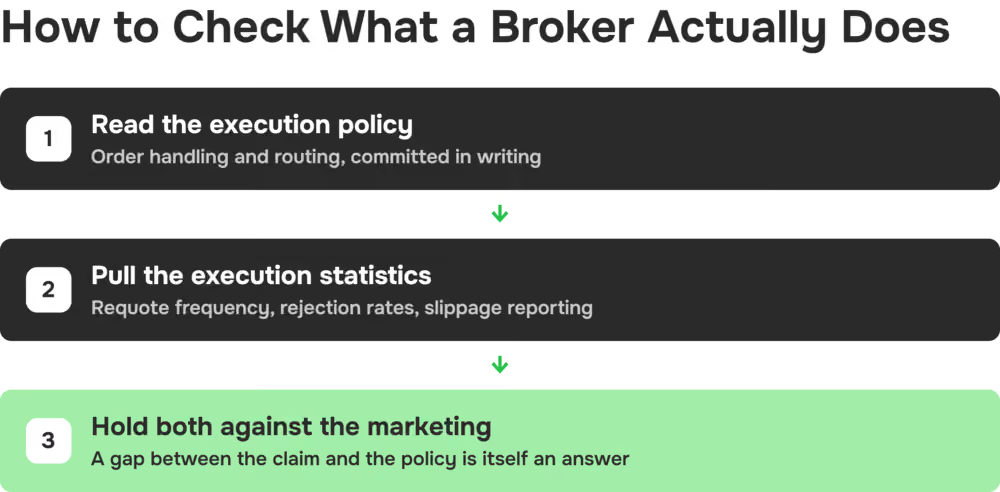
Many brokers market themselves as ECN forex brokers, a label that reveals nothing about order handling on its own. Two sets of evidence do: execution statistics and what the disclosures commit to.
Execution Statistics and Requote Frequency
Requote frequency, rejection rates, slippage reporting, and a stated fill policy together show whether execution is hands-off or open to discretionary intervention. Of those, only the policy must exist, because MiFID II obliges EU firms to execute orders on the terms most favourable to the client and to publish the execution policy that delivers it. The statistics are voluntary. A broker that publishes them is easier to verify.
Regulatory Disclosures and Order Flow Transparency
The execution policy, order-handling disclosures, and legal-entity information can each be held against the marketing claims on the same website. If the execution policy describes discretionary handling while the homepage says ECN, the policy is the accurate document. B2PRIME publishes its entity and licence detail for each jurisdiction, and routes clients to the entity that will hold their account during onboarding.
The ECN Model at Institutional Scale: Multi-Asset and Multi-Jurisdiction Context
At institutional scale, the execution model is no longer a single question. B2PRIME pairs ECN-style execution, as set out in its execution policy, with multi-asset access and jurisdiction-specific onboarding, so one review covers the routing, the entity holding the account, and the instruments that account can reach. Routing and instrument access can be tested on a demo balance; the entity is confirmed on the licence page before funding.
The Execution Model Is Checkable
Three questions settle the model: who fills the trade, how the broker gets paid, and what the routing disclosures actually commit to. Each one has a documented answer somewhere. A broker unable to produce that answer has given one.
[[aa-cta]]
Test ECN-Style Execution Yourself
RAW pricing from $2.50 per lot per side, verifiable order routing, and multi-asset access across regulated entities.
CFDs are complex instruments and come with a high risk of losing money rapidly due to leverage. You should consider whether you understand how CFDs work and whether you can afford to take the high risk of losing your money. Crypto CFDs carry additional risks due to the high volatility of the underlying assets.
This content is for informational and educational purposes only and does not constitute investment advice or a personal recommendation. B2PRIME (B2B Prime Services EU Ltd) is authorised and regulated by the Cyprus Securities and Exchange Commission (CySEC), licence no. 370/18.
[[/a]]
[[aa-faq]]
FAQs about ECN Brokers and Market Makers
Is there really a difference between a market maker broker and an ECN broker?
Yes. The two models differ in counterparty. An ECN broker passes the order out to competing liquidity providers, while a market maker can fill it from its own book and hold the opposite exposure itself.
Which is better, ECN or STP?
ECN is usually the more transparent model, because pricing and commissions are separated. STP can still work well, though where providers add spread markups, the cost lands hardest on frequent traders and automated systems.
How do I choose a broker: ECN, STP, or market maker?
The more trades a strategy fires, the more weight the pricing model carries, so the strategy usually chooses. Scalpers, algorithmic traders, and institutions often prefer ECN or STP, while occasional traders may tolerate market maker pricing if execution remains transparent.
What does an ECN broker typically offer?
A true ECN broker usually offers raw variable spreads, transparent commissions, and market execution without dealing desk intervention. You may also see deeper order book visibility, fewer requotes, and access through TradingView, cTrader, or an API.
How can I verify whether a broker is truly ECN?
The execution policy, fee schedule, and order handling disclosures are the first documents to read. If a broker claims ECN but shows frequent requotes, opaque markups, or mixed routing language, that may point to a hybrid model.
[[/a]]
Connect with Our Experts
Our team is equipped to provide solutions precisely to your requirements. Let's explore your options and discuss how we can support your objectives



.svg)