Oops! Something went wrong while submitting the form.
Notice: It looks like you are visiting us from United Arab Emirates or have selected it as your residency location.
For accurate information and services under the correct licensed entity, please visit the appropriate section of our website. For more information view Regulatory Information
For accurate information and services under the correct licensed entity, please visit the appropriate section of our website. For more information view Regulatory Information
For educational purposes only, not investment advice.
Cross-collateral means posting BTC or ETH as margin for other positions instead of selling them first, so a trader can reach forex, indices, or CFD markets while keeping the underlying crypto exposure intact. Selling crypto to fund a separate trading account adds operational friction and, in many jurisdictions, triggers a taxable disposal before a single trade is placed.
This guide is written for traders who already hold crypto and want access to other markets without liquidating it.
[[aa-key-takeaways]]
Key Takeaways
Cross-collateral in crypto means using assets like BTC or ETH as collateral for other positions, unlike cross-margin, where collateral is shared across trades.
Using crypto as collateral instead of selling it to fund a trade may help you retain market exposure and avoid a taxable disposal at the funding step.
Collateral haircuts matter because only a portion of your BTC or ETH value may count toward the margin, which affects usable exposure and liquidation risk.
If a trade moves against you, cross-collateral can put your deposited crypto at risk because the same collateral supports positions across the account.
Regulated, multi-asset account infrastructure can make cross-collateral crypto more practical when you want to access forex, indices, and CFDs from a single platform.
[[/a]]
[[aa-cta]]
Keep Your Crypto, Access More Markets
Use BTC or ETH as collateral for forex, indices, and CFD positions without selling your holdings first.
What Cross-Collateral Actually Means in Crypto Trading
Under cross-collateral, a cryptocurrency you already hold, typically Bitcoin or Ethereum, can meet the margin requirement on a position in another market. The forex pair or index CFD opens without converting the coin to cash first. That is where the capital efficiency comes from.
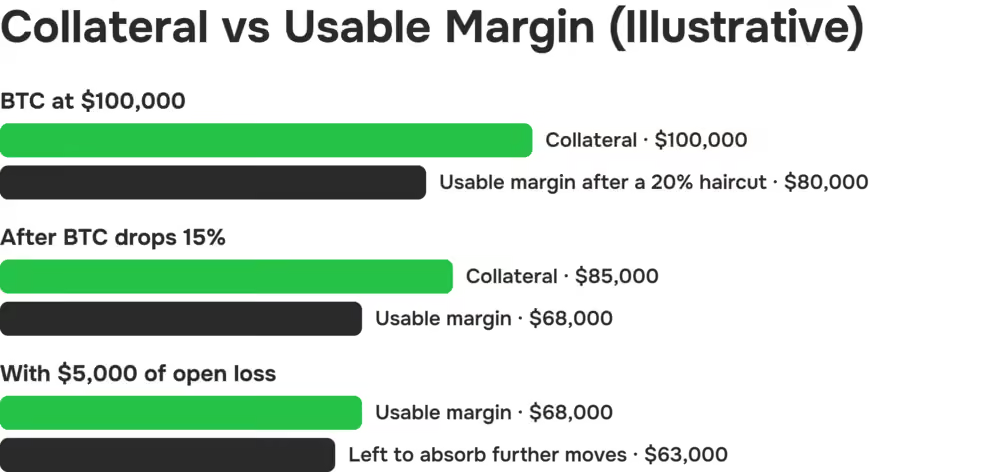
A hypothetical trader holds $100,000 in BTC. If the platform applies a 20% haircut to that collateral, $80,000 counts as usable margin. That $80,000 can then support forex, index, or CFD positions, while the underlying BTC remains in the account and continues to track the market.
Cross-Collateral vs. Cross-Margin: Why the Distinction Matters
People often use the two terms interchangeably, but they answer different questions. Cross-collateral names the asset that backs the margin. Cross-margin sets how far that margin stretches: one pool covering every position in the account. Isolated margin sits at the other end of the same scale, ring-fencing collateral to a single position. Margin call thresholds and portfolio-wide liquidation behavior differ between cross-margin and isolated margin, regardless of the asset backing them.
How Collateral Haircuts Reduce Your Effective Margin
Volatile collateral is discounted before it counts toward margin: the 20% haircut above is that discount. Because it forces overcollateralization, the protection goes to the broker rather than the trader. Because it applies to a moving price, the margin balance falls with BTC itself, before the traded position has moved at all.
Two thresholds sit underneath: the initial margin needed to open the position, and the maintenance margin that keeps it open. Both are measured against collateral that reprices, so risk management here means watching two moving numbers rather than one.
The Hidden Cost of Selling Crypto to Fund a Trade
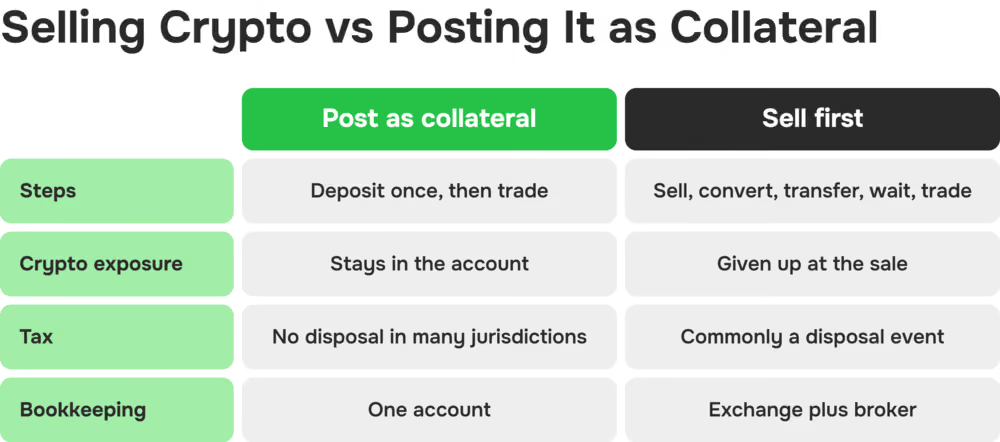
Funding a non-crypto trade often means liquidating crypto first. The friction starts before any market analysis does, and in many jurisdictions the tax event starts there too. Selling crypto is commonly treated as a disposal for tax purposes. The exact treatment depends on the jurisdiction, so it is worth confirming with a qualified tax professional before acting on anything in this article.
The Old Workflow: Sell, Convert, Fund, Trade
The conventional path runs in five steps: sell BTC, convert the proceeds into USD or another funding currency, transfer the funds to a separate broker, wait for settlement, then open a forex or CFD position. Selling into stablecoins such as USDT or USDC shortens the middle of that chain without removing it.
The cost sits in the transfer window, where a trader gives up crypto upside while funds move. The round trip also leaves bookkeeping spread across an exchange and a broker. Owning an asset is not the same as posting it as margin, which is exactly where spot and margin trading diverge.
The Cross-Collateral Workflow: Deposit, Trade, Retain Exposure
The cross-collateral path is shorter: deposit BTC or ETH once, post it as collateral, trade other markets, and keep the underlying crypto exposure throughout. Depositing crypto as collateral does not remove the risk of loss. If open positions move against you or the collateral asset reprices, available margin can fall without any sale.
Using BTC or ETH as Margin for Forex, Indices, and CFDs
Traders often already hold crypto but need quick access to FX, indices, and commodities without fragmenting capital across separate venues. Two things decide whether that works in practice: which markets the collateral can reach, and what happens to it when a position goes wrong.
Which Asset Classes You Can Access With Crypto Collateral
Digital assets posted as collateral can support access to forex, metals, indices, energies, commodities, crypto spot, and crypto perpetual futures within one account. The non-crypto classes each bring something a crypto-only book does not have:
Forex adds currency exposure.
Commodities and metals run on different macro drivers than crypto.
Indices give broad equity-market exposure without a separate equities account.
The structure buys fewer transfers between venues and fewer idle balances split across a crypto exchange and a CFD broker. It does not change how a leveraged position behaves once open. Those mechanics are the same as for any other crypto derivative.
What Happens to Your Collateral if a Position Moves Against You
If open losses grow or BTC drops in value, usable margin falls in two ways: through the position's drawdown and through the collateral's repricing.
The same $100,000 in BTC, worth $80,000 as usable margin after the haircut, supports a forex position. BTC then drops 15% while the forex position is down $5,000. The collateral is now worth roughly $68,000 after the haircut, and $5,000 of that margin is already absorbed by the losing position. This example is illustrative only and does not represent actual account terms.
Each factor alone would be manageable. Together they move the account toward a margin call faster than either suggests on its own.
Why Regulated Infrastructure Changes the Counterparty Risk Calculation
The next question is who holds the collateral, under what rules, and what happens if markets turn disorderly. That is where a regulated broker and a crypto venue differ in substance rather than in interface.
Margin offsets across instrument types are spreading in regulated markets too. Eurex is building them between repos and bond derivatives, inside a clearing framework that answers to a regulator.
How Client Asset Segregation Applies to Crypto Collateral
Segregation applies at the entity level: client assets sit under the requirements of the licensed entity that holds them, separate from company funds. Collateral held this way sits on the broker's books rather than on the blockchain: the regulatory wrapper comes at that price.
Which entity covers a given client is set out in B2PRIME's regulatory disclosures, a check that comes before any of the collateral mechanics. It also decides the protections attached to the account, including whether negative balance protection applies.
Why Multi-Jurisdictional Licensing Matters When Your Collateral Is Volatile
B2PRIME operates under licenses from CySEC in Cyprus, DFSA in Dubai, FSCA in South Africa, FSC in Mauritius, FSA in Seychelles, and SCB in the Bahamas. Each license sets its own onboarding requirements and disclosures. When collateral can reprice overnight, the entity's rules on client asset treatment and margin decide what happens next.
Bitcoin as Loan Collateral Versus Trading Margin
Bitcoin can back a loan, whether through a lender or through DeFi protocols where smart contracts hold the collateral. That is a different transaction from posting it as trading margin. When the goal is market access rather than borrowing cash, BTC as trading margin keeps the crypto exposure and opens forex, indices, or CFD positions without adding a lending platform as a second counterparty.
Cross-Collateral Margin Through a Regulated Multi-Asset Account Is Now a Retail Option
Splitting a crypto exchange account from a traditional brokerage account used to be the only way to hold both. One regulated multi-asset structure now does it. BTC or ETH provides the margin for forex, index, and CFD positions, while the crypto exposure stays where it is.
CFDs are complex instruments and come with a high risk of losing money rapidly due to leverage. You should consider whether you understand how CFDs work and whether you can afford to take the high risk of losing your money. Crypto CFDs carry additional risks due to the high volatility of the underlying assets.
This content is for informational and educational purposes only and does not constitute investment advice or a personal recommendation. It is not tax advice. Consult a qualified tax professional regarding the treatment of crypto transactions in your jurisdiction. B2PRIME (B2B Prime Services EU Ltd) is authorized and regulated by the Cyprus Securities and Exchange Commission (CySEC), license no. 370/18.
[[/a]]
[[aa-faq]]
FAQs about Cross-Collateral Crypto
What does cross-collateral mean in crypto trading?
Cross-collateral crypto refers to using BTC, ETH, or another approved asset as collateral for positions settled in a different currency. You keep the crypto exposure while the account recognizes part of that value for trading.
What is the difference between cross-collateral and cross-margin in crypto?
Cross-collateral describes what asset backs your margin, while cross-margin describes how margin is shared across positions inside the account. That distinction matters because cross-margin can expose the full balance, while cross-collateral introduces haircut and collateral-eligibility rules.
Can I use Bitcoin as collateral for a loan?
Yes, Bitcoin can be pledged as collateral in lending structures. If the goal is market access rather than borrowed cash, though, using BTC as trading margin may be more direct, as it avoids selling, converting, and funding a separate account.
What happens to my crypto collateral if a position moves against me?
When positions move against you, the platform revalues the collateral in real time and checks whether effective margin still covers requirements. If losses deepen or the collateral falls, liquidation may begin earlier than traders expect because volatile assets usually receive a haircut.
Why use a regulated unified account for cross-collateral crypto?
A regulated unified account may help reduce the fragmentation of holding crypto on one venue and funding CFDs on another. With B2PRIME's Unified Trading Account, approved crypto collateral can provide access to forex, indices, commodities, and crypto products from a single account. As regulators look more closely at crypto collateral and its links to traditional markets, it's worth checking the entity behind that account.
[[/a]]
Connect with Our Experts
Our team is equipped to provide solutions precisely to your requirements. Let's explore your options and discuss how we can support your objectives



.svg)