Oops! Something went wrong while submitting the form.
Notice: It looks like you are visiting us from United Arab Emirates or have selected it as your residency location.
For accurate information and services under the correct licensed entity, please visit the appropriate section of our website. For more information view Regulatory Information
For accurate information and services under the correct licensed entity, please visit the appropriate section of our website. For more information view Regulatory Information
For educational purposes only, not investment advice.
Opening range breakouts fail most often at two points: the anchor the range is measured from, and the confirmation required before entry. This guide rebuilds both for forex and crypto CFDs. You get a synthetic open measured from a session start, an ICT-style liquidity sweep as the confirmation trigger, the three ways a breakout fails, and risk rules to test on a demo before committing capital.
ORB is a day trading strategy that frames trades around the high and low of an early-session range, a shorter horizon than swing trading on higher timeframes. Forex, indices, and crypto trade continuously and have no opening auction to measure from, which is why the range here starts at a session anchor you choose. That is the one adjustment the original version, built on cash equities and futures contracts, never needs.
[[aa-key-takeaways]]
Key Takeaways
An ORB strategy uses the high and low of an opening range, or a synthetic open in FX and crypto, to frame breakouts.
The ORB timeframe, often 5, 15, or 30 minutes, changes how much noise you absorb before a breakout becomes actionable.
Using the Asian session range as the opening range may help FX and crypto traders interpret London or New York breakouts.
A liquidity sweep at the range boundary can confirm a genuine ORB breakout, or warn that the move is just a stop hunt.
A workable ORB plan defines entry style, stop placement, profit targets, and when sitting out protects you from weak setups.
[[/a]]
[[aa-cta]]
Test an ORB Framework on a Demo First
Try session-based ORB across forex, indices, and crypto CFDs on B2PRIME's platforms, with no capital at risk.
An opening range is the high and low that form during a fixed window after a session anchor; a breakout is when price leaves that range and seeks follow-through. Written compactly, the range is [L_OR, H_OR] measured over the window [t0, t1], and a breakout is the first move beyond either boundary, optionally filtered by a small volatility-scaled buffer to reduce noise on liquid instruments.
ORB differs from generic breakout trading because of time anchoring, session microstructure, and concentrated opening order flow. Its technical analysis rests on the range itself, so it leaves out technical indicators such as moving averages. Our broader breakout trading strategy guide covers the foundations, so this article stays on FX and crypto CFD execution.
How the Opening Range Is Defined
The range is the high and low across a fixed window after a session anchor, commonly 5, 15, or 30 minutes. Forex and crypto trade continuously, with no opening auction to anchor to. The range starts from a synthetic open instead, meaning a session start the trader chooses in advance.
What Counts as a Breakout
Define it precisely rather than saying "price moved higher." A breakout is the first close beyond H_OR or L_OR, or the first print beyond the boundary plus a volatility-scaled buffer. State the confirmation you require: a 5-minute candle close, a held retest, or a sweep-and-reverse rejection so that the rule can be backtested.
Why the Open Concentrates Order Flow
A session open resolves overnight information, pending orders, and liquidity imbalances at once, which is why breakout candles there often carry unusually strong intent. Opening activity tends to be above average, though in forex centralized volume reporting is incomplete, which limits how much weight a tool like VWAP can carry; momentum and candle spread are more reliable cues than a hard volume figure.
Choosing the Right Opening Range Timeframe
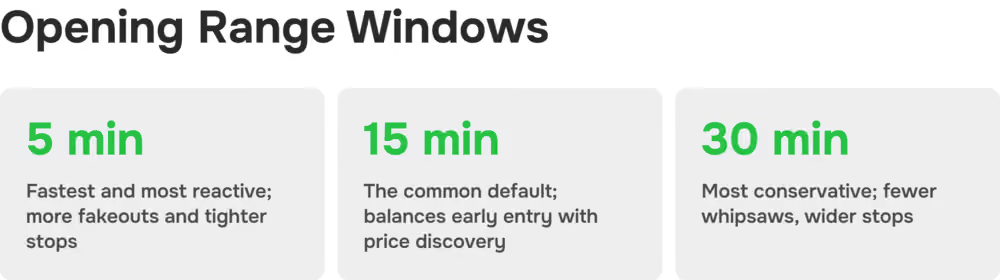
Shorter windows react faster; longer windows filter more noise but delay participation. The 5-, 15-, and 30-minute windows are not interchangeable across instruments, sessions, or execution styles. Practitioner content most often references 15 minutes for index futures and ETFs, but FX and crypto may call for different anchors.
5-Minute Window
The 5-minute ORB is the fastest, most reactive variant, with higher fakeout exposure, tighter stops, and a stronger dependence on spread quality. It suits liquid majors and index CFDs rather than illiquid symbols, because execution realism matters more than theory here.
15-Minute Window
The 15-minute ORB is the reference case most readers expect. It balances early participation against enough price discovery to reduce random noise, which is why it is a sensible default before testing whether another window fits a given instrument better.
30-Minute Window
The 30-minute ORB is the most conservative window. It can reduce whipsaws but widens stops and compresses the remaining intraday opportunity. A wider opening range can turn an acceptable setup into a poor risk/reward ratio, especially on already volatile crypto perpetuals.
ORB in Forex and Crypto: Using Synthetic Opens
Forex and crypto lack a single exchange open, which is why ORB in these markets relies on repeatable synthetic session anchors. A synthetic open is simply a defined session start used to frame the range. The London, New York, and Asian session ranges each behave differently, and liquidity drives those differences.
London Open as a Synthetic Range Anchor
The London open matters for majors like EUR/USD and GBP/USD because liquidity picks up sharply and cleaner early directional moves become more common. Define the range from the first minutes after London begins, then test whether breaks align with higher-timeframe market structure.
New York Open as a Synthetic Range Anchor
New York brings US data releases, cash-equity influence, and the London overlap, a mix that can create sharp breakout conditions in FX and indices. The overlap window in particular concentrates participation from both regions, which can produce cleaner continuation but also faster reversals when a US release lands.
Ranges built around New York may distort near scheduled macro releases, so it is worth checking the economic calendar before anchoring a range there; the pre-news section below covers how to handle those windows.
Asian Session Range as the Opening Range for FX and Crypto
Used as an ICT-style anchor, the Asian session range often becomes a liquidity pool. The highs and lows built during quieter Asian hours leave obvious levels that later sessions gravitate toward. A sweep above or below the Asian range during London or New York can therefore be liquidity hunting rather than true continuation. On BTC/USD, ETH/USD, or major FX pairs, this framework fits continuous markets better than forcing an equity-style open.
A practical routine is to mark the Asian range high and range low before London opens. Then watch what the first London move does with one of those sides: a sweep that rejects reads differently from a break that holds. That behavior gauges session sentiment, and it beats trading the very first push.
ICT Liquidity Sweep Logic Applied to ORB Confirmation
A liquidity sweep is a move that raids stops just outside the range, then either continues or rejects. Applied to ORB, it helps you judge whether a breakout is genuine acceptance or just a liquidity grab. Classic ORB enters on the break; liquidity-confirmed ORB waits to see how price behaves at the boundary. For the full sweep, killzone, and sweep-and-reverse framework, see our ICT trading strategies guide and our explainer on buy-side and sell-side liquidity.
What a Liquidity Sweep Looks Like at the Range Boundary
The sequence is precise: a boundary breach, a stop run, a fast rejection, and a close back inside or just beyond the range. The price action to watch is wick length, rejection speed, failed follow-through, and whether structure breaks after the sweep.
Using the Sweep-and-Reverse Pattern as an Entry Trigger
Step by step: price sweeps the boundary, rejects, shifts short-term structure, then triggers on the first pullback or confirmation close. The key distinction is acceptance versus rejection. If price sweeps the range high, fails to hold above it, and closes back inside, the break was likely a stop hunt and the higher-probability read is the reverse. If price sweeps and then keeps closing beyond the boundary, that is acceptance, and the original breakout direction stands.
Like any filter, this one trades coverage for quality. It may reduce fakeouts, but it also means fewer trades and later entries, and some genuine moves will run without a clean sweep to trigger on.
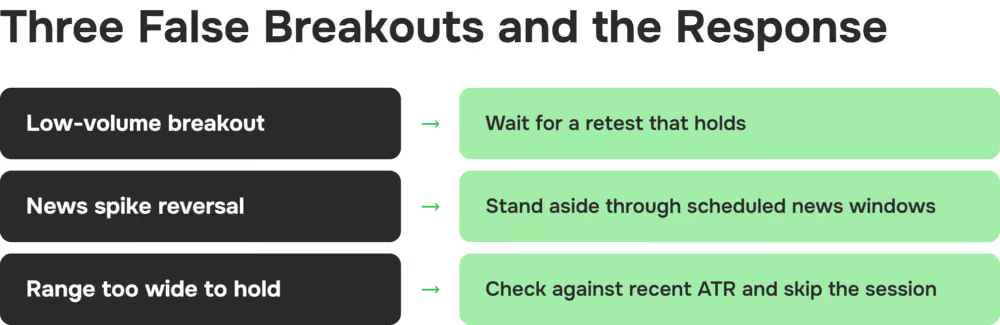
False Breakout Taxonomy: Three Failure Modes to Know
Not all fakeouts are identical. Each failure mode below gets its own response, not one generic filter.
Low-Volume Breakout With No Follow-Through
A marginal break that stalls quickly. In forex, where volume confirmation is unreliable, lean on momentum and candle spread rather than exchange-style volume certainty. Response: wait for a hold on a retest before committing.
News Spike Reversal
A macro release (such as NFP or CPI) can create a valid-looking breakout that reverses immediately as data reprices the market. Response: treat scheduled event windows as a separate regime where technical structure matters less, and stand aside through them.
Range Too Wide to Hold
An abnormally wide opening range often destroys reward-to-risk, because even when the break occurs, the stop distance makes the trade inefficient. Response: reject ranges far above the recent average and wait for the next session. An average true range comparison is a simple way to calibrate what counts as far.
Entry, Stop-Loss, and Profit Target Rules
Advanced readers want executable entry and exit parameters, plus risk management rules. The rules below are stated plainly. A short worked example uses neutral hypothetical numbers, not a recommendation.
If price closes beyond H_OR with a buffer and holds a retest, then consider a long with the stop below the range. If a sweep of L_OR rejects and structure shifts into an uptrend, then consider a long on the first pullback. The same structure mirrors for long and short trades, with the boundaries reversed.
Worked example (illustrative): a 20-pip opening range, entry on a confirmed break, stop 12 pips beyond the opposite boundary, risking a fixed percentage of the account, with a first target at 1R and a runner managed to structure.
Immediate Breakout Entry vs Retest Entry
Immediate entries capture momentum earlier; retest entries may reduce fakeouts but can miss fast moves. Practitioners often find retest entries improve reward-to-risk by tightening stops, sometimes at the cost of win rate, though neither outcome is universal.
Stop-Loss Placement and Volatility-Adjusted Sizing
Place stops in priority order: structural invalidation first, volatility second, then handle position sizing from account risk and stop distance. Leverage amplifies gains and losses equally, and a well-defined range does not make ORB safer.
Profit Target Methodology
Compare range-based targets with market-structure exits: a 50% range projection, a full 1:1 range-measured move, or a 2R objective all work as planning frameworks. Partial-taking or trailing rules help only if they are explicit, since vague target management is impossible to test.
When Not to Trade ORB
Skipping a weak setup counts as executing the strategy. Use these as fast pre-session filters.
Pre-News Windows and High-Impact Events
Typical disqualifiers: FOMC meetings, NFP, CPI, and central-bank decisions. Event risk can override technical range logic, so define a no-trade buffer before scheduled releases.
Low-Liquidity Sessions and Choppy Conditions
ORB's edge tends to degrade during holidays, lunch lulls, and thin overnight conditions, where poor follow-through follows lower participation and wider spreads. A quiet FX session, a thin crypto weekend, and a sleepy index-CFD period do not behave the same.
Ranges That Are Too Narrow or Too Wide Before the Open
Very narrow ranges can invite stop hunts; very wide ranges leave too little asymmetric opportunity after the break. The recent average range or ATR is a practical calibration tool for filtering both extremes.
Put Your ORB Strategy to Work With B2PRIME
The way to evaluate an evolved ORB framework is to test it without risking capital first. B2PRIME is a multi-regulated broker with neutral tier-1 execution and a unified cross-collateral account spanning forex, indices, commodities, Crypto Spot, and Crypto Perpetual Futures. The same session-based framework can be tested across markets on TradingView, cTrader, or B2TRADER.
Spread quality matters for short-window ORB, and RAW pricing starting at $2.50 per lot per side keeps costs transparent, though lower cost reduces the break-even threshold rather than making a setup profitable.
[[aa-cta]]
Build and Test Your ORB Rules
Neutral tier-1 execution, RAW pricing starting at $2.50 per lot per side, and TradingView, cTrader, and B2TRADER, on one account.
CFDs are complex instruments and come with a high risk of losing money rapidly due to leverage. You should consider whether you understand how CFDs work and whether you can afford to take the high risk of losing your money. Crypto CFDs carry additional risks due to the high volatility of the underlying assets.
This content is for informational and educational purposes only and does not constitute investment advice or a personal recommendation. B2PRIME (B2B Prime Services EU Ltd) is authorized and regulated by the Cyprus Securities and Exchange Commission (CySEC), license no. 370/18. General breakout mechanics are also summarised in Investopedia's overview of abreakout, and session liquidity context is set out in theBIS Triennial Survey.
[[/a]]
[[aa-faq]]
FAQs about ORB Trading Strategies
What is the best timeframe for an ORB strategy?
There is no single best timeframe. The 15-minute window is a common reference because it balances early participation with price discovery, while 5-minute is faster and more fakeout-prone. 30-minute is more conservative, with wider stops. The right choice depends on the instrument, session, and execution style, so it is worth testing on a demo.
Can ORB be used in forex and crypto, not just stocks?
ORB began in the stock market, where an opening auction sets the anchor. Forex and crypto trade continuously, so they need a synthetic open: a defined session anchor such as the London, New York, or Asian session standing in for the exchange auction. Anchoring the range to a session makes ORB workable on FX pairs and crypto CFDs.
How does a liquidity sweep confirm an ORB breakout?
A sweep is when price raids stops just beyond the range, and then either accepts or rejects. If it sweeps a boundary, rejects quickly, and shifts short-term structure, that can indicate the initial break was a stop hunt and the real move is the reverse. It is a confirmation filter, not a guarantee.
How do I avoid false breakouts with ORB?
Match the response to the failure mode: wait for a retest on low-volume stalls, stand aside during scheduled news windows, and reject opening ranges that are abnormally wide relative to the recent average. Requiring a close beyond the boundary filters many weak breaks that a wick alone would let through.
[[/a]]
Connect with Our Experts
Our team is equipped to provide solutions precisely to your requirements. Let's explore your options and discuss how we can support your objectives



.svg)