Oops! Something went wrong while submitting the form.
Notice: It looks like you are visiting us from United Arab Emirates or have selected it as your residency location.
For accurate information and services under the correct licensed entity, please visit the appropriate section of our website. For more information view Regulatory Information
For accurate information and services under the correct licensed entity, please visit the appropriate section of our website. For more information view Regulatory Information
For educational purposes only, not investment advice.
A EUR/USD order fills three-tenths of a pip above the price on screen. Was the difference caused by a moving market, limited liquidity, or the broker's order handling? The fill alone cannot answer that question. Its timestamp and the broker's execution policy provide a starting point.
Assessing institutional execution in retail trading means connecting those records to the route an order takes. This guide explains the regulatory standards behind that assessment, then examines routing and last look before applying an evidence checklist to B2PRIME's RAW account.
[[aa-key-takeaways]]
Key Takeaways
Institutional-grade execution describes order handling. Banks and individuals can use different execution models regardless of their participant category.
EU and UK best-execution rules consider several factors, with total consideration central for retail clients. FINRA's securities framework has its own scope.
An ECN or STP label needs supporting execution disclosures, including the counterparty's role and any last-look review.
A useful broker comparison combines realized costs with fill and rejection data collected under comparable conditions.
Execution infrastructure cannot remove market risk. Leveraged CFD trading can amplify both gains and losses.
[[/a]]
Institutional Execution vs. Retail Trading: Why the Old Divide Has Narrowed
Institutional traders act for organizations such as banks, hedge funds and asset managers, often handling large orders or pooled capital. Retail traders generally invest their own money through personal accounts. Order size influences access and bargaining power, but it does not determine every feature of the execution infrastructure available.
Electronic aggregation lets a retail-facing broker combine liquidity from several providers. An individual client may therefore receive aggregated from several liquidity providers without establishing a direct banking relationship. Access still depends on the broker's arrangements, available instruments and the terms of the account.
Who Trades vs. How Trades Execute
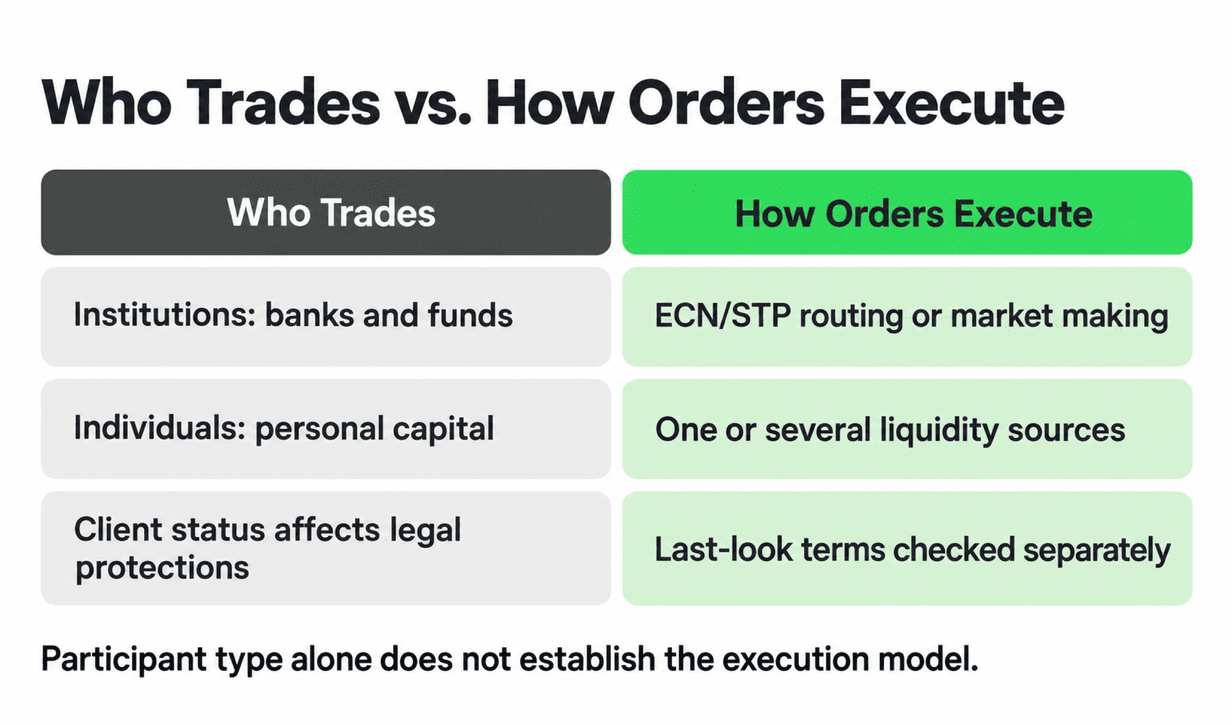
Participant identity answers whose capital is being traded. Execution describes who quotes a price, who accepts the trade and how the broker handles the request. Legal client classification is a separate question again, with consequences for the protections owed to the client.
A financial institution may trade with a market maker. An individual may use a broker that routes orders externally. Retail classification alone does not prohibit access to aggregated prices or professional execution tools, although it does not create an entitlement to them.
What Best Execution Means Under MiFID II, FCA and FINRA Rules
Best execution is an obligation supported by documented policies and monitoring. A fast fill or a narrow spread is only part of the evidence. The applicable rules depend on the firm, instrument and client category.
European Union: MiFID II Article 27 requires investment firms to take all sufficient steps to obtain the best possible result. Relevant factors include price and costs alongside speed, execution and settlement likelihood, size and order characteristics.
United Kingdom: COBS 11.2A sets out the FCA's MiFID best-execution provisions. For retail orders, the overall price and execution-related charges are central to total consideration.
United States: FINRA Rule 5310 requires member firms to apply reasonable diligence when finding the market for a customer's security. Its factors include market conditions, transaction size and type, markets checked, quotation access and order terms.
These frameworks have different legal reach. A broker's license in one jurisdiction does not make another jurisdiction's rules apply to the account. Under the FCA's client-categorization framework in COBS 3, retail or professional status also affects conduct protections.
Comparing Price, Cost and the Completed Fill
For a retail order under the EU or UK provisions, total consideration combines the instrument price with execution-related costs. Speed and fill likelihood remain relevant, particularly when a price is unavailable for the required size. A quoted spread cannot establish that overall result.
Consider an illustrative one-standard-lot EUR/USD buy, with a USD account and a displayed ask of 1.10000. A fill at 1.10004 is 0.4 pip worse. At $10 per pip for that position, entry slippage costs $4.
Adding an illustrative $2.50 entry commission brings the difference from the displayed ask to $6.50. Exit commission and financing are excluded. Because the benchmark is already the ask, adding the full bid-ask spread again would double count part of the cost.
Execution Mechanics Behind the Fill
A broker's route determines which prices an order can reach and which counterparty decides whether to accept it. The available volume at those prices limits how much can be filled. Rejection rules determine what happens when a quoted price cannot be honored.
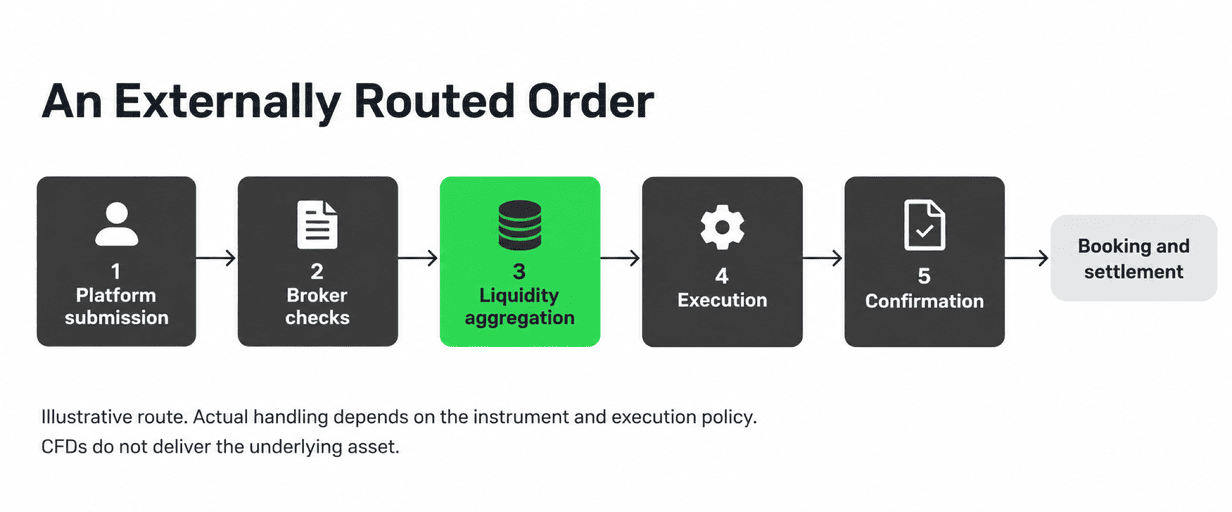
For an externally routed order, the path may run from platform submission through broker checks to liquidity aggregation, execution and confirmation. A liquidity bridge connects the platform to those external providers. Subsequent booking and settlement depend on the instrument, with CFDs settled under their contract terms without delivery of the underlying asset.
ECN and STP Labels vs. Counterparty Evidence
The ECN and STP models describe different forms of electronic order handling, whereas a market maker may act as principal and fill an order internally. Whatever route applies, the counterparty incentives require management and disclosure.
An evaluation therefore starts with the execution policy. It should identify the firm's counterparty role and explain its choice of execution venues or providers. Rejection terms need a separate check because an electronic routing label alone does not establish a no-last-look policy.
Payment for Order Flow and Direct Market Access
Payment for order flow involves compensation connected to directing customer orders to an execution destination. That compensation can create an incentive to favor a route for reasons beyond the client's execution result.
Direct market access describes how an order reaches a venue. It does not, by itself, establish the absence of fees or conflicts. Whether an order-flow payment is permitted depends on the jurisdiction and instrument, so the relevant disclosures must be assessed for the specific account.
Last-Look Pricing and Its Possible Costs
A liquidity provider using last look has a final window to accept or reject a trade request against its quote. The FX Global Code calls for disclosure of that window and its purpose. The Code is voluntary guidance for wholesale FX, supplementing applicable regulation.
In a hypothetical EUR/USD example, a buy request at 1.10000 is rejected. The trader then accepts a fresh quote at 1.10003. The completed trade is 0.3 pip worse than the initial request, but that difference is not a universal last-look charge.
Rejection can expose a trader to further price movement while seeking another fill. That movement may be favorable or adverse. Slippage measures a price difference against a chosen benchmark, while implementation shortfall can also capture fees and the opportunity cost of unfilled orders.
Prime-of-Prime Aggregation and Order-Book Depth
A prime-of-prime provider gives brokers access to liquidity from multiple sources. Aggregation combines their quotes and available sizes. Connections to tier-1 liquidity providers, where applicable,can broaden the pool of prices a broker can use, subject to its credit and execution arrangements.
The best displayed price may cover only part of an order. Any remaining size may fill at later price levels, changing the average achieved price. Displayed market depth is therefore useful evidence, although available liquidity can change before execution.
[[aa-cta]]
Review RAW Account Execution Terms
B2PRIME's RAW account details provide a basis for comparing platform access and disclosed commission costs.
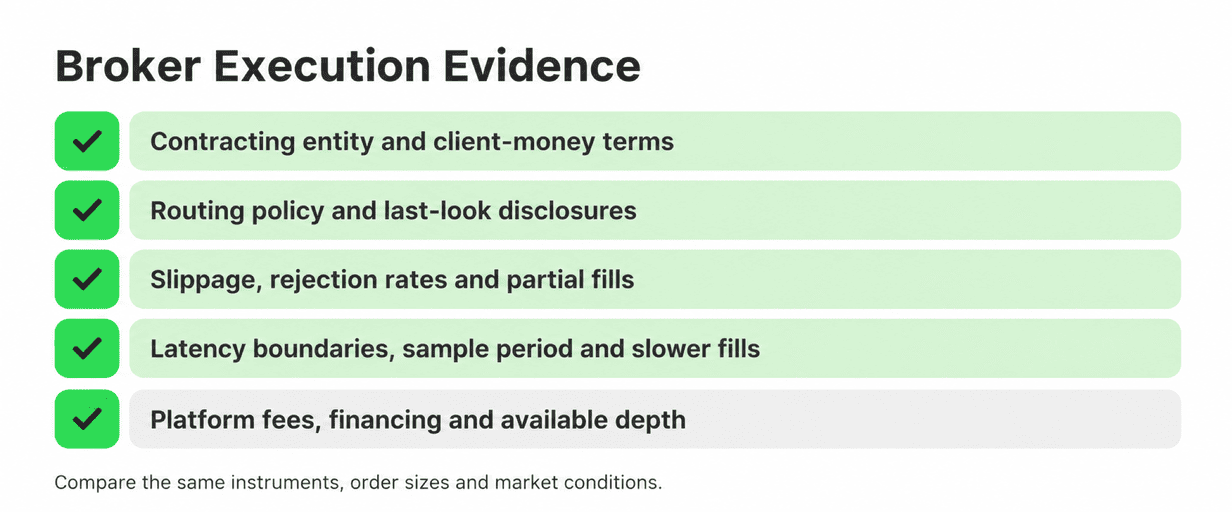
A broker comparison becomes more useful when every claim has a corresponding document or trade record. The same comparison period and order sizes should be used wherever possible.
Account and funds: contracting entity, license, client-money arrangements and complaints procedure.
Routing: execution policy, counterparty role, available venues and last-look terms.
Outcomes: positive and negative slippage, rejection rates and partial fills.
Speed: measurement boundaries, sample period, typical latency and slower results.
Costs and depth: platform-specific fees, financing charges and volume available at relevant prices.
A batch of completed trades can reveal patterns that an average hides. For example, a similar average fill price can accompany very different rejection rates. Unfilled orders belong in the assessment because their cost disappears from a dataset containing only successful fills.
Regulatory Coverage and Client Funds
B2PRIME's regulated entities include the CySEC-regulated B2B Prime Services EU Ltd in Cyprus, and separately regulated entities under the DFSA in Dubai and FSCA in South Africa. The group also includes entities regulated by the FSC in Mauritius, FSA in Seychelles and SCB in the Bahamas.
The contracting entity determines the applicable rules. Client eligibility and protections differ, including any compensation arrangements. A group-wide list of licenses does not establish the protections for a particular account.
Client-money segregation means holding client funds separately from the firm's own funds. The applicable client agreement and entity disclosures establish the actual arrangements and their limitations. Segregation does not remove every bank or counterparty risk.
Transparent Costs and Verifiable Speed
A cost review includes spread and commissions, plus financing where applicable. Slippage and the effect of rejected orders need an explicit benchmark. Market impact describes the price movement caused by executing size, so it may already be reflected in measured slippage.
These components should not be added mechanically when they overlap. A consistent transaction-cost analysis states the benchmark first, then counts each charge or price effect once.
A latency figure also needs defined start and end points. Platform-to-broker transmission, server processing and completed execution measure different intervals. A stated sample period and the distribution of slower fills make an average more useful for comparison.
How B2PRIME Brings Institutional Infrastructure to the RAW Account
B2PRIME's retail launch has allowed the Company to extended its already developed infrastructure for B2B liquidity clients to individually funded accounts. RAW account access combines commission-based pricing with a choice of two options, cTrader and B2TRADER. The published account structure has no minimum deposit, although opening and trading remain subject to eligibility and account requirements.
Those features can be checked against the same evidence framework used for another broker. Leveraged CFD trading still carries a high risk of loss as well as the potential for gains. Lower charges cannot make a trading strategy profitable on their own.
RAW Pricing and an Illustrative Commission Comparison
As checked on October 23, 2026, B2PRIME's published RAW FX/CFD commission is $2.50 per lot per side on B2TRADER and TradingView, and $2.90 on cTrader. For one standard EUR/USD lot, those rates imply round-trip commissions of $5.00 and $5.80 respectively. These figures exclude spreads and financing; product availability and applicable terms depend on the servicing entity.
Using an illustrative comparison rate of $3.50 per side gives a $7.00 round-trip commission. Against the $5.00 B2TRADER/TradingView example, the difference is $2.00 per one-lot round trip. This is a selected comparison rate, not a verified market-wide standard.
At 100 such round trips each month, the hypothetical commission-only difference is $200 monthly. Holding that volume and both rates constant for 12 months gives $2,400. Spreads and financing are excluded, so the calculation does not establish an overall cost advantage. Current platform, instrument and entity terms require verification.
CFDs are complex instruments carrying a high risk of rapid losses through leverage. The commission difference changes costs, while both potential gains and losses remain subject to market movements.
Familiar Platforms With Distinct Account Terms
The RAW account supports cTrader and B2TRADER with TradingView integration. TradingView connects to B2TRADER for chart-based execution. Choosing an interface also means checking the fees and instruments available through that route.
Platform availability does not establish identical functionality across every account. Depth-of-market displays and API permissions require confirmation for the platform and account concerned. Neither an interface nor an account label substitutes for the execution policy.
Evaluating a RAW Account Through Verifiable Results
The useful comparison connects the contracting entity to the account's costs, then compares those costs with completed and rejected orders. Routing disclosures explain how the broker handles the requests behind those results.
B2PRIME's RAW account provides published platform and pricing terms for that assessment. Reviewing them alongside the applicable execution policy gives a basis for comparison. Execution infrastructure cannot remove market risk or ensure favorable outcomes.
[[aa-cta]]
Assess B2PRIME's RAW Account
Review the available platforms and commission structure alongside the terms of the entity that holds the account.
CFDs are complex instruments and come with a high risk of losing money rapidly due to leverage. You should consider whether you understand how CFDs work and whether you can afford to take the high risk of losing your money.
This content is for informational and educational purposes only and does not constitute investment advice or a personal recommendation. B2PRIME (B2B Prime Services EU Ltd) is authorized and regulated by the Cyprus Securities and Exchange Commission (CySEC), license no. 370/18.
[[/a]]
[[aa-faq]]
FAQs about Institutional Execution in Retail Trading
What is the difference between institutional trading and institutional-grade execution?
Institutional trading describes activity by organizations such as banks or asset managers. Institutional-grade execution describes the infrastructure and handling of orders. An individual may access some of that infrastructure through a broker, subject to the account's terms.
How does institutional execution differ from standard retail broker execution?
Differences may appear in liquidity access, routing transparency and rejection practices, regardless of the client's participant category. Because that category cannot establish how an order was handled, the broker's policy and observed fills provide the evidence for comparison.
What does best execution mean for retail traders?
The applicable rules require a firm to seek the prescribed overall execution result, taking relevant factors into account. In the EU and UK retail frameworks, price plus execution-related costs is central. The precise obligation depends on jurisdiction and account classification.
How does last look affect execution quality?
A liquidity provider may accept or reject a request during its disclosed review window. After rejection, obtaining another fill can expose the trader to a changed price. Removing last look removes that review step, although slippage remains possible.
What should active traders check before choosing a RAW account?
The contracting entity, routing policy and realized execution costs are central checks. B2PRIME's published RAW rates start from $2.50 per lot per side on B2TRADER/TradingView, compared with $2.90 on cTrader as checked on October 23, 2026. Lower costs do not ensure profitable outcomes, and leveraged CFD trading can amplify both gains and losses.
[[/a]]
Connect with Our Experts
Our team is equipped to provide solutions precisely to your requirements. Let's explore your options and discuss how we can support your objectives