Oops! Something went wrong while submitting the form.
Notice: It looks like you are visiting us from United Arab Emirates or have selected it as your residency location.
For accurate information and services under the correct licensed entity, please visit the appropriate section of our website. For more information view Regulatory Information
For accurate information and services under the correct licensed entity, please visit the appropriate section of our website. For more information view Regulatory Information
For educational purposes only, not investment advice.
Shares and contracts for difference can both give you exposure to the same company, on completely different terms. Whether CFDs belong in your approach depends on how long you hold, how much capital you want tied up, and whether you need to go short. Share trading and CFD trading solve different problems, and many active traders run both.
The comparison below runs on what you own, what your margin buys, and what a position costs by the time you close it. It ends with the conditions that favor each instrument, so you can match them to your own trading.
[[aa-key-takeaways]]
Key Takeaways
Share trading gives you ownership rights; a CFD gives you price exposure without owning the underlying asset.
CFDs can improve capital efficiency through margin, but leverage also amplifies losses and can make position risk harder to manage.
If short selling is part of your strategy, CFDs usually offer a more direct way to trade falling markets than selling physical shares.
Total cost runs well beyond commission: CFD overnight financing accrues over time, while physical shares can carry different dealing and tax costs.
The broker matters more with CFDs, because you face OTC counterparty exposure, while share trading settles through an exchange clearing layer.
[[/a]]
[[aa-cta]]
One Account, Multi-Asset CFDs
Trade CFDs on forex, indices, commodities, and crypto from B2PRIME's unified cross-collateral account, on institutional infrastructure.
The Wrong Question Most Traders Ask About CFDs and Shares
The binary "CFDs or shares?" framing suits beginners, but professionals usually decide by use case. The relevant variables are mandate alignment, turnover, short-term tactical needs, collateral efficiency, and governance requirements. A long-term holder building a dividend portfolio from shares and ETFs and an active trader hedging event risk are not answering the same question, and neither needs a universal verdict.
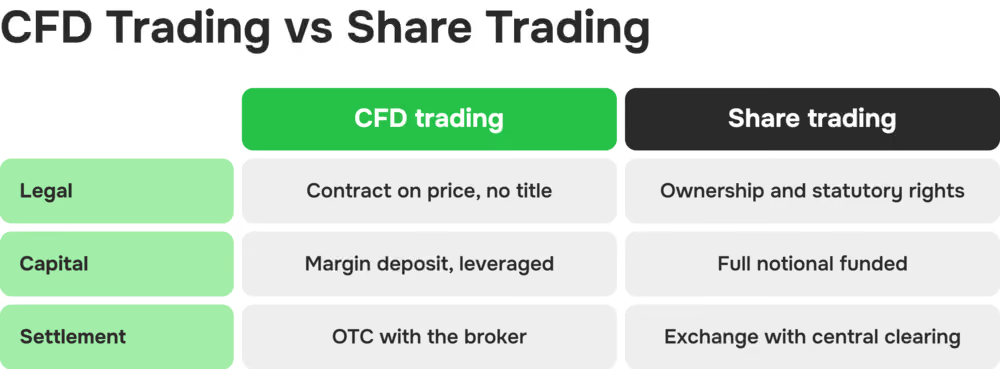
Defined simply: shares transfer ownership, while a CFD is a contract that tracks share price changes without transferring title, which makes it a way of speculating on price movements without holding an asset. That single structural difference cascades into rights, costs, and risk.
Share Trading: Legal Ownership With Statutory Rights
Buying shares makes you a part-owner of the company, with statutory rights: voting, a residual claim on assets, dividend entitlement, and participation in corporate actions. Trades execute on a stock exchange and settle through central infrastructure (commonly T+1), and the position is fully funded, with no leverage involved.
CFD Trading: Contractual Price Exposure Without Ownership
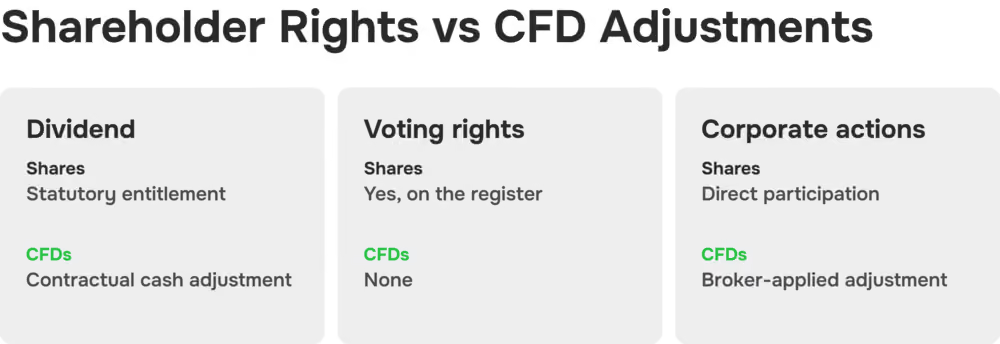
A CFD holder owns nothing of the underlying, receives no voting rights, and gets a contractual cash adjustment around dividends rather than a statutory entitlement. At the evaluation stage, this matters because, with an over-the-counter product, the broker's terms, regulation, and execution quality shape the trading experience more than exchange mechanics do.
Leverage, Margin, and Capital Efficiency Compared
Capital efficiency is the main draw of CFDs for active traders, and it comes with amplified losses and margin-call risk in equal measure. Share trading funds the full notional value of a position; a CFD requires only a margin deposit, freeing capital but magnifying the effect of price moves.
How Leverage Works in CFD Positions
Consider a share CFD with a $10,000 notional value. At 20% margin, the required deposit is $2,000. A 5% adverse move is a $500 change on the full notional, which is 25% of that $2,000 margin, not 5% of it.
Leverage scales gains and losses against the full notional, while the deposit only sets how large a position a trader can open. Depending on jurisdiction and product terms, losses can exceed the initial margin. Position sizing should be based on notional exposure and a predefined invalidation level, the point where stop-loss orders are usually placed, never on the margin figure alone.
Retail Leverage Caps Under ESMA and the Professional Client Pathway
Under ESMA product-intervention measures, retail CFD leverage in the EU is capped by asset class. Major currency pairs sit at 30:1, and indices, commodities, and crypto are capped lower. The UK applies comparable caps under the FCA.
Experienced traders may qualify for professional client classification, which can remove some retail caps. Typical criteria involve portfolio size, trading frequency, and relevant experience. Professional status also means fewer regulatory protections, including negative balance protection, so it is a trade-off to weigh rather than a status to assume. This guide describes that trade-off without advising on suitability.
Going Short: Why CFDs Give Active Traders a Structural Edge
A standard share purchase is naturally long-biased, since profit generally requires price to rise. Expressing a downside view instead means borrowing stock to short, which is operationally heavier and not always available. A CFD lets a trader open short exposure directly through the broker with the same ease as going long, which matters for hedging, managing event risk, or expressing a tactical view without borrowing stock.
For example, a trader might hold a physical equity book for the long term and short an index CFD against it ahead of an uncertain macro event, reducing net exposure without selling the underlying holdings and triggering a taxable event. Once the event passes, the trader closes the hedge, and the core position remains intact.
Shorting widens the range of views a trader can act on. Whether a given market is worth shorting is a separate question, and a short position carries the same risk of loss as a long one.
Cost Structures Side by Side: What You Actually Pay
Holding period and turnover drive cost far more than the individual fee categories, which is why a useful comparison models total cost across the whole hold. The table below uses one illustrative example with stated assumptions so you can challenge the maths.
CFD Costs: Spreads, Overnight Financing, and Commissions
CFD cost has three parts: the spread, a commission, and overnight financing charged daily to carry a leveraged position. The spread is paid on entry and exit; the commission is a fixed per-lot charge; and financing accrues every night the position is open, which is why CFDs usually become less efficient the longer a position is held.
On pricing, the B2PRIME RAW account is $2.50 per lot per side, against an industry average of around $3.50, though lower commission reduces the break-even threshold rather than making a strategy profitable. Because financing dominates the cost of a long hold, the commission difference matters most to high-turnover traders who open and close many positions.
Share Trading Costs: Brokerage Commissions and Settlement
Share dealing typically carries a brokerage commission and, in some jurisdictions, stamp duty or exchange fees, but no overnight financing on a fully paid position. Settlement and custody rarely change the comparison materially, and tax treatment varies by jurisdiction, so it is worth checking locally.
Cost Modelling Example: 1 Day, 1 Week, 1 Month
Assumptions (illustrative): a $10,000 position; CFD commission $2.50 per side ($5 round trip) plus daily financing of ~$1.20; physical shares at $5 commission per side ($10 round trip), no financing.
The figures are illustrative, and the pattern they trace holds beyond this example. CFDs come out cheaper for short holds and progressively less efficient as financing accrues, while fully funded shares carry no financing and instead tie up the full notional. Actual pricing varies by market, liquidity, and account terms, which is why many traders rerun the maths on a demo account against live conditions before committing capital.
[[aa-cta]]
Model Your Costs on Transparent RAW Pricing
RAW commission starts at $2.50 per lot per side, zero minimum deposit, and every condition published in full.
Dividends, Corporate Actions, and Governance Rights
The difference here is rights versus economic adjustments. Shares may make statutory dividend payments and carry voting and corporate-action participation; CFDs usually apply a contractual cash adjustment around the ex-dividend date instead.
Beyond income, this connects to shareholder registers, tax treatment, and how corporate actions are processed.
Counterparty Risk and Settlement: The Structural Difference Broker Selection Determines
This is where the two structures diverge most, and where broker choice becomes the primary control. Both structures carry risk; what differs is where that risk sits.
How Central Counterparty Clearing Protects Share Traders
Exchange-traded shares settle through a central counterparty (CCP), which steps between buyer and seller to guarantee settlement. In US equities, the NSCC performs this role. This clearing layer mutualizes and manages settlement risk, so an individual trader is not directly exposed to a single counterparty's failure. Investopedia's overview of the central counterparty clearing house explains how it works.
Why OTC CFD Exposure Makes Broker Regulation the Primary Risk Variable
CFDs are over-the-counter, with no CCP in the middle, so the broker is the direct counterparty to every position. That makes licensing, client-fund segregation, and operational resilience the primary risk variables, because the trader's exposure runs to the firm on the other side of the contract, with no mutualized clearing layer in between. This is why two brokers quoting the same instrument can represent very different counterparty risk depending on how they are regulated and capitalized.
B2PRIME holds six licenses across separate jurisdictions, from CySEC in Cyprus to the DFSA, FSCA, FSC, FSA, and SCB, and keeps client assets segregated. Which entity a trader deals with depends on residence, and onboarding assigns it. In CFD trading, regulatory standing belongs in the risk-governance column of a broker comparison.
Market Hours, Asset Universe, and Multi-Asset Access
CFDs can extend tradable hours and broaden the asset universe across financial markets, while shares remain tied to exchange listings and sessions. The practical contrast is equities versus multi-asset CFDs across FX, indices, commodities, and crypto, which matters to a trader running several strategies from one account. Extended-hours availability depends on the instrument and broker, and conditions aren't identical around the clock, so liquidity shouldn't be assumed to be uniform.
CFD vs Share Trading: A Decision Framework for Professional Traders
No single verdict settles this for a sophisticated trader. The useful tool is a framework: map your own mandate against holding period, leverage need, short exposure, governance rights, and risk tolerance for counterparty exposure.
When CFDs Are the Stronger Instrument Choice
Conditions that tend to favor CFDs: short holding periods, a need to go short, leverage efficiency, and cross-asset access from one account. Platform workflow is a practical edge here too, since B2PRIME supports TradingView (as an official Platinum Partner), cTrader, and B2TRADER for multi-asset CFD execution, with full API access for automated strategies.
Traders who have decided CFDs fit their mandate can then structure execution with our guide to CFD trading strategies. The common thread is that CFDs reward traders who value flexibility and capital efficiency over ownership, and who are prepared to manage financing and counterparty considerations as part of the trade.
When Physical Shares Are the Stronger Instrument Choice
Conditions that tend to favor shares: a long-term investment horizon, dividend priority, governance rights, and lower dependence on broker financing terms. Investors prioritizing these usually value the ownership structure over capital efficiency.
When Sophisticated Traders Use Both
The two combine naturally, with physical shares carrying the long-term book while CFDs handle hedging, event risk, or temporary sector rotation. When several active strategies run at once, a unified cross-collateral account can reduce operational fragmentation by keeping exposures in one place.
Start Trading CFDs With Institutional Infrastructure and No Minimum Deposit
For traders who have concluded CFDs fit their approach, B2PRIME pairs institutional pricing, multi-licensed regulation, and no minimum deposit, which lowers the friction of evaluating the instrument. Its neutral tier-1 execution and unified cross-collateral account are built for active, multi-asset trading across liquid markets.
[[aa-disclaimer]]
CFDs are complex instruments and come with a high risk of losing money rapidly due to leverage. You should consider whether you understand how CFDs work and whether you can afford to take the high risk of losing your money. Crypto CFDs carry additional risks due to the high volatility of the underlying assets.
This content is for informational and educational purposes only and does not constitute investment advice or a personal recommendation. B2PRIME (B2B Prime Services EU Ltd) is authorized and regulated by the Cyprus Securities and Exchange Commission (CySEC), license no. 370/18.
[[/a]]
[[aa-faq]]
FAQs about CFD vs Share Trading
Is it better to trade stocks or CFDs?
Neither is inherently better, because they solve different problems. Shares suit long-duration ownership, dividends, and governance rights, while CFDs suit tactical exposure, short selling, and lower upfront capital use. Many sophisticated traders use both, with shares for portfolio construction and CFDs for hedging or shorter-term execution.
Can you switch between CFD and share trading with the same broker?
Sometimes, but broker coverage and account structure determine that flexibility. Many firms separate cash equities from CFD access, while others prioritize derivatives and broader multi-asset execution. B2PRIME focuses on liquid CFD markets and institutional infrastructure rather than a large single-stock catalog.
Are CFDs available to traders in all jurisdictions?
No. CFD availability is jurisdiction-specific and varies by client classification and local regulation; some markets restrict or prohibit retail CFD trading. Onboarding should follow the correct licensed entity for your residence, which B2PRIME aligns with during account opening.
What does the professional client classification unlock for CFD traders?
In many regimes, professional classification can unlock higher leverage thresholds than retail status. That may improve capital efficiency, but it also increases loss speed and margin sensitivity and reduces regulatory protections. Experienced traders should weigh fewer protections against more flexible margin before applying.
How do overnight financing charges affect CFD holding costs?
Overnight financing is the daily cost of carrying leveraged CFD exposure past the broker's cut-off. For short holds, it can be manageable. Still, over weeks or months, it can materially reshape trade economics, which is why it should be assessed alongside commissions when comparing CFDs with shares.
[[/a]]
Connect with Our Experts
Our team is equipped to provide solutions precisely to your requirements. Let's explore your options and discuss how we can support your objectives



.svg)