Oops! Something went wrong while submitting the form.
Notice: It looks like you are visiting us from United Arab Emirates or have selected it as your residency location.
For accurate information and services under the correct licensed entity, please visit the appropriate section of our website. For more information view Regulatory Information
For accurate information and services under the correct licensed entity, please visit the appropriate section of our website. For more information view Regulatory Information
For educational purposes only, not investment advice.
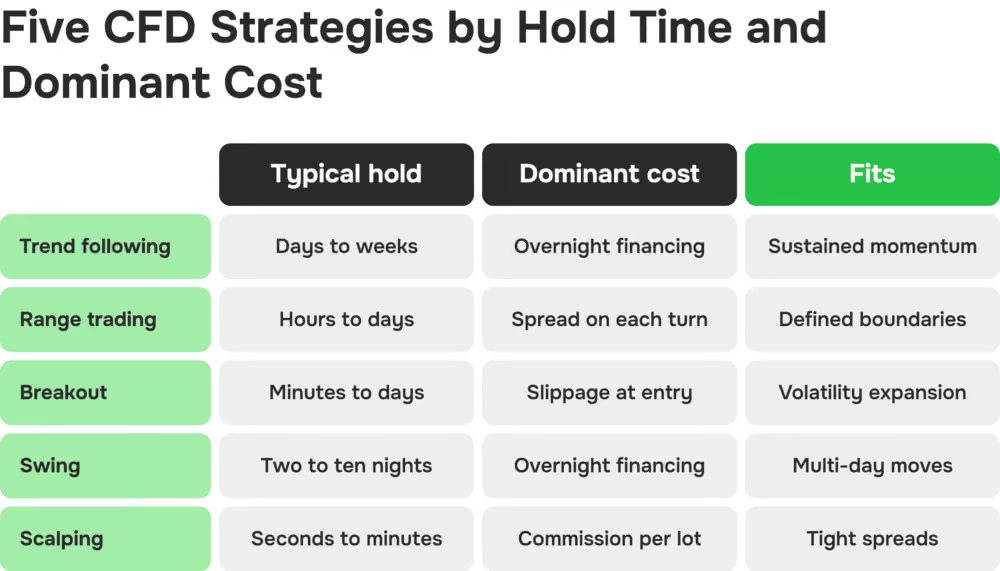
Two numbers rank CFD strategies against each other: how much of the expected return goes to costs, and how many nights the position stays open. Cost sensitivity and hold time are the shorthand for those two.
Both numbers come from the instrument. Contracts for difference give leveraged exposure to price moves without ownership of the underlying asset. Because the deposit behind a position is small, costs weigh more against it, and every night held adds a financing charge.
[[aa-key-takeaways]]
Key Takeaways
Leverage and overnight financing change three things in every CFD strategy: how large the position can be, where the stop sits, and how long the trade can stay open.
No single CFD strategy suits all market conditions. Trend following, for example, may fit sustained momentum, while range trading can align better with low-volatility, oscillating price action.
For active scalpers, commission per lot is the primary cost variable. B2PRIME's RAW account charges from $2.50 per lot per side against an industry standard closer to $3.50, a $2.00 difference on every round trip (indicative).
Swing trading crypto CFDs typically costs more in overnight financing than forex or index CFDs, a gap that can compress net returns on multi-day leveraged positions.
A cross-collateral account lets one margin balance support forex, commodities, and crypto positions, instead of a separate cash buffer sitting in each.
[[/a]]
[[aa-cta]]
Trade Every Strategy From One Account
Run trend, range, breakout, swing, and scalping setups across forex, commodities, and crypto from a single cross-collateral balance.
A strategy that works in equities or futures doesn't carry over unchanged to derivative products like CFDs. Sizing built for a fully funded position is too large on margin; a hold period built for zero financing gets expensive once the charge accrues every night.
How Leverage Reshapes Every Strategic Decision
Leverage amplifies gains and losses alike. It is therefore the first variable to fix before sizing any CFD position. Where a $1,000 margin deposit controls $100,000 of notional value, the full size of the position, at 1:100, a 1% adverse move costs the whole deposit.
This is an illustrative example, not a trading recommendation; leverage magnifies losses as much as gains, and trading CFDs carries a high risk of losing money rapidly.
Overnight Financing and Its Effect on Hold Periods
Overnight financing is the daily cost applied to any leveraged CFD position held past the session cutoff: notional value × (benchmark rate + broker spread) / 365. Because every input is known in advance, the cost of a planned hold can be priced before entry.
The higher the leverage and the longer the hold, the greater the drag on net return. That drag limits the hold period because, past a certain number of nights, financing can cost more than the expected move is worth.
Hold time runs from scalping and intraday trading at one end, through swing setups, to position trading at the other.
Trend Following in CFD Markets
Trend following means entering positions aligned with a confirmed directional move and holding until momentum deteriorates: a long position in an uptrend, a short position in a downtrend, with additions on a pullback. A spot trader can sit in that trend indefinitely at no carrying cost.
On margin, the same trade pays financing every night and ties up a margin requirement that scales with size. The stop distance and the entry timing now answer to that margin budget before they answer to the chart. That constraint also gives the hold an end date the spot version never had.
The setup runs across forex, indices, and commodities inside a single account at B2PRIME, a multi-asset broker holding six licences. The mechanics hold whether the exposure sits in currency pairs or ETFs. Entry signals themselves, from moving averages to the relative strength index (RSI) and the MACD momentum indicator, are their own subject. One family of them, Inner Circle Trader (ICT) setups, is covered in a separate ICT trading strategies guide.
How Leverage Amplifies Trend Entries and Exits
A leveraged trend entry magnifies the reward of a sustained move and the cost of a premature exit. Both depend on how much of the account's margin the position consumes.
A 50-pip move on EUR/USD shows the difference between 1:100 and 1:20. A standard lot is 100,000 units. One pip, a 0.0001 step in the quote, is worth $10 on that size, so the 50-pip adverse move costs $500 at either ratio. The margin requirement is roughly $1,000 at 1:100 versus $5,000 at 1:20. The difference is the share of committed capital the move takes: half the margin at 1:100, a tenth at 1:20.
Illustrative sizing example, not a recommendation for either leverage ratio.
Range Trading Strategy for CFDs
Range trading identifies price oscillation between defined support and resistance levels and enters near those boundaries. Two things decide whether it works on margin: how precisely the boundaries are drawn, and how much leverage is on the position when price reaches them. A range that breaks while a leveraged position sits at full size erodes margin quickly.
The mechanics below hold across asset classes. The crypto-specific version has its own crypto CFD strategy guide.
Margin Risk When Price Breaks the Range
A range break against a leveraged boundary position draws margin down faster than the same break in unleveraged trading, because a fixed deposit absorbs the loss that a fully funded position would dilute.
When margin falls low enough, the broker issues a margin call. Once thresholds are breached outright, forced liquidation without prior client notification is standard across leveraged trading, because the right to close positions sits in the margin agreement itself. The rules governing that process depend on the entity holding the account. B2PRIME operates under six licences: CySEC in Cyprus, DFSA in Dubai, FSCA in South Africa, FSC in Mauritius, FSA in Seychelles, and SCB in the Bahamas.
Breakout Trading With CFDs
Breakout trading targets the moment price moves decisively beyond a defined level, expecting momentum to carry it further. The order type chosen at that moment —limit or market —decides the fill price, and through the fill, the slippage taken and the margin consumed. Both entry and exit points depend on the liquidity at that level when the order arrives.
False breakouts under leverage generate outsized losses when stops are not calibrated for volatility expansion. The analysis finds the level. The seconds around it decide the order type and the stop distance. Executing straight from TradingView charts through B2PRIME's integration keeps analysis and order entry in one place, removing the platform switch between signal and order.
Entry Timing and Order Type Selection
A market order at the breakout candle close secures execution once the level is cleared, at the cost of slippage when spreads widen during the fast part of the move. A limit order on a retest of the broken level improves the entry price and removes that slippage. That improvement costs execution certainty, because the order sits waiting for a return that may never come.
Slippage at breakout points is set by execution speed and spread width under volatility. A worse fill consumes more margin for the same nominal position size. For a breakout trader, routing quality is therefore a cost input on the same footing as the spread.
False Breakouts and Stop Placement Under Leverage
A false breakout is a move beyond a defined level that reverses quickly, trapping breakout traders in a losing position before the move develops. The same pip reversal that produces a manageable loss unleveraged takes a disproportionate share of margin at high leverage.
Stop placement has two options and no right answer. A stop just inside the prior range caps the loss but gets clipped by valid breakouts that wick before continuing. A stop at the breakout candle extreme gives the trade that room back and pays for it when the breakout fails. Both scenarios get sized against the margin budget before entry.
Risk management on a leveraged breakout leaves no room for improvisation. Stop-loss orders and take-profit orders go in at entry, with trailing stops taking over once the move has covered the risk taken.
These scenarios are illustrative; leveraged CFD trading carries a high risk of loss.
Swing Trading Strategy and Financing Costs
Swing trading targets multi-day price moves. Every position accrues an overnight financing charge for each night it stays open. The charge scales with notional size and the prevailing interbank rate.
Because forex and crypto CFDs carry different financing rates, that gap alone can decide where a multi-day setup runs.
Calculating Overnight Financing Across Multi-Day Holds
The formula on a five-day hold works out like this: $100,000 notional in forex at a combined illustrative rate of 5% annualised gives roughly $13.70 a day, about $68.50 across five nights.
That drag scales with notional size, and notional size scales with leverage. The same margin deposit at a higher ratio opens a larger position and pays more financing for the identical hold period. Against a 2:1 reward-to-risk target, $68.50 comes straight out of the intended net outcome.
These figures are illustrative and directional, not confirmed current rates; verify actual financing rates for your instrument and account before entering a multi-day position. Neither leverage scenario here is a recommendation.
Swing Trading Crypto CFDs vs. Traditional Instruments
Crypto CFDs on the major cryptocurrencies typically carry higher overnight financing rates than forex or index CFDs, because the benchmark rates behind them sit higher and a volatility premium is priced in on top. The size of that gap varies by instrument and account and should be confirmed directly.
B2PRIME's multi-asset account lets one cross-collateral balance carry both sides of that comparison, with no transfers between platforms.
Scalping CFDs: Cost Structure and Execution
Scalping runs on a high volume of short trades. That volume puts commission per lot ahead of every other cost in the strategy. Overtrading therefore costs a scalper more than it costs a swing or position trader.
At an industry-standard rate closer to $3.50 per lot per side, a scalper executing 200 round-trip trades a month pays roughly $1,400 in commissions alone (indicative). The next section works through the same volume at a lower rate.
Why Commission Per Lot Determines Scalping Viability
Scalping captures small moves repeatedly, so commission per lot becomes a fixed cost recovered on every single trade before any net gain appears. Day trading meets the same cost at lower frequency.
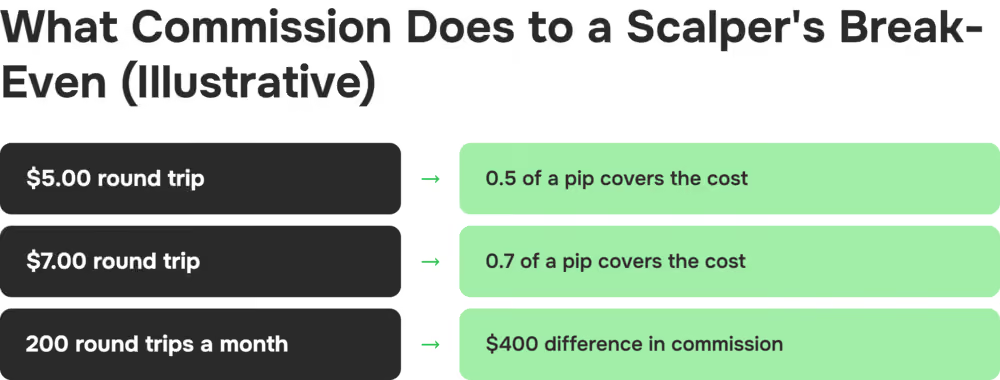
On a standard lot, where a pip is $10, a 5-pip gross target is worth $50. A $5.00 round-trip commission consumes 10% of it; the industry-standard $7.00 consumes 14%. The gap shifts the break-even point: at $7.00, the price has to move 0.7 pips before anything is left, versus 0.5 at $5.00. That difference lands on every one of the hundreds of trades such a style requires each month.
These inputs are illustrative and used to demonstrate the calculation method, not a performance projection.
RAW Account Pricing vs. Industry Standard Rates
B2PRIME's RAW account charges from $2.50 per lot per side, $5.00 round trip. Several widely used raw-pricing brokers publish standard per-side commissions closer to $3.50, or $7.00 round trip, at comparable account tiers. Published rates vary by account type and region and should be verified against each broker's current terms.
At 100 round trips a month, a $2.00 difference per round trip is roughly $200. At 200 round trips, it is roughly $400 a month. A year at that pace comes to about $4,800.
Past performance and cost projections are not indicative of future results; actual savings depend on trading volume and each broker's current published rates.
Matching CFD Strategy to Market Regime
No single CFD strategy performs consistently across all market conditions. Each has a precondition it cannot do without: sustained directional momentum for trend following, price oscillation within defined boundaries for range trading, a catalyst with confirmed expansion for breakouts.
So the regime gets identified first and the strategy second. Reversing that order is how a sound setup ends up being applied in the one condition it was never built for.
Reading the regime is technical analysis at its most basic. Scheduled economic indicators usually end one regime and start the next, so fundamental analysis and the economic calendar sit alongside the chart.
Trending Markets: Which Strategies Fit
Trend following and breakout trading are the primary fits for trending conditions. Range trading is structurally misaligned here, because boundary breaks under leverage accelerate margin drawdown.
Time-series momentum strategies, which go long or short on an asset's prior price direction, are trend following written as a rule set. No technical indicators are needed for that rule, only the prior return.
Ranging Markets: Which Strategies Fit
Low-volatility, oscillating conditions belong to range trading. The same conditions give trend and breakout strategies mostly false signals and whipsaw moves, with leverage raising the cost of every incorrect entry. A trend strategy in a ranging market produces the same structural mismatch as a range strategy in a trending one.
High-Volatility Regimes: Adjusting Approach and Sizing
High volatility favours no single strategy. It changes position sizing, stop distance, and hold period across all of them at once. Spreads widen in these periods, raising the cost threshold for scalping and breakout entries in particular. If fills lose consistency under that stress, the strategy's economics suffer.
The sharpest version of that stress is a scheduled release, the moment news trading targets on purpose. Hedging an open position is one way traders carry exposure through the event instead of widening the stop.
Multi-Asset CFD Execution in One Account
Running several strategies across forex, commodities, indices, and crypto at once needs an account structure that keeps capital in one place. In a cross-collateral account, margin posted against one position supports exposure in another asset class, with no transfers between platforms. B2PRIME's multi-asset account holds crypto spot, crypto perpetual futures, and traditional CFDs on that single balance.
Cross-Collateral Accounts and Capital Efficiency
Cross-collateral shares available margin across eligible instruments, so crypto holdings can back a forex CFD position. The saving is the cash buffer that would otherwise sit idle in a separate account for each asset class, waiting for a setup that may not come.
The entries themselves are decided on the chart. As a TradingView Platinum Partner, B2PRIME keeps execution and order management on the same trading platform.
Build Your Edge on Infrastructure Built for It
Four variables decide whether a CFD strategy keeps its edge. The regime decides which setup applies at all. Inside it, leverage mechanics set the sizing and financing costs set the hold window, while commission decides how small a move can still be worth taking.
All four are measurable before capital is committed, on a demo account or on the first small position. A trading plan fixes those numbers in advance. A trading journal then records what the costs actually came to, turning the estimate into evidence.
[[aa-cta]]
Test Your Strategy's Real Cost Structure
RAW pricing from $2.50 per lot per side, direct TradingView execution, and cross-collateral access on the multi-asset account.
CFDs are complex instruments and come with a high risk of losing money rapidly due to leverage. You should consider whether you understand how CFDs work and whether you can afford to take the high risk of losing your money. Crypto CFDs carry additional risks due to the high volatility of the underlying assets.
This content is for informational and educational purposes only and does not constitute investment advice or a personal recommendation. B2PRIME (B2B Prime Services EU Ltd) is authorised and regulated by the Cyprus Securities and Exchange Commission (CySEC), licence no. 370/18.
[[/a]]
[[aa-faq]]
FAQs about CFD Trading Strategies
How does leverage affect the choice of CFD trading strategy?
Leverage amplifies both gains and losses, so the ratio is chosen against the expected hold period before the position is opened. Shorter holds can tolerate more leverage, whereas swing trades held over multiple days incur overnight financing costs that can compress net returns at high ratios.
Which CFD strategies suit trending versus ranging markets?
Trend following and breakout trading are structurally aligned with trending conditions, where sustained directional momentum supports multi-session holds. Range trading may perform better in low-volatility, oscillating conditions where price repeatedly tests defined boundaries. In a trending market, a range strategy exposes a leveraged position to boundary breaks that accelerate margin drawdown.
How do overnight financing costs affect CFD swing trading profitability?
Every leveraged CFD position held past the daily session cutoff accrues a financing charge based on notional value, the prevailing benchmark rate, and the broker's spread. On a five-day swing trade at high leverage, these charges may erode a meaningful portion of a 2:1 reward-to-risk target. Overnight financing on crypto CFDs typically runs above the forex and index equivalents, so on a multi-day crypto position that premium is the first number to check.
Why does commission per lot matter so much for CFD scalping strategies?
Commission is the cost a scalper pays most often, because every small move captured has a full round trip charged against it. The rate gap looks small on a single trade, roughly $2.00 per round trip between an industry-standard tier and B2PRIME's RAW pricing from $2.50 per side (indicative). A scalping month multiplies it hundreds of times over.
What account structure supports running multiple CFD strategies simultaneously?
A cross-collateral account lets available margin support positions across asset classes. Hence, a trader running trend-following on forex alongside breakouts on commodities or crypto needs no separate capital buffer for each. B2PRIME's multi-asset account covers crypto spot, crypto perpetual futures, and traditional CFDs on one balance.
[[/a]]
Connect with Our Experts
Our team is equipped to provide solutions precisely to your requirements. Let's explore your options and discuss how we can support your objectives



.svg)