Oops! Something went wrong while submitting the form.
Notice: It looks like you are visiting us from United Arab Emirates or have selected it as your residency location.
For accurate information and services under the correct licensed entity, please visit the appropriate section of our website. For more information view Regulatory Information
For accurate information and services under the correct licensed entity, please visit the appropriate section of our website. For more information view Regulatory Information
For educational purposes only, not investment advice.
A CFD broker holds part of your capital, a crypto exchange holds the rest, and each margins only what sits inside it. When one position needs collateral while the free cash sits at the other venue, you transfer and wait. The wait falls in the middle of the move that created the need. A unified trading account removes the transfer: one regulated balance carries the margin for every market it supports, on every platform you trade from.
The mechanics come next: how cross-collateral margining changes the capital maths, how isolated, cross, and portfolio margin differ inside one balance, and which risks consolidation concentrates in one place.
[[aa-key-takeaways]]
Key Takeaways
A unified trading account brings CFDs, crypto spot, perpetual futures, and forex into one margin environment, so capital does not have to move between separate accounts.
In practice, it can convert unrealized P&L and existing holdings into usable collateral, potentially reducing idle margin across trading strategies.
Isolated, cross, and portfolio margin behave differently: the same unified account can concentrate risk or improve capital efficiency depending on the account mode.
For professionals, a unified account is a fund-structure decision, best assessed through regulation and client-money segregation before convenience.
One unified balance can support trading across TradingView, cTrader, B2TRADER, and mobile without changing the account architecture.
[[/a]]
[[aa-cta]]
One Balance, Every Market
B2PRIME's unified cross-collateral account holds CFDs, crypto spot, and perpetual futures in one regulated balance, so capital stops sitting idle across venues.
Why Splitting Capital Across Accounts Costs You More Than You Think
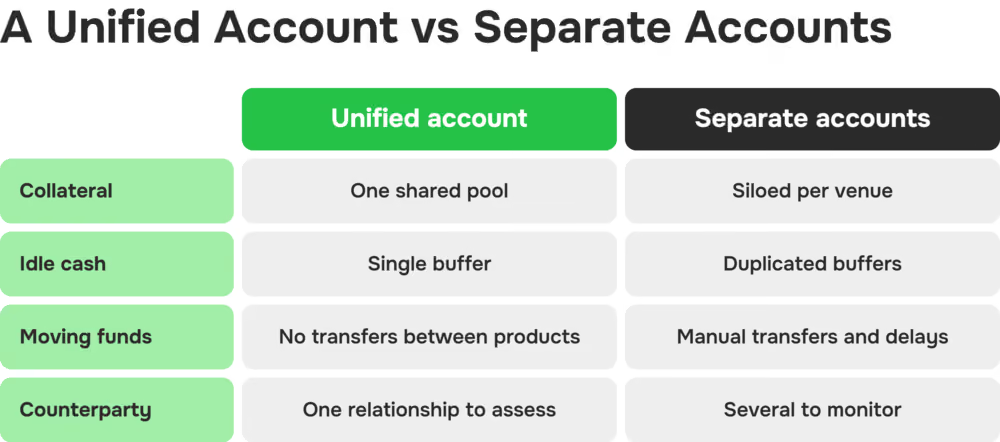
Splitting capital costs more than a wider spread. Each venue margins only what it holds, so you keep a cash buffer in both places: one where the CFD position can call margin, one where the crypto position can. Collateral sits idle on both sides. A transfer between them takes time the setup may not give you, and the month-end picture has to be assembled from two statements.
Account type decides how much of this you feel. A cash account funds positions in full, while a margin account lends against them and brings margin calls with it. A unified account extends that margin model across markets, which leaves you with one counterparty, one set of margin rules, and no transfers between venues.
Margin Locked in the Wrong Place at the Wrong Moment
A classic account structure keeps every venue funded on its own, above what any single position needs. Consider USD 20,000 split evenly: 10,000 held in USDT on a crypto exchange, 10,000 with a CFD broker. If each side keeps a 3,000 buffer above margin, 6,000 of the 20,000 does no work at all. In one account, both positions draw on a single buffer, which puts about half of that back to work. The figures are illustrative, and the pattern holds at any size.
The Trades You Miss While Funds Are in Transit
The sequence is familiar. A signal appears, the funds you need are still moving between providers, price runs, and you either miss the entry or take a smaller size than planned. That delay rarely shows up in a feature comparison, and it can cost you more than the spread difference between the two venues.
What a Unified Trading Account Actually Is
A unified trading account, often shortened to UTA, puts one collateral framework behind every position. Precisely, it is a single cross-collateral account, denominated in USD or EUR, covering CFDs, crypto spot, and crypto perpetual futures. B2PRIME launched this structure as covered in its Q1 2026 leadership update.
One Margin Pool, Every Asset Class
The unified margin pool is shared collateral across supported asset classes: forex, metals, indices, commodities, crypto spot, and crypto perpetual futures. This broker-level, multi-asset access may appeal to multi-asset professionals, with traditional CFDs and crypto sharing one pool.
How Unrealized Gains Become Active Collateral
Unrealized profit on one position may count toward available margin elsewhere, reducing transfers and keeping capital deployable during active sessions. That flexibility is symmetrical, though. Just as open profit raises available equity, an adverse move can quickly shrink the same collateral.
How Cross-Collateral Margining Changes the Maths
Cross-collateral margining changes capital usage, not market direction. When the broker's risk model treats two positions as offsetting, the pair can run on less cash than each would need on its own. Regulated clearing infrastructure works on the same principle: Eurex, for example, now runs cross-margining within one risk model, which credits offsets between products inside a regulated framework. Initial margin, maintenance margin, and margin calls behave here as they do in any margin account.
Isolated, Cross, and Portfolio Margin — When Each One Applies
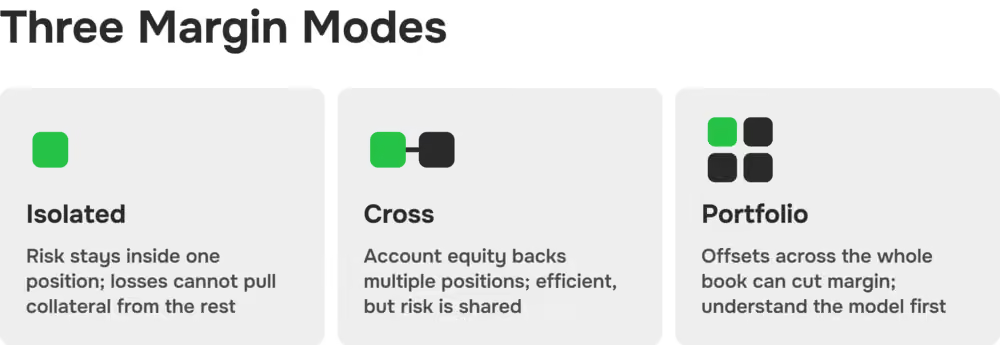
All three are forms of margin trading, and what separates them is how widely they share collateral. With isolated margin, a loss stays inside the position that caused it and cannot reach collateral held elsewhere. Cross margin pools equity across open positions, freeing cash and letting one losing position draw on the others. Portfolio margin goes widest, netting offsets across the whole book. The requirement can fall further, and the trader has to know which offsets the model credits before sizing around them. That last mode is the professional case, where exposures genuinely offset.
The Complete Asset Class Picture Inside One Account
Most unified-account content stops at crypto trading; the professional picture is broader. The value is workflow consolidation, replacing fragmented venues rather than collecting more account types or sub-accounts.
Forex, Metals, Indices, and Commodities
Keeping these CFD markets beside crypto matters for hedging, macro trading, and event-driven rotation from one balance. On pricing, the RAW account is $2.50 per lot per side ($5 round trip) against an industry average of around $7 round trip. Past performance is not indicative of future results. CFDs are complex instruments and carry a high risk of rapid loss of capital due to leverage.
Crypto Spot and Perpetual Futures
Spot trading represents owned crypto exposure, BTC or ETH held outright, while futures trading through perpetuals is leveraged, with distinct funding and margin behavior. B2PRIME combines crypto spot, crypto perpetual futures, and traditional CFDs in a single regulated cross-collateral account.
Four Trading Environments, One Unified Balance
A unified account should not lock a trader into one interface. The balance stays the same; the workflow can change by task, which suits traders who analyze, execute, and monitor from different environments in a single day.
cTrader and TradingView
Analyze and execute from TradingView charts (B2PRIME is an official Platinum Partner, with an average execution latency of around 7 milliseconds), or use cTrader for a familiar professional workflow and copy-trading access.
B2TRADER and the B2PRIME App
B2TRADER and the B2PRIME app are access layers to the same account, for web, mobile, and trading-room management. Access is jurisdiction-aware, routing users under the correct licensed entity to reduce compliance friction for globally distributed operations.
What Regulation Actually Means for How Your Funds Are Held
One account means more of your money and positions sit with a single firm, so how that firm is licensed and how it holds client money is no longer a background detail. B2PRIME holds six separate licenses: CySEC, DFSA, FSCA, FSC, FSA, and SCB. Client assets are held apart from company funds, and onboarding puts you under the entity that covers your residence. That entity sets your protections and leverage limits.
Regulators examine the same question at market scale. The Bank of England's 2026 discussion paper on central counterparty resolution works through what happens when risk concentrates inside one operational framework. B2PRIME is not a CCP and is not subject to CCP resolution rules; the reference is to a broader governance context, not regulatory equivalence.
The Structural Risks of a Unified Account — And How to Size Them
Efficiency and concentration arrive together, and the concentration is worth naming before the mitigation. Three trade-offs come with the structure:
Counterparty concentration. More of the account sits with one provider, which increases reliance on that provider's regulation and segregation.
Margin model risk. Portfolio offsets can compress the margin rate, and stress widens it again at the least convenient moment.
Operational dependency. One outage reaches every position instead of one venue's worth.
The practical response is to hold buffers above the required margin, cap exposure per asset class, and know what the margin model credits before relying on it. Sizing positions as if margin were tighter than the account currently requires keeps a shift from portfolio to cross margin during stress from forcing partial liquidation of the book.
Whether that concentration is acceptable depends on the provider. A well-regulated firm that segregates client funds makes consolidation a reasonable trade; without those two protections, it is not.
Formalized models state their own limits. LCH SA's CDSClear framework, approved by the SEC in 2026, is calibrated to a 99.7% confidence level under normal conditions, which leaves 0.3% of modeled outcomes outside the calibration. It does not imply a unified account is inherently safe.
Your Capital Has Been Working in Two Places
Capital split across venues spends most of its time waiting. One regulated account with broader collateral use puts it to work: equity and unrealized profit can support positions across markets from a single balance.
B2PRIME's unified cross-collateral account holds CFDs, crypto spot, and perpetual futures in one regulated balance, on neutral tier-1 execution. There is no minimum deposit, which makes the structure cheap to test before moving size into it. The Standard, RAW, and dedicated crypto accounts sit alongside it, so the choice comes down to which structure matches how a trader already works.
[[aa-cta]]
Consolidate Your Capital in One Account
Multi-asset access, cross-collateral margin, and transparent RAW pricing across six licensed jurisdictions.
CFDs are complex instruments and come with a high risk of losing money rapidly due to leverage. You should consider whether you understand how CFDs work and whether you can afford to take the high risk of losing your money. Crypto CFDs carry additional risks due to the high volatility of the underlying assets.
This content is for informational and educational purposes only and does not constitute investment advice or a personal recommendation. B2PRIME (B2B Prime Services EU Ltd) is authorized and regulated by the Cyprus Securities and Exchange Commission (CySEC), license no. 370/18.
[[/a]]
[[aa-faq]]
FAQs about Unified Trading Accounts
What is a unified trading account?
A unified trading account combines positions, collateral, and margin across multiple markets into a single account. In its simplest terms, you stop moving funds between siloed accounts and manage portfolio risk from one balance. That structure may help active traders deploy capital across forex, CFDs, crypto spot, and perpetual futures with less operational friction.
What is the difference between a funding account and a unified trading account?
A funding account is mainly a wallet for deposits, withdrawals, and internal transfers; a spot account holds assets outright; and a unified trading account is the live margin environment. With a unified structure, available equity and unrealized profit can support positions across supported markets instead of sitting idle in separate buckets. That distinction matters when timing is tight and transferring cash between product silos could delay execution.
What margin modes are available under a unified trading account?
Most unified accounts support isolated and cross margin, and some providers also offer a portfolio margin mode for qualified traders. Isolated margin retains risk within a single position, while cross margin uses total account equity as collateral for multiple positions. Portfolio margin goes further by recognizing offsets across the book, which may reduce margin usage but makes the model harder to understand.
What does regulation actually change in a unified trading account?
Regulation shapes onboarding, disclosures, and how client relationships are handled under the correct licensed entity in your jurisdiction. For professionals, that matters because a unified account concentrates execution, collateral, and counterparty exposure in one provider. B2PRIME routes clients to the correct licensed entity through its regulated multi-entity structure across supported regions.
[[/a]]
Fale com os Nossos Especialistas
A nossa equipa está preparada para fornecer soluções perfeitamente adaptadas às suas necessidades. Vamos explorar as suas opções e discutir como podemos apoiar os seus objetivos.



.svg)