Oops! Something went wrong while submitting the form.
Notice: It looks like you are visiting us from United Arab Emirates or have selected it as your residency location.
For accurate information and services under the correct licensed entity, please visit the appropriate section of our website. For more information view Regulatory Information
For accurate information and services under the correct licensed entity, please visit the appropriate section of our website. For more information view Regulatory Information
For educational purposes only, not investment advice.
B2PRIME offers institutional-grade trading conditions without institutional minimums. This review is for traders who have the broker on a shortlist and want the numbers and trade-offs before opening an account. Competitor figures move with their pricing, so those comparisons are indicative and worth checking.
[[aa-key-takeaways]]
Key Takeaways
Protections and product access depend on which of B2PRIME's six licensed entities onboards you, from CySEC in the EU to SCB in the Bahamas.
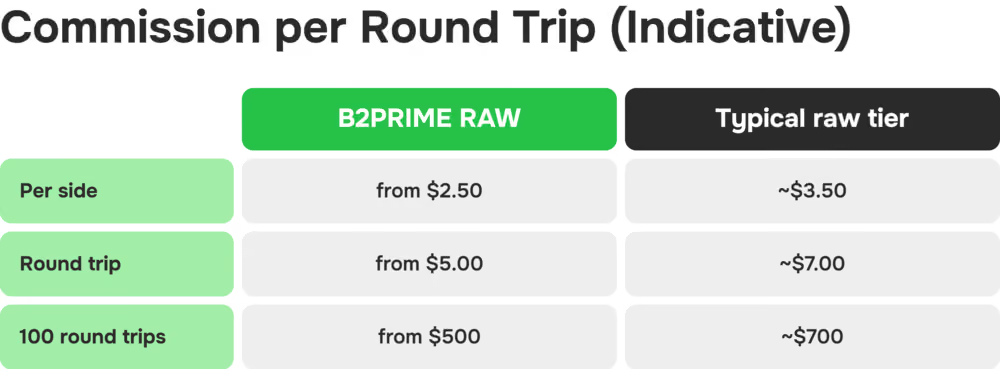
The RAW account starts from $2.50 per side, a $5 round trip at that rate against roughly $7 at comparable raw tiers, or about $200 a month at 100 round trips (indicative).
Average execution latency of about 7ms sits against a 25–30ms range commonly cited for retail-facing brokers (indicative). The gap shows up in scalping and algorithmic strategies and rarely in swing trading.
One cross-collateral account covers FX, commodities, CFDs, crypto spot, and perpetual futures, with no transfers between platforms to change asset class.
The main trade-off is platform choice, since B2PRIME runs B2TRADER, TradingView, and cTrader but not MT*4 or MT*5.
[[/a]]
[[aa-cta]]
Evaluate B2PRIME With a Live or Demo Account
Test the execution, pricing, and platforms described here across FX, commodities, and crypto, with no minimum deposit.
B2PRIME is a multi-regulated broker for individual and professional traders seeking regulated access to FX, commodities, indices, and crypto through a single account. Clients are onboarded through the licensed entity covering their residence, then trade on raw spreads via STP routing, with no minimum deposit on the RAW account.
How B2PRIME Executes Orders
B2PRIME aggregates quotes from several liquidity providers and routes client orders into that pool through straight-through processing, or STP. The raw spreads come from the pool. As its execution policy describes, B2PRIME does not act as a market maker that systematically takes the opposite side of your orders. Under the STP model, slippage reflects market conditions rather than a position the broker has taken against the order.
For a trader, that structure shows up in two ways. Deep liquidity is the first: several liquidity providers stand behind a quote rather than a single venue's book, though depth still varies with market conditions. Coverage is the second: one account reaches markets that would otherwise need several separate venues.
Regulatory Standing Across Six Jurisdictions
Regulation is the primary trust filter for a broker because the entity you onboard through determines your protections, disclosures, and product access. At B2PRIME, onboarding is residency-based, routing each client to the appropriate entity.
The entities differ in what they bring:
CySEC puts the EU in scope, with the MiFID II framework, passporting across the bloc. Disclosure standards are familiar to European traders, including the ESMA retail leverage caps.
DFSA provides onshore credibility for UAE-based clients operating from the DIFC, which can reduce compliance ambiguity for the region.
FSCA gives South African clients local market-conduct oversight close to home.
FSC Mauritius supports international and emerging-market onboarding, while SCB Bahamas and FSA Seychelles are offshore securities-dealer frameworks that extend geographic reach.
The three onshore entities generally carry stronger disclosure and conduct standards, while the offshore ones expand reach with lighter-touch frameworks. That is simply how multi-entity groups work: client protections, product access, and applicable leverage all vary by entity. The practical step is confirming which licensed entity covers your residence and what it permits.
Trading Conditions: Spreads, Commissions, and Total Cost Per Trade
Cost has three parts: commission, spread, and access conditions. B2PRIME's RAW account starts from $2.50 per side with raw spreads from 0.0 pips in typical market conditions, against a common standard raw-tier commission of around $3.50 per side elsewhere.
That $2.50 tier applies on B2TRADER and TradingView. The same RAW account on cTrader is priced at $2.90 per side, while a commission-free Standard account there starts from 0.8 pips. Which platform you pick changes what you pay.
Worked Cost Example: $100,000 EUR/USD Round Trip
Using one standard lot (roughly $100,000 notional) on EUR/USD, commission only:
The fixed difference is about $2 per round trip before spread variability, which compounds with turnover: roughly $200 a month at 100 round trips, $400 at 200.
Commission is only part of the cost. On a raw account, EUR/USD spreads often sit near 0.0–0.2 pips in liquid conditions, where one pip on a standard lot is about $10, so a 0.2-pip spread adds roughly $2 per side.
For a high-turnover trader, commission is the fixed, predictable part of the cost. A lower fixed commission therefore reduces the part of the bill that does not move with market conditions. These figures are indicative of standard raw tiers. Like any broker's schedule, the B2PRIME RAW account pricing should be checked for current rates before you rely on it.
Minimum Deposit and Access Compared to Tiered Raw Accounts
Access is where the gap is clearest. Raw-tier pricing near $1 per side is typically reserved for six-figure deposits, while B2PRIME's pricing starts from $2.50 per side with no minimum. That makes the commission band testable without wiring a large deposit first. A discount brokerage tier structure works the other way around, opening the better rates only once the deposit is there.
Execution Quality: What 7ms Latency and STP Routing Mean in Practice
Execution speed is measured as latency: the time between sending an order and having it filled. B2PRIME reports about 7ms on average, against a 25–30ms range commonly cited for retail-facing brokers. Both figures are indicative.
At that speed with STP routing, the practical effects tend to be narrower slippage against the quoted price, more predictable stop fills, and steadier behavior when spreads widen. Fill quality still varies with market conditions and connectivity.
Scalping and Algorithmic Strategies During Volatile Conditions
Milliseconds become visible in two situations: when spreads widen on a news print, and when an algorithm sends orders faster than a person could. In both, routing has to behave the same way on every order, because that is the assumption the strategy was tested on.
Capacity is the other half of the same operational question. An automated book can leave dozens of small positions in the market at once; B2PRIME's infrastructure is designed to support that many simultaneously. Lower latency still cannot make a strategy profitable: it removes one cost between the decision and the fill, no more.
Discretionary Swing Trading and the Latency Threshold
Swing traders notice latency less often, since entries are less time-critical and positions are held across sessions. There is no fixed threshold here; routing has to be stable enough that stops fill near their level through news gaps and partial fills. For this style, financing costs and spread stability usually decide the account instead.
Asset Class Coverage and the Cross-Collateral Account Structure
Capital split across venues sits idle and moves slowly. One unified account holds a single margin pool behind every instrument, so the same balance can back an FX position and a crypto position without a transfer.
FX, Commodities, and Traditional CFDs
The non-crypto core of B2PRIME includes forex, metals, indices, energy, and commodities, selected for depth in each instrument rather than the length of the list. Depth decides whether the size goes through near the quoted price. Because depth itself moves with market conditions, so does the fill.
Crypto Spot and Perpetual Futures
Crypto spot, crypto perpetual futures, and traditional CFDs sit in one account with shared collateral. Most venues keep crypto and CFDs in separate margin pools, making the combination unusual. Spot is owned cryptocurrency exposure. Perpetual futures are leveraged derivatives with a funding rate, which holders pay or receive periodically depending on which side of the market they sit. Leverage on both is capped by product and jurisdiction.
In practice, spot crypto held in the account can support an FX or index CFD position as collateral, which spares a trader running both books from posting separate cash for each.
The same structure concentrates risk. Leverage amplifies losses as well as gains. Crypto is volatile, and margining one asset class against another puts both in the same pool, so position sizing has to assume that the collateral and the position can fall together.
Platform Access: B2TRADER, TradingView, cTrader, and the B2PRIME Apps
Three trading platforms and one app cover the same account. They differ in where you place orders and what each interface is built to do.
B2TRADER: The Terminal Behind the Unified Account
B2TRADER is B2PRIME's own multi-asset trading platform, carrying FX and CFDs, crypto spot, perpetual futures, and the unified cross-collateral account. The terminal runs in the browser, with a workspace assembled from widgets for order entry, charts, open positions, orders, and margin. Collateral and exposure therefore sit on the same screen as the order ticket. API tokens for automated strategies are issued from the terminal itself.
TradingView Platinum Partner Integration as an Execution Channel
As an official TradingView Platinum Partner, B2PRIME lets traders place and manage limit orders directly from TradingView charts. Orders route to the same B2TRADER account, with positions mirrored between the two. Traders who mark levels and sessions before entering no longer read a level in one tool and trade it in another.
cTrader for Chart and Ladder Work
cTrader shows depth of market and supports one-click entries, with a stop order placed from the same ladder. Both matter when a position is opened close to a level and every click costs time. Copy-trading sits on the same platform for traders who follow other accounts. The product range is narrower here: crypto spot, perpetual futures, and the cross-collateral account run on B2TRADER and TradingView instead.
The B2PRIME Mobile Apps
The iOS and Android apps cover account management on the go: funding and withdrawals, monitoring open positions, and onboarding. Onboarding routes a client to the entity that covers their residence. For anyone trading from more than one country, the country of origin determines which protections apply.
No MT*4 or MT*5: What That Means for Your Existing Setup
MetaTrader* is not part of the lineup for client trading. Access comes through B2TRADER, TradingView, and cTrader, with more platforms announced. B2PRIME's platforms page also lists an MT*4/5 bridge. That product connects a firm's own MetaTrader* server to B2PRIME liquidity, so a personal account still trades on the three platforms above. If your setup runs on MT*4 or MT*5 with custom expert advisors, the cost to weigh is migration. For some traders, that cost is the reason to look elsewhere.
How to Read Third-Party Review Scores
Aggregator ratings can help, but only if you know what they measure. A community rating on TradingView reflects sentiment among that platform's users: B2PRIME's sits around 4.1/5 as of publication, drawn from a few dozen reviews, a sample small enough that a handful of new ratings can move the number.
WikiFX and Traders Union build composite scores from regulation, popularity, and user input, without publishing the full weightings behind them. Any single number is one input, worth more once you know what it counts.
Who B2PRIME Suits, and Who It Does Not
B2PRIME fits cost-aware traders working across several markets who value transparent pricing on raw spreads, neutral execution, and regulated access across jurisdictions. It assumes comfort with B2TRADER, TradingView, or cTrader. The clearest beneficiaries are active and algorithmic traders whose turnover makes the lower fixed commission add up, and traders tired of moving capital between a crypto exchange and a CFD broker.
It is a weaker fit for a few groups. Traders committed to MetaTrader face a migration cost that may outweigh the pricing advantage. Those wanting a large single-stock CFD catalog will find the instrument list focused on liquid FX, metals, indices, commodities, and crypto rather than thousands of individual equities. And anyone shopping for deposit bonuses or very high leverage will not find them here: B2PRIME does not offer bonuses and operates within regulated leverage limits.
The strengths are pricing, execution, and one account across markets. For a desk built on MetaTrader* expert advisors, the migration cost can outweigh all three. For a discretionary trader, it rarely does.
[[aa-cta]]
Put the Numbers to the Test
RAW pricing from $2.50 per lot per side, no minimum deposit, and STP execution across six licensed jurisdictions.
CFDs are complex instruments and come with a high risk of losing money rapidly due to leverage. You should consider whether you understand how CFDs work and whether you can afford to take the high risk of losing your money. Crypto CFDs carry additional risks due to the high volatility of the underlying assets.
This content is for informational and educational purposes only and does not constitute investment advice or a personal recommendation. B2PRIME (B2B Prime Services EU Ltd) is authorized and regulated by the Cyprus Securities and Exchange Commission (CySEC), license no. 370/18. Pricing and third-party figures are indicative and may change; verify current details before opening an account.
[[/a]]
[[aa-faq]]
FAQs about B2PRIME
Is B2PRIME a regulated broker?
Yes. B2PRIME operates across six regulated entities, including CySEC in the EU, DFSA in the UAE, and FSCA in South Africa, alongside offshore frameworks in Mauritius, the Bahamas, and Seychelles. Clients onboard through the entity for their region, whose framework then sets the applicable protections and disclosures, so it is worth confirming which one covers you.
How much does it cost to trade with B2PRIME?
The RAW account starts from $2.50 per lot per side ($5 round trip at that rate) on B2TRADER and TradingView, with raw spreads from 0.0 pips, versus a common industry standard of around $3.50 per side. The same account on cTrader is $2.90 per side. Spread is additional and varies with market liquidity, so total cost per trade depends on the instrument and conditions. Figures are indicative and should be verified against the current schedule.
Does B2PRIME support MetaTrader*?
No. B2PRIME offers B2TRADER, TradingView, and cTrader.
What is the minimum deposit at B2PRIME?
B2PRIME does not require a minimum deposit for its RAW pricing. Comparable per-side rates elsewhere are typically reserved for six-figure deposits (indicative; check the current terms of any tier you compare). That lets a trader evaluate execution quality without committing that scale of capital first.
[[/a]]
Connect with Our Experts
Our team is equipped to provide solutions precisely to your requirements. Let's explore your options and discuss how we can support your objectives



.svg)